
In the Web3 world, where attention is scarce and narratives rotate at warp speed, “time nodes” like holidays and token listings act as natural amplifiers: people are primed to retweet, join raffles, and execute that first transaction. But let’s be real—”buzz” does not equal “growth.” If users can’t be verified, if their actions don’t settle into tangible benefits, and if the heat doesn’t stick, everything ends up being as fleeting as fireworks.
So, how does the growth platform TaskOn turn a single event into a TaskChain, and then operate that into a reusable growth loop?
I. From “Event” to “Narrative”: Why Now, and Why You?
Holidays are often the linchpin in a marketing system because they aggregate every essential marketing element. First, it’s the crowd—massive attention is released, making attention-capture far more effective. The holiday context “rationalizes” mass dissemination. Furthermore, since holiday marketing budgets are generally larger, the attraction for users is stronger. This gives projects a clear “reason to act” for listings or entering new markets. Similarly, if there’s a new feature launch, the promotional effect during these windows is exponentially higher.
At TaskOn, the shared challenge in these scenarios isn’t “will people come,” but rather: How do we turn the people who show up into users who are verified, segmented, and operable?
This requires a path that can be seen.
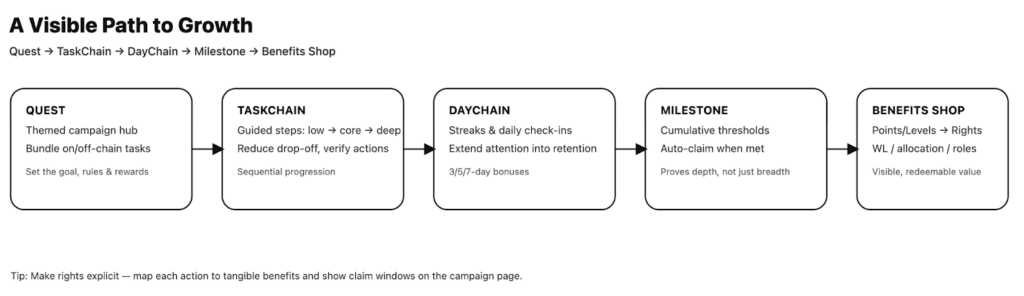
II. A Visible Path: Quest → TaskChain → DayChain → Milestone → Benefits Shop
At the very first glance, you need to showcase the campaign’s alpha and the richness of the prize pool to instantly hook the user’s attention.
Additionally, by structuring the activity like a “plot,” users won’t drop off at the first step. Here is TaskOn’s standardized path:
Quest → TaskChain → DayChain → Milestone → Benefits Shop
The key isn’t just “giving rewards,” but ensuring the user knows exactly what to do, how much to do, what they get immediately, and what unlocks if they keep going. These four questions correspond to the visual design of the TaskChain, Milestone, and Benefits Shop.
III. Execution: Landing the Top 3 Hotspot Themes
1) The Holiday Season: Turning Heat into Retention
Holiday campaigns easily generate volume, but they are also prone to “easy come, easy go.” Therefore, the setup must be built around retention and streaks.
TaskOn Structure: Quest + TaskChain + DayChain + Milestone + Benefits Shop.
- The Hook: Use the DayChain streak (3/5/7 days to build habit) + mid-term Milestone claiming (interim benefits) + Leaderboard (long-term incentives) as retention anchors.
- The Narrative: Pair this with a daily “come back” narrative.
- Action Design: Start with frictionless, guided content (Follow/Join/Bind) for immediate feedback (Points/Raffle rights). Then, guide them through the TaskChain education path to execute key on-chain transactions. This corresponds to leveling up and upgrading benefits, culminating in stage-based perks via Milestones and the ultimate goal of the Leaderboard.
2) Token Listing / New Market: Structuring Trading Behavior
During a listing week, users want to see predictable returns for their actions.
Structure: Quest + TaskChain (including Trading Tasks) + Milestone + Leaderboard + Benefits Shop.
- The Narrative: From “Onboarding” to “Sprinting.” Use guaranteed rewards + tiered rewards to reduce “luck anxiety.”
- Action Design:
- Warm-up: Open “Prep Actions” (Deposit/Bridge/Follow Announcements).
- Launch Day: Unlock “Trading Tasks” (Set minimum effective volume and time windows to ensure quality).
- Mid-term: Trigger Milestone auto-claims (e.g., Cumulative Volume ≥ X).
- Leaderboard: Daily refreshes so there’s still room to catch up in the final stretch.
- Closing: Funnel into the Benefits Shop for WL (Whitelists), Allocations, or Exclusive Roles.
3) New Feature Launch: Turning “Try” into “Use”
A single touchpoint is easy, but keeping users inside a feature relies on streaks and thresholds.
Structure: TaskChain (3 steps to start) + DayChain (7~10 days) + Milestone (Mid/End).
- The Narrative: From “Novice” to “Expert”—make the user feel “the more I use it, the more valuable it gets.”
- Action Design:
- Step 1: Light Experience → Step 2: Core Feature → Step 3: Advanced Usage.
- Use streaks and two milestones to drag “trying it out” into “habit formation,” directing points/levels toward back-end benefits.
IV. Clarifying the “Alpha”: The Direct Link of Task—Points—Level—Benefits
| Behavior Layer | Typical Task | Immediate Return | Long-term Return (Benefits Shop) |
| Entry | Follow / Join / Bind | Points + Raffle Tickets | Benefits Shop Access |
| Key On-chain | First Mint / Bridge / Swap | Level Up to L2 | WL Queue / Secondary Allocation |
| Deep On-chain | Cumulative Vol / Governance Vote | Badges / Weighted Score | WL Guarantee / Priority Beta / Exclusive Channel |
| Streak | 3 / 5 / 7 Days | Streak Boost | Holiday Limited Badge / Role |
| Milestone | Reach Threshold (Key Tasks) | Grand Prize / Whitelist | High-tier Benefits & Discount Redemption |
| Leaderboard | Top N Users | Exposure & Glory | Ambassador / Merch / Long-term Perks |
Note the three Iron Rules of Rewards:
- Benefits must be crystal clear.
- Claiming must be perceptible.
- Anti-Sybil measures must be upfront.
This ensures users can focus and commit. TaskOn’s product design leans heavily into this: the homepage features a “Reward Custody” badge, and the Quest page highlights reward types. A good campaign page is essentially a good narrative.
A killer campaign page displays three “Key Indicators” instantly:
- I’m in the right place: Theme Banner + North Star Metric + Prize Pool Structure (Instantly understand “Why Now”).
- I’m on the way: TaskChain is only 3~5 steps; the countdown to the next Milestone is visible.
- I deserve to be different: Leaderboard shows Avatars/Nicknames/Badges; Benefits Shop shows exactly what I can swap for.
V. Measuring Real Growth: Doing It Right with Key Metrics
- Qualified New Users: New users completing ≥1 on-chain action. This measures “Real Acquisition.”
- Streak Completion Rate: Percentage completing 3/5/7 day DayChains. This measures the “Heat → Retention” conversion.
- Milestone Achievement Rate: Percentage reaching the threshold and auto-claiming. Measures “Deep Water Actions.”
- Redemption Rate: Percentage entering the Benefits Shop post-campaign to redeem. Checks if “Incentives are Real.”
- Return Rate: Visits on Day 7/14/30 post-campaign. Determines if low-burden recurring tasks should be retained.
VI. TaskMas: Joint Events as a Traffic Weapon
Epic is TaskOn’s signature seasonal event format—a carnival launched jointly with numerous projects. It drives the growth flywheel by lowering user barriers + aggregating traffic effects, while stacked incentives push for broader participation groups.
For every major holiday moment, TaskOn’s growth flywheel unites multiple ecosystem projects to create a massive Epic event.
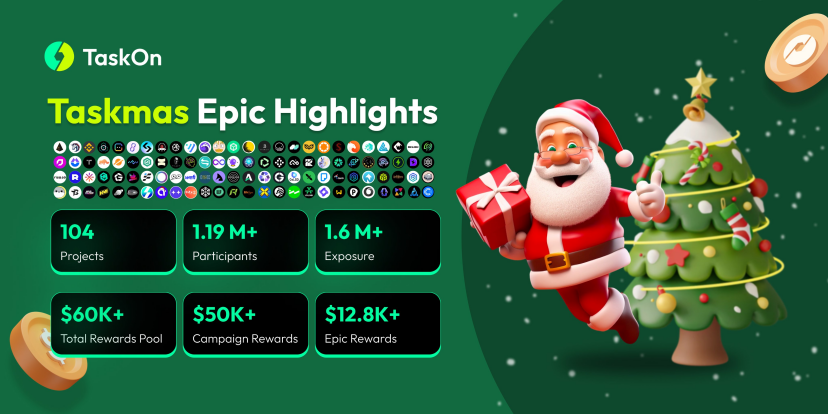
For example, the TaskMas campaign attracted 1.19 million participants, covering 104 projects including top-tier names like 1inch and Binance. Total exposure reached 1.6 million, showcasing the massive reach and strong partnerships inherent in joint events and holiday marketing.
You can also design concepts like Season 1 and Season 2 to instill a brand mindset, keeping users anticipating the continuity of the campaign.
VII. Conclusion
Holidays, listings, and new features naturally command attention. TaskOn’s value lies in organizing this attention into a route, binding that route to benefits, and amplifying the volume via the social proof of Milestones and Leaderboards.
Growth isn’t about “giving away” freebies; it’s about “proving.” Proving you actually did it, proving you achieved it, and proving you earned a tangible right. That right will be seen, redeemed, and talked about in the Benefits Shop. And when the next holiday rolls around, you’ll find that what people are actually waiting for is the chance to be “proven” once again.