

In the world of Web3 growth, single-point campaigns struggle to drive “mass adoption” or scalable growth. The real alpha lies in “Ecosystem Synergy Campaigns”—where multiple projects unite to share prize pools, user bases, and exposure.
However, amplifying brand collaboration to achieve genuine ecosystem empowerment and mutual aid is no easy feat.
TaskOn is one of the few platforms that has turned “ecosystem synergy” into a structured capability. It doesn’t just host standalone project campaigns; it aggregates dozens of projects into a legitimate “Traffic Accelerator.”
Let’s dive into three successful EPIC campaigns on TaskOn—Spring Bloom, the Official Halloween Campaign, and the Hyperliquid x Multi-Project Collaboration—to see how to build a high-quality growth paradigm.
I | The Underlying Logic of Ecosystem Synergy: Mutual Benefit + Shared Users
The value proposition of ecosystem synergy is crystal clear:
① Multi-Party Prize Pool Construction → Lower Costs for Individual Projects
Take the Halloween campaign as an example: 50+ projects collectively contributed prizes and perks, creating a prize pool scale far beyond the budget capabilities of any single project.
② User Pool Sharing → Wider Reach for Every Participant
On TaskOn, once a user enters the campaign, they interact with task pages from multiple projects, creating natural cross-pollination and exposure.
③ Modular Reward Distribution → High Operational Efficiency
Collaborative rewards can be complex, but TaskOn handles this seamlessly: prize pools are automatically split, and steps don’t interfere with each other. Each task functions as an independent prize pool unit; completing a set number of tasks unlocks the joint pool. If Token rewards run out, points serve as a fallback. This eliminates manual reckoning and minimizes human error, significantly lowering the cost of ecosystem collaboration.
II | How TaskOn Achieves Cross-Project Growth (Structured Capabilities)
Ecosystem synergy isn’t just piling tasks together; it’s a complete collaboration framework built by TaskOn:
| Growth Requirement | TaskOn Capability |
| Unified Entry for Multiple Projects | Event / EPIC Page |
| Standardized Task Modules | Reusable Quest Templates |
| Shared User Pool | All tasks can cross-reach new users |
| Unified Verifiable Actions | Automated Verification (On-chain/Social/API) |
| Integrated Incentive Structure | Benefit Shop / Multi-Pool Combinations |
| Data Attribution | Campaign Dashboard + Project Backend |
| Player Psychology Incentives | Massive Prize Pool + Multi-Project Exposure + Leaderboard |
TaskOn’s strongest asset isn’t just “running events,” but making “Ecosystem Growth” scalable, collaborative, and sustainable.
III | Case Study 1: Spring Bloom
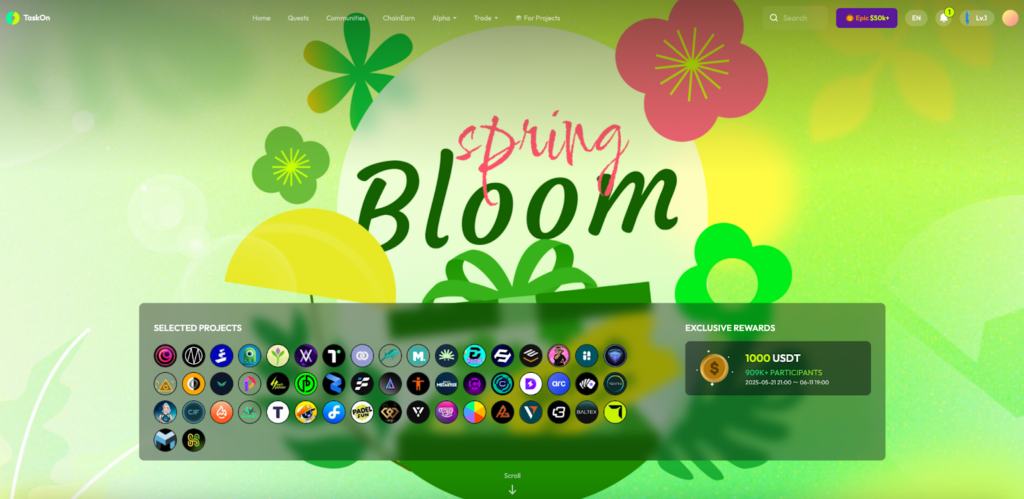
Event Link: https://taskon.xyz/epic/9
EPIC is TaskOn’s official “Cyclical Large-Scale Joint Campaign” and serves as its flagship ecosystem synergy structure. Each iteration features dozens of participating projects.
Spring Bloom is TaskOn’s fixed seasonal campaign, now possessing mature brand influence. In this year’s Spring Bloom, a total of 50+ projects participated.
① The Logic Behind EPIC: An Annual-Level Ecosystem Aggregator
EPIC isn’t a one-off; it’s TaskOn’s “Quarterly Flagship Growth Event.”
It features three core characteristics: Multi-project participation (usually 20–60), multi-chain cross-ecosystem scope, and parallel task types. Its essence is to provide a “Joint Growth Window” for the entire ecosystem.
In Spring Bloom, projects could capture deeper user behavioral paths. Due to the broad and numerous user base, projects could tailor user journeys to their specific needs.
Tasks in EPIC included:
- Follow / Join (Light Tasks)
- Product Usage or Docs Review (Mid Tasks)
- On-chain Basic Interactions (On-chain Tasks)
In EPIC, project goals range from “User Acquisition,” “User Education,” and “Feature Comprehension” to on-chain behavior and deep engagement.
Additionally, reward configurations were more structured and diverse. Beyond just Tokens, they included WL (Whitelists), NFTs, Points, and Partner Perks.
This allows users to perceive the flow: “Complete Task → Enter Ecosystem → Gain Identity.” This type of campaign is the most suitable growth model for Web3 Mainstream users.
For instance, VOOX‘s social media acquisition tasks saw participation numbers nearly double compared to previous Quests. Meanwhile, DuckChain added Staking tasks as optional requirements, driving users deeper into the ecosystem experience, resulting in over 10,000+ interactions and significant on-chain effects.
During the entire event, there were over 900,000 interacting users. This is the true significance of a cross-ecosystem EPIC.
Case Study 2: Halloween Official Event
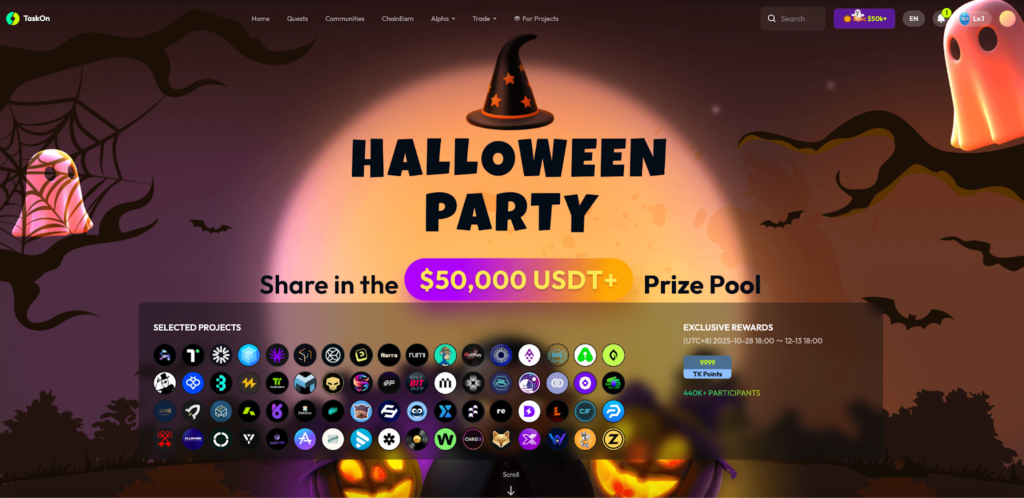
Event Link: https://taskon.xyz/epic/11
The EPIC campaign is TaskOn’s most viral ecosystem weapon. This year’s Halloween event once again highlighted the power of ecosystem synergy, serving as a classic case of “Ecosystem Co-building.”
The Halloween event united 70+ projects, forming the largest-scale “Content + Reward” array. Compared to previous events, the incentive pool was massive, utilizing a high-incentive model to trigger viral propagation.
① A 50+ Project Lineup Brings Natural Traffic Aggregation
Every project has its own user base. When all projects participate in a joint campaign simultaneously, users flow between them on the TaskOn event page. This is the quintessential “User Shared Pool” effect.
② Prize Pool Stacking: High Incentives Outperform Single Projects
Different projects contributed their own prizes: Tokens, Whitelists, points, NFTs… For users, this is a cross-ecosystem “Comprehensive Reward” experience.
③ Content-Driven + Social Diffusion
Task difficulty ranged from high to low. Social tasks focused on Follow / Join / Retweet lowered the entry barrier, covering a broader user base. Simultaneously, centered on on-chain tasks—for example, performing any swap of $5 or more within the Wigwam mobile app qualified users for a prize pool draw up to $1,200.
④ Built for Massive Exposure, Not Just Deep Behavior
The Halloween tasks were lighter, making it a typical “Horizontal Growth” campaign. The value lies in reach rather than on-chain depth. High incentives attract users and expand participation, while the stacked prize pool creates a secondary viral effect, making user acquisition easier.
The entire Halloween event offered $50,000+ in rewards and engaged over 496,000+ users.
Case Study 3: Hyperliquid x Multi-Ecosystem Collaboration
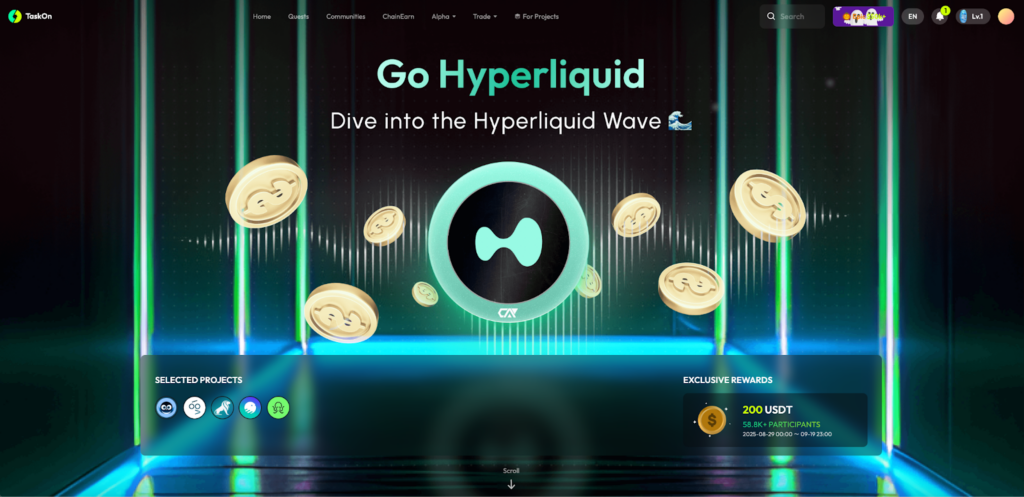
Event Link: https://taskon.xyz/epic/10
The Hyperliquid ecosystem campaign was a highly precise ecosystem-building exercise. Unlike typical EPICs, this focused on building high-cognition, high-level users specifically within the ecosystem. It bypassed the “traffic trap” to focus on on-chain user awareness.
Anchored in precise user growth rather than generic traffic, all Quests revolved around “Real Trading Behavior.” Five Hyperliquid ecosystem projects participated. For users new to the Hyperliquid ecosystem, projects like Magpie XYZ, VOOI, Dexari, Okto, and Symbiosis served as their primary interface to understand Hyperliquid.
① All Tasks Centered on the Main Hyperliquid Ecosystem
Real task types included: Trading, Registration, Leaderboard usage, Following ecosystem updates, and basic usage of multi-ecosystem products.
All participating projects revolved around the Hyperliquid main narrative rather than “doing their own thing.” This gave the event an “Integrated Ecosystem” feel, rather than a disjointed platter of collaborations.
② High-Difficulty Tasks Filter Fake Users, Retaining Quality Behavior
In contrast to the broad coverage of Halloween, the Hyperliquid EPIC pursued High-Quality On-chain Interaction.
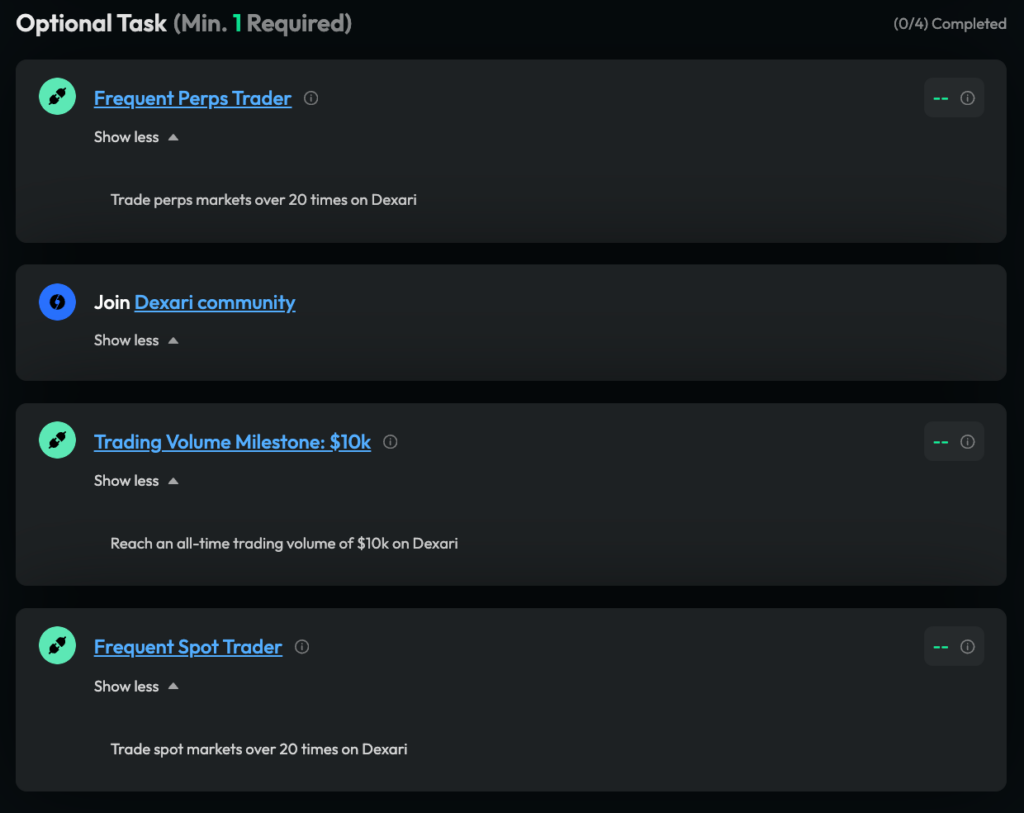
For example, Dexari’s activity required users to genuinely register and complete at least one real trade. Optional tasks included completing 20 on-chain transactions and achieving $10k trading volume, rewarding high-frequency traders. Magpie XYZ guided users to create their own Meme coins. Okto required users to complete a total futures trading volume of at least 1,000 USDT.
③ Clear Interest Alignment: Ecosystem Value for Quality User Behavior
Participants joined not for “generic rewards,” but because they were interested in Hyperliquid trading, genuinely needed to understand the ecosystem, or were willing to complete on-chain interactions.
This reflects the value of high-tier campaigns: not bringing in the most users, but bringing in “users who will stay.”
The Hyperliquid ecosystem campaign gathered over 588,000 participants, achieving strong ecosystem propagation.
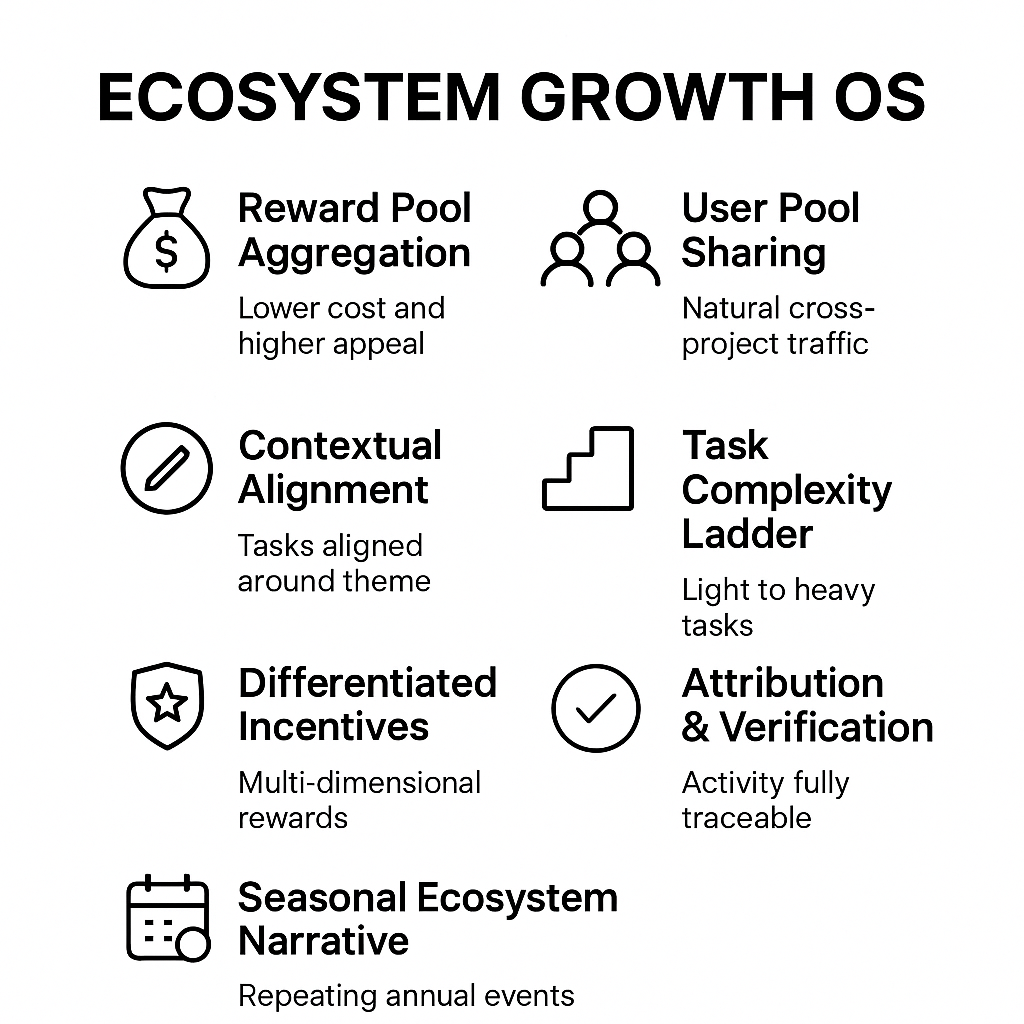
IV | Replicable Methodology for Ecosystem Synergy (Ecosystem Growth OS)
① Reward Pool Aggregation
Lowers the cost for individual projects while boosting the overall attraction of the event.
② User Pool Sharing
Users from different projects permeate each other’s bases, forming a natural traffic flow.
③ Contextual Alignment
Every project must align its task structure around the main campaign direction (e.g., Hyperliquid).
④ Task Complexity Ladder
- Light Tasks → Cognition
- Mid Tasks → Participation
- Heavy Tasks → High-Quality Users
⑤ Differentiated Incentives
Not all participating projects provide Tokens; the reward structure remains multidimensional.
⑥ Attribution & Verification
Post-campaign, every project can see: how many users came from the event, which tasks they completed, which behaviors were most valuable, and the composition of the rewards.
Without TaskOn’s automatic verification, this level of attribution is nearly impossible.
⑦ Seasonal Ecosystem Narrative
The EPIC series establishes a sense of “Annual Cycle”: users begin to expect the next event.
This is crucial for ecosystem mindshare.
Conclusion: Ecosystem Synergy is Not Just a “Collab,” It’s a “Growth Structure”
TaskOn has upgraded ecosystem synergy from one-off events into a growth model that is: Co-Growth, Template-based, Auto-Verified, Attributable, and Sustainable (Seasonal Growth).
This is precisely the most important direction for the future of Web3 ecosystem growth: not solo growth, but Shared Ecosystem Growth.