

In the Web3 world, user attention is the scarcest resource.
On-Chain data reports from Dune Analytics reveal a brutal reality: 70% of users go permanently “dormant” after just a single transaction. Meanwhile, Binance Research indicates that 90% of Web3 users churn within their first week of entering a new ecosystem.
Traditional Web2 giants like TikTok use algorithms and social hooks to lock users in, while Duolingo boosts retention by integrating mission objectives and streak rewards, breaking down long-term goals into instant gratification.
Ideally, Web3’s decentralization should foster a stronger sense of ownership, and its incentive layer should trigger dopamine hits more effectively.
However, only by combining “Behavioral Economics” with “Gamified Design” to construct an “Asset-based, Gamified” incentive system can we truly turn every user interaction into deposited value. This is the key to breaking the Web3 growth and retention dilemma.
Why Do Web3 Users Have a “Three-Minute Attention Span”? And How Can Gamification Fix It?
The “flash in the pan” phenomenon isn’t just a growth bottleneck; it represents a systemic collapse of the current Web3 growth model.
- High Technical Barriers: Cognitive friction is massive. Newcomers lack one-on-one guidance. Data shows that 80% of users drop out after their first interaction.
- One-Dimensional Incentives: Reliance on airdrops creates a lack of depth and follow-up pathways. Users operate on a “hit-and-run” basis — farming rewards and leaving — with an average activity cycle of just 3 days.
- Lack of Emotional Anchors: Users lack a sense of identity and status, and community contributions are hard to quantify.
Traditional marketing ignores the long-haul user journey. So, how do we better educate and retain users? How do we use gamification to reshape the Web3 user journey?
The core of gamification lies in instant feedback, interactive rewards, and viral fission mechanisms. The assetization of data in Web3 offers a natural advantage here. On one hand, sunk costs become visible — Points, NFT badges, and Tokens tie users to on-chain value, raising the cost of leaving. On the other hand, randomized gamified rewards create a “Skinner Box” effect, heightening anticipation.
By combining gamified behavioral mechanics with Web3 incentive models, we can effectively design educational paths, reconstruct retention systems, and reshape user honor systems.
Attempts at this in the Web3 world have been continuous: Base turned on-chain interaction into art with Onchain Summer; Blast locked in future airdrops via a composite incentive system; the GameFi boom popularized the X2E model to incentivize immediate behavior. TaskOn, however, constructs a complete user lifecycle management system, precipitating the value of user behavior through a comprehensive points system.
The Base Revelation: OnChain Summer
Instead of viewing “retention” as the short-term heat from a single airdrop, view it as a chain-native journey composed of “continuous participation.” Base’s OnChain Summer is the quintessential counter-example in Web3 — it proved that when On-Chain behaviors are structured into trackable, quantifiable, and incentivized task systems, user behavior shifts from one-off interactions to long-term engagement.
During the OnChain Summer cycle, a series of On-Chain art, gaming, and music projects powered by Base were released to demonstrate the efficiency and cost-effectiveness of the Layer 2 Chain.
The core logic of OnChain Summer is “turning every On-Chain action into visualized participation.”
It wasn’t just an event, but a reusable, stackable, and cyclical on-chain incentive system:
- User Layer: Every mint, interaction, transfer, and signature was reconstructed as a collectible NFT, a countable Action, and a trackable on-chain footprint. Minting became a proof of participation depth, not just a souvenir.
- Project Layer: Participating Dapps used task-based onboarding to guide users through step-by-step On-Chain operations — from entry-level minting to account binding and on-chain consumption — forming a “phased educational path.”
- Incentive Layer: Base used “Gas Refunds + Partner Rewards + Official Exposure” to upgrade rewards from “airdrop subsidies” to “behavioral subsidies,” making the incentive equal to the value of the behavior itself, rather than speculative arbitrage.
- Propagation Layer: The Coinbase App, Farcaster, artist ecosystems, and creator communities amplified on-chain assets (NFT/Mint), building the largest “OnChain Festival” in Web3 history.
In other words, Base did something critical with Onchain Summer: It gamified all On-Chain interactions and converted that gamification into assetized On-Chain honor and rewards.
It wasn’t about getting users to “play for a day,” but using a “multi-day, multi-week, multi-step” structured path to drive continuous on-chain behavior, breaking the three-day churn curse via compound incentives.
In its early mainnet days, Base didn’t rely solely on airdrop speculation. Instead, it launched a weeks-long celebration. Partnering with brands like Coca-Cola and Zora, Base unlocked a limited-time exclusive NFT mint daily. This “now or never” scarcity forced low-frequency Web3 users to develop the muscle memory of “opening their wallet daily” for a month. Platforms like Mint.fun showed that massive numbers of users maintained startlingly high consecutive activity just to collect the full NFT series.
Base proved a truth: High-frequency “Asset Confirmation” (i.e., Minting NFTs) retains users better than the occasional “Pie-in-the-Sky Airdrop.”
OnChain Summer demonstrated that user retention relies not on airdrops, but on Task Links + Gamified Incentives + Visualized Growth.
TaskOn Growth Flywheel: Reconstructing the Incentive Retention System
The core innovation of the growth platform TaskOn lies in upgrading user behavior outputs from “consumable points” to “investable assets.” By combining assets, points, reputation, and identity, it builds a “Crypto Value Account” for users, creating long-term value accumulation.
The Value Layer
1. Foundation Layer: Quantifying Effort
- EXP: The bedrock of the points system, driving Level and Milestones. It ensures every user effort is recorded and recognized by the system, serving as the cornerstone for all high-level benefits.
- Lucky Ticket: Rewards claimed within Milestones. When a user’s Lucky Ticket balance equals or exceeds the task reward amount, their probability of winning in task draws increases significantly.
2. Core Value Layer: Universality & Exchangeability
- GEM: The universal value medium of the TaskOn incentive system. GEM bridges daily tasks and high-level privileges, incentivizing users to accumulate for long-term goals.
- Token & USDT: Direct crypto rewards ensure the authenticity of incentives and immediate liquidity — a basic prerequisite for retaining Web3 users.
3. Loyalty & Identity Layer: The Long-Term Value of Honor
- POX: A unique evaluation system that quantifies a user’s real contribution. POX determines a user’s influence and status within the ecosystem, solving the “non-quantifiable contribution” problem in Web3 communities.
- NFT: NFTs issued by the TaskOn Club are not just collectibles; they are aggregates of honor, access, and equity. High contributors are granted permanent identity and privileges via NFTs, translating virtual contributions into tangible Web3 identity assets.
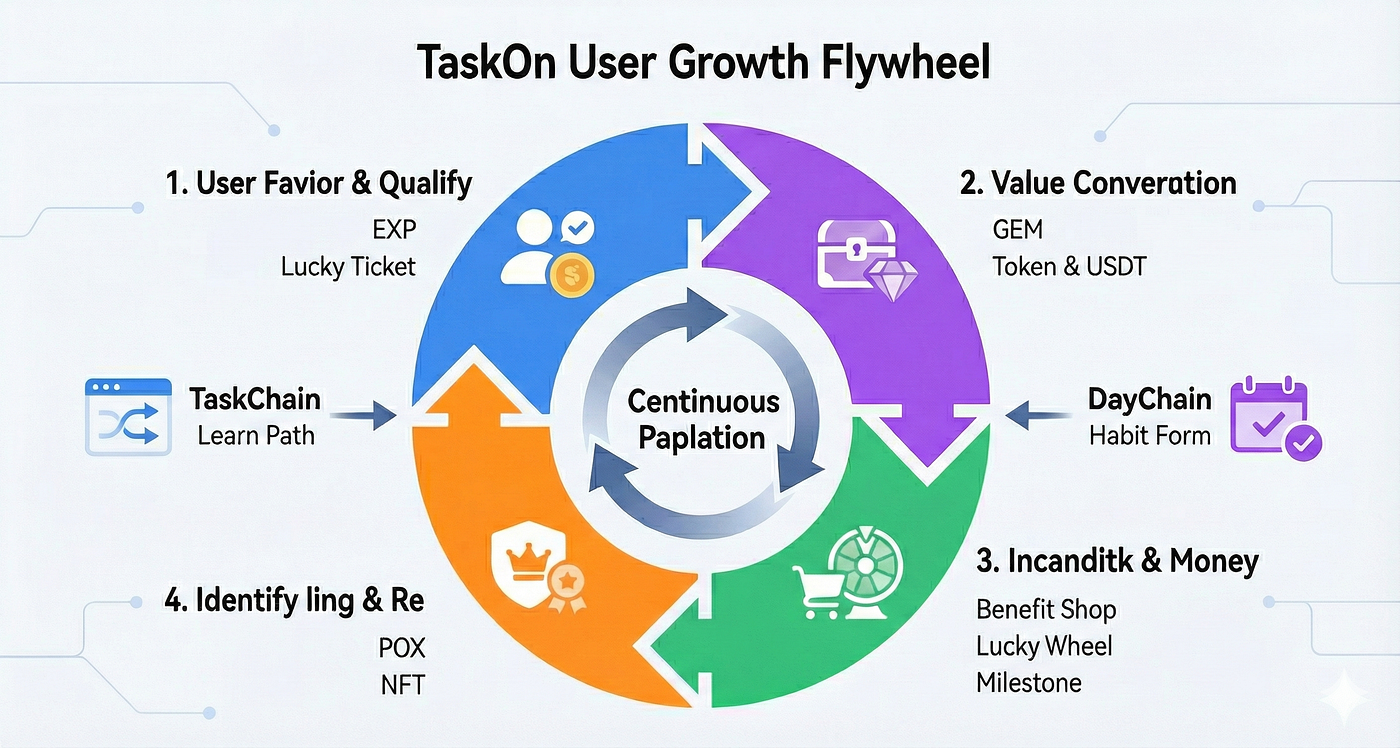
The Gamification Engine: The “Growth Flywheel” Driving Continuous Behavior
1. The Growth Flywheel: The Double Helix of TaskChain & DayChain
TaskOn designed a dual engine for growth and retention:
- TaskChain (Narrative Arc): Uses a card-style, interlinked design. It sets up serial tasks and educational paths, breaking down complex interactions (like cross-chain bridging or staking) into a “level-clearing game” ranging from novice to master. Users undergo deep product education (Onboarding) while completing tasks.
- DayChain (Habit Formation): Utilizes nurturing mechanics. As consecutive check-in days increase, the reward pool accumulates exponentially. This is a classic “habit-forming” strategy, converting DAU (Daily Active Users) into long-tail retention by constantly increasing sunk costs.
2. Competition & Exposure: Leaderboard
- Function: Injects P2P competitive fun, converting user contribution and rank into public honor and status to stimulate competitive desires. The leaderboard displays not just point rankings but proves real user participation and influence, satisfying the Web3 user’s need for identity recognition.
- Leaderboard Sprint: Anchors cyclical rewards to trigger FOMO. Together with Points, Milestones, and Benefits, it creates a complete gamified incentive loop.
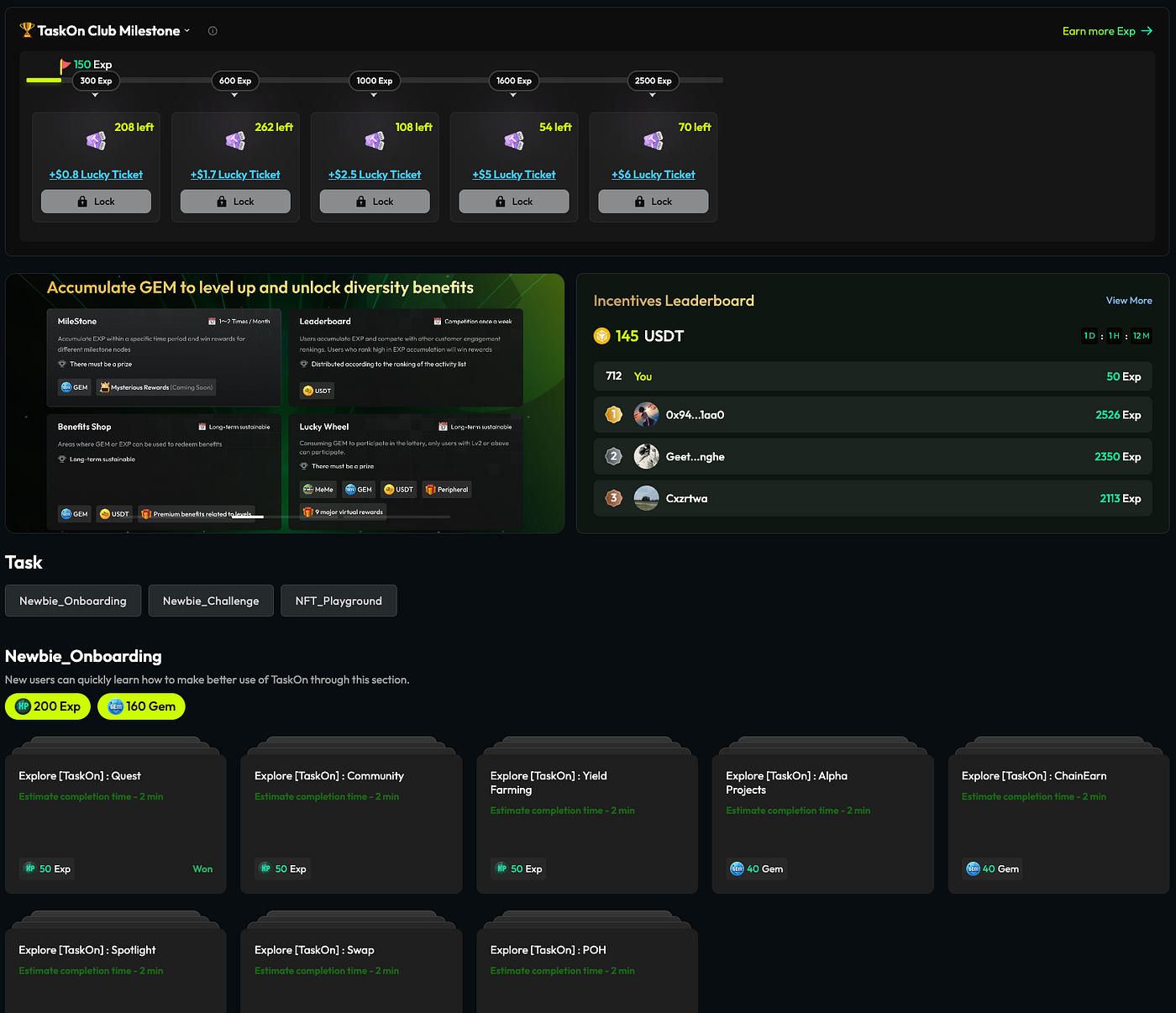
3. Long-Term Goals & Achievements: Milestones
- Function: Deconstructs the complex platform participation process into achievable staged goals. Users receive rewards and feedback upon reaching Milestone targets, providing a clear growth path and solving the “lost phase” of participation.
4. Asset Conversion & Feedback: Benefit & Lucky Wheel
- Benefit Shop: Provides an exit for assets (GEM), allowing users to convert accumulation into needed resources or rights, reinforcing the perceived value of GEM.
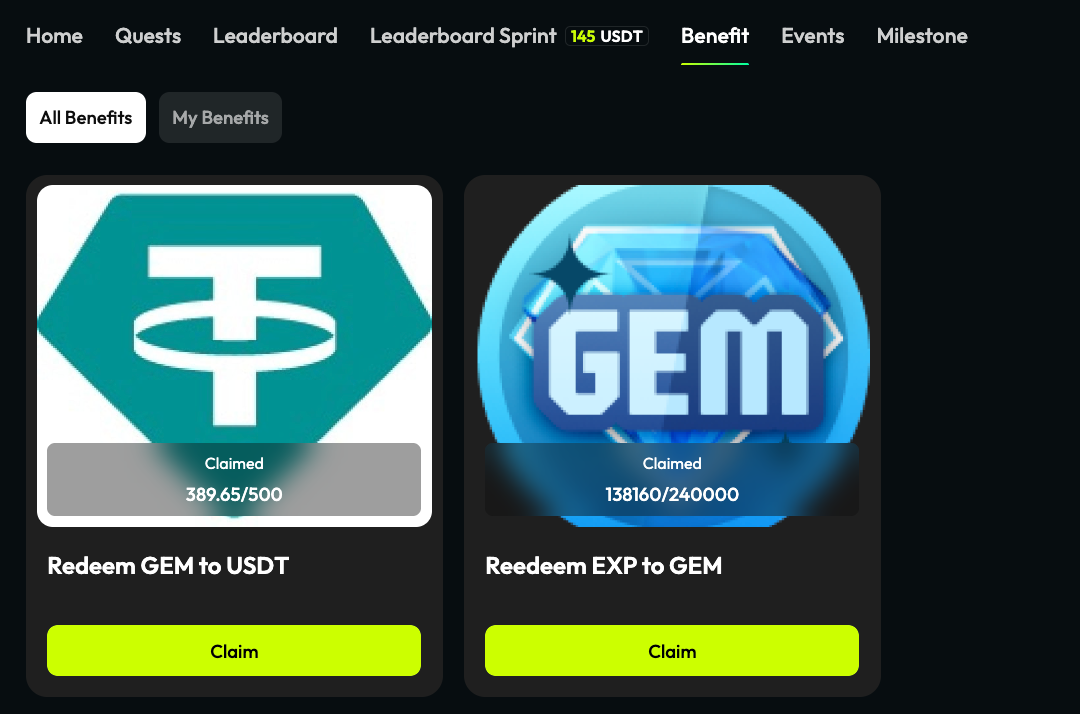
- Lucky Wheel: Offers instant and randomized incentives, serving as a daily engagement and stickiness tool to increase platform visit frequency.
As asset-based incentives, the Benefit Shop & Lucky Wheel facilitate the fundamental redemption of points. But crucially, points serve as the data-driven manifestation of a user’s contribution to the community.
Assets lay the foundation of value, but retaining users requires sustainable momentum. TaskOn, through sophisticated gamification gameplay, converts asset accumulation into a community-based “Growth Flywheel” with continuous feedback loops.
The Allure of Randomness: Leveraging Gambling Psychology
To prevent user fatigue from fixed rewards, TaskOn introduced the Smart Blind Box mechanism and the Lucky Wheel points redemption draw. These features simulate the excitement of a casino, allowing users to earn rewards while significantly boosting the fun factor of gamification.
The Lucky Ticket, meanwhile, functions more like a weighted algorithm: holding more Lucky Tickets increases the probability of winning. Algorithmically, this realizes the fairness of “the harder you work, the luckier you get,” preventing pure luck from dominating the outcome.
Gamification isn’t just entertainment; it is a loyalty engine that converts passive users into active participants. On TaskOn, after on-chain active users complete tasks to earn Token rewards and Points, backend Data Analytics reveal striking operational data: thanks to the gamification system, the retention rate for core community users hits 65%, far exceeding the industry average of 10%. This stretches the “three-minute” attention span to “7+ days,” proving that gamification is the “glue” of Web3.
VI. Conclusion: Gamification Ushers in the Web3 Loyalty Era
Web3 marketing is undergoing a paradigm shift.
The “three-minute heat” was once a persistent ailment in Web3. In the past, we worshipped “traffic is king,” buying a horde of disloyal “mercenaries” with expensive airdrop costs. But now, gamification mechanics prove: Retention isn’t luck; it’s design.
By assetizing user behavior, gamifying interaction processes, and bringing identity verification on-chain, we are transforming Web3 user relationships from “transactional” to “collaborative.” By turning the growth flywheel into a loyalty engine, users shift from “tourists” to “guardians,” and ecosystems move from fragile to resilient.
In the next bull market, whoever builds a gamified system that gets users “hooked” and “profiting” will be the one to truly lock in user loyalty amidst the fierce battle for attention.