
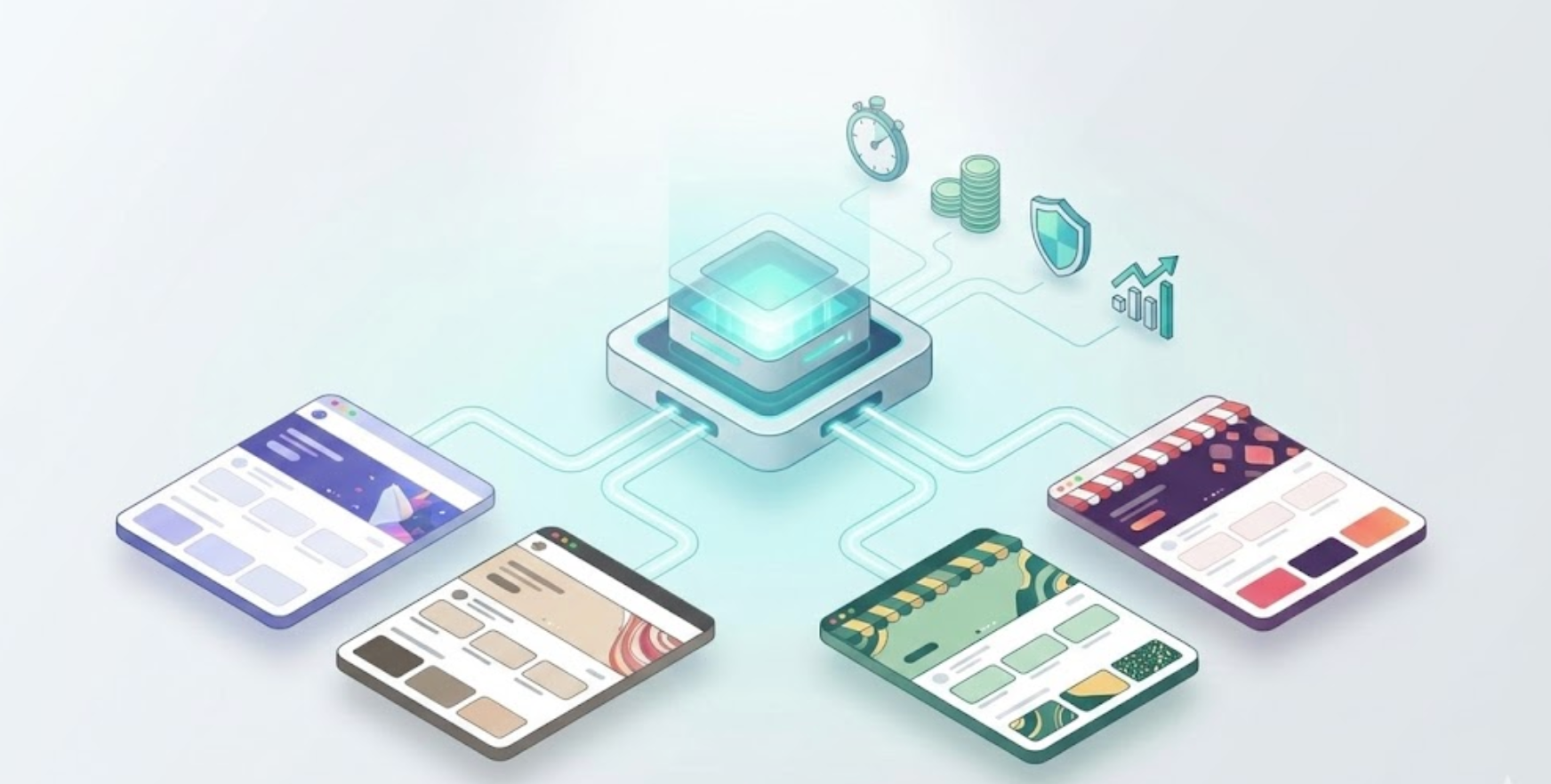
In the current Web3 marketing landscape, the “Quest Platform” has become the industry standard. Projects, hungry for user acquisition, flock to third-party traffic pools—like TaskOn, Galxe, or Zealy—hoping to siphon liquidity and attention.
The logic seems sound: go where the users are. However, while these aggregators offer quick metrics and ready-made traffic, relying on them as the primary interface for your community comes with a hidden, accumulating cost: Brand Dilution.
To build a sustainable protocol in a bear or bull market, you need “Brand Sovereignty.” This means shifting from renting attention on shared aggregators to owning the relationship via a dedicated, white-labeled Loyalty Hub.
Here is the comprehensive argument for why owning your interface—specifically through custom domains, sovereign UI, and data ownership—is the only way to build genuine trust.
- The “Rented Land” Problem
There is an old maxim in digital marketing: “Don’t build your house on rented land.”
When you run a campaign on a third-party aggregator like TaskOn, you are building their brand equity, not yours. Users are trained to visit taskon.xyz, look for the highest APY or reward, complete the task, and leave.
In this model, the user relationship is triangular and fragile:
User→Aggregator Platform→Your Project
The user’s primary loyalty is to the platform that aggregates the rewards. Your project is simply one of a dozen tiles on a dashboard. If the platform changes its algorithm, delists you, or shuts down, you lose your connection to those users instantly. You are effectively renting access to your own community.
- The Psychology of Trust: Why domains are Security Signals
The strongest argument for a self-hosted Loyalty Hub is security psychology. In an industry rife with phishing attacks, wallet drainers, and scams, visual and technical consistency is not just an aesthetic choice—it is a security signal.
The Phishing Risk of External Links
Consider the user journey. You ask a user to click a link on Twitter/X to claim a reward.
- Scenario A (Third-Party): https://taskon.xyz/campaign/detail/12345
- Scenario B (White-Label):
Scenario A trains your users to click links that lead away from your official domain. It normalizes the behavior of connecting wallets to third-party URLs. This is bad security hygiene.
Scenario B tells the user: “You are still in our home.” By using a custom subdomain (quest. or reward.), you transfer the “Trust Score” from the platform to your own brand. Users feel significantly safer signing a transaction or connecting a wallet on a subdomain of a project they already know, rather than a third-party aggregator they might view as merely a “middleman.”
- The “Uncanny Valley” of UI/UX
Thorough white-labeling goes beyond placing your logo in the top corner of a generic template. It requires User Interface (UI) sovereignty.
Most quest platforms utilize a standard “Web3 Dark Mode” aesthetic—neon purples, dark greys, and grid layouts. If your DeFi protocol uses a clean, minimalist, high-trust banking aesthetic (e.g., Uniswap or Aave style), sending a user to a neon-colored TaskOn page creates a jarring experience.
This visual disconnect signals to the user that the reward experience is an afterthought, outsourced to the lowest bidder.
A White-Labeled solution allows you to:
- Match Design Systems: Use your specific hex codes, fonts, and button radiuses.
- Seamless Navigation: The user should never feel like they have “left” your app. The loyalty hub should feel like a native feature, not an external homework assignment.
- Prestige: A custom UI signals competence, resources, and long-term vision. It tells the user, “We take our community experience as seriously as our smart contracts.”
- Technical Sovereignty: The API Advantage
While branding is psychological, the technical advantages of a white-labeled hub are measurable and operational. This is where the distinction between Aggregators and Infrastructure becomes key.
Platforms like TaskOn are powerful because they have backend verification engines (e.g., verifying if a user holds an NFT, has swapped tokens, or follows a Twitter account). However, you should use them as Infrastructure (via API), not as the Destination.
A. Headless Architecture
By using the API of a quest provider but building your own frontend, you achieve a “Headless” architecture.
- The Engine: TaskOn (or similar) handles the messy work of verifying on-chain data and dispensing rewards.
- The Chassis: You build a React or Vue frontend that calls these APIs. You control the CSS, the animations, and the user flow entirely.
B. Data and Cookies
When you send traffic to taskon.xyz, the analytics belong to them. You are subject to their dashboard’s limitations.
- First-Party Data: Hosting the hub on your-protocol.com allows you to set first-party cookies. You can track the user’s journey from Landing Page → Quest Completion → dApp Transaction with 100% fidelity.
- Wallet Binding: In a self-hosted environment, you can bind the user’s wallet address to your own internal User ID (UUID) immediately. This creates a unified “Customer 360” profile that spans your product and your marketing campaigns, something impossible to do accurately when data is siloed in a third-party dashboard.
- Escaping “Competitor Drift”
Perhaps the most dangerous aspect of relying on traffic pools is the “Sidebar Problem.”
Aggregator platforms are businesses. Their metric for success is Time on Site (for them). When a user finishes your task on TaskOn, the platform’s algorithm immediately recommends: “Similar campaigns with high rewards.”
Often, these recommendations are your direct competitors.
- The Traffic Pool Risk: You pay to bring a user to the platform. They finish your task, see a sidebar ad for a rival protocol offering a slightly higher APY, and click away. You have effectively subsidized your competitor’s user acquisition.
- The Sovereign Solution: On your white-labeled hub, there is no sidebar. There are no “Recommended Campaigns” from other projects. The only “Next Step” available to the user is to launch your app and use your protocol.
- Case Study: MaAvatar’s Path to Brand Sovereignty
MaAvatar serves as a prime example of a project moving beyond “rented land.” Rather than sending their community to an external aggregator, MaAvatar leverages TaskOn’s Whitelabel Service to anchor their engagement strategy within their own domain.
- Seamless Integration: By embedding the TaskOn verification engine directly into the MaAvatar homepage, they have eliminated the “Redirection Friction” that usually kills conversion rates.
- Identity Continuity: Users interact using the same credentials they use for the MaAvatar ecosystem. This removes the psychological barrier of trusting a third-party login, keeping the relationship strictly between the user and the project.
- The Result: A unified, on-brand engagement hub. Users explore campaigns, track rewards, and engage with the community without ever seeing a taskon.xyz URL. For the user, the experience is 100% MaAvatar; for the project, the heavy lifting of task verification is handled by TaskOn’s invisible infrastructure.
- Case Study: MamaBull and the “Growth Flywheel” Effect
MamaBull illustrates a sophisticated application of brand sovereignty by utilizing TaskOn’s GTC (Go to Community)white-label service. Rather than viewing community engagement as an external satellite activity, MamaBull has internalized the entire experience, transforming their official domain into a high-traffic destination.
The Unified Traffic Pool
By integrating the GTC service, MamaBull has bridged the gap between their native community and TaskOn’s global user base. Whether a user discovers them via an aggregator or visits the official site directly, the experience is consolidated. This “One-Click Integration” ensures that 100% of user attention is captured within the MamaBull ecosystem, effectively turning their website into a sovereign traffic hub with over 65,000 active participants.
Deep Functional Diversity
MamaBull doesn’t just offer “tasks”; they have built a multi-dimensional service layer. Through the white-label API, they have deployed a comprehensive suite of modules:
On-Chain & Social Synergy: One-click setups for everything from daily social engagement to complex smart contract interactions.
The “SALT” Points Economy: A built-in loyalty system centered around “SALT” points. This allows MamaBull to record every user action as a data point, which is then used to distribute tangible rewards—USDT, whitelist spots, and tokens—through automated lottery systems and leaderboards.
Omni-Channel Synchronization
Sovereignty isn’t limited to the web. MamaBull utilizes an integrated Telegram Bot synced with the white-label hub. This ensures a “Closed-Loop” marketing cycle: users are reminded of tasks in Telegram, click through to the official domain, and earn rewards—all while their data is tracked and stored in MamaBull’s sovereign data silo.
The Result: From Management to Automation
For MamaBull, the GTC integration represents a shift in operational philosophy. By automating community management and gamifying the reward process, they have moved beyond manual “campaigns.” They have created a self-sustaining reward center where data is tightly bound to the ecosystem, enhancing the user’s sense of belonging while maximizing project efficiency.
- Strategic Guide: Leveraging White Label (WL) Solutions for Web3 Growth
This document outlines high-value information extracted from the latest project analysis to strengthen the value proposition of White Label (WL) operations. These insights focus on identifying ideal customers, deploying industry-specific tactics, and quantifying ROI.
High-Value Customer Profiling (The “ICP”)
Beyond basic categories like “DEX” or “Perps,” target projects that exhibit these specific operational signals:
The “Messy Middle” Signal: Projects that have a Rewards or Missions tab in their UI that is either empty, manually updated via Google Sheets, or visually inconsistent. These projects have already “sold” themselves on the concept but lack the infrastructure.
Post-TGE / Maturity Phase: Projects facing “Mercenary Capital” issues—users who “farm and dump.” They need WL to pivot from generic incentives to Loyalty-based retention.
UI/UX “Purists”: High-tier projects with unique brand aesthetics (Cyberpunk, Minimalist) that refuse to use third-party quest platforms because it breaks their “Flow State” and “Brand Sanctity.”
Data Sovereignty Seekers: Teams that demand 100% ownership of user interaction data and want rewards to be triggered directly by their own smart contracts without external redirects.
Vertical-Specific Growth Strategies
Tailor the WL pitch to the specific “Lifeblood” metric of the sector:
GameFi (Maintaining “The Flow”): Gamers hate context-switching. Use DayChain for in-game “Gasless Check-ins” and daily streaks. This maintains DAU (Daily Active Users) without breaking the immersive gaming experience.
Perpetual DEXs (The “Degen” Loop): Focus on the Leaderboard and Milestone modules. Perps live on competition. Use WL to gamify “PnL Rankings” or “Trading Volumes” with real-time feedback loops.
Wallets & Super Apps (The “Education Funnel”): Use TaskChain to build an onboarding journey. Example: Connect Wallet -> Swap -> Stake -> Governance. This reduces the friction of complex Web3 interactions through “Micro-Rewards.”
New Ecosystem/L2 Launches: When a project deploys on a new chain (e.g., Base or Monad), use the WL Widget to create a “New Frontier” mission tab directly on the home site to migrate liquidity instantly.
Psychological & Economic Scenarios (Examples)
Use these psychological triggers to explain the WL advantage:
The “Sunk Cost” Strategy: By integrating Badges and Levels directly into the project’s domain, the user’s progress becomes part of their platform identity. This “Sunk Cost” significantly increases the barrier to switching to a competitor.
The “Endowed Progress Effect”: Set up non-linear level curves (easy start, hard finish). Giving a user a “Level 1” badge immediately upon login creates a psychological “head start,” increasing the likelihood of task completion.
The “Token Deflation” Engine: Use the Benefits Shop and Lucky Wheel to create sinks for the project’s native token. Users spend tokens for “Boosted APY” or “Trading Fee Rebates,” effectively removing tokens from circulation.
Hard ROI: The “Buy vs. Build” Argument
Quantify the cost-saving to move the conversation from “Marketing Budget” to “Efficiency Gains”:
Direct Cost Savings: Building a robust, secure, and multi-chain verified points system requires ~2 full-stack engineers for 3 months. Estimated cost: $50,000–$80,000. WL offers “Zero-Code” deployment at a fraction of the cost.
Operational Velocity: Marketing teams can launch a “Trading Race” in hours instead of weeks because they don’t need to wait for a developer’s sprint cycle.
AARRR Analytics: WL provides a ready-made ROI Dashboard covering LTV (Lifetime Value), CAC (Customer Acquisition Cost), and automated attribution that would take months to build internally.
Overcoming Technical Hesitation
Security & Privacy: Emphasize that the WL Widget is a “Read-Only/Interaction” layer. It requires Zero Permissions to private keys and complies with data standards like GDPR/CCPA.
Seamless Integration: The “No-Jump” experience. Using CSS customization (Dark/Light mode), the WL module feels like a native feature.
Migration Ease: Offer “One-click Data Import” for projects that already have existing points systems but want to upgrade to a professional infrastructure.
Glossary of Core WL Modules for Sales
TaskChain: The “Lead Magnet” for complex protocols (Multi-step onboarding).
DayChain: The “Retention Hook” (Daily recurring interactions).
Milestone: The “Community Anchor” (Group goals, e.g., “When TVL hits $100M, everyone gets a Badge”).
Benefits Shop: The “Value Exit” (Where points turn into real utility like fee discounts).
Conclusion: From Mercenaries to Loyalists
Third-party platforms are excellent tools for cold traffic discovery—they act as the “top of the funnel.” However, they should never be the final destination for your community.
The era of “easy growth” via generic airdrop farming is fading. To mature from a project into a sovereign brand, you must bring your users in-house. By implementing a fully white-labeled solution—where the domain is yours, the UI matches your product, and the data stays in your silo—you stop asking users to trust a generic platform and start proving they can trust you.