

How can we effectively measure the growth of Web3 projects? Obviously, there is a fundamental difference between the growth logic of Web2 and Web3. After communicating with multiple exchanges, project teams, and investment institutions, I realized that in the Web3 world, where traffic costs remain high, the traditional AARRR “funnel model” is becoming obsolete—users are no longer prey to be captured, but rather partners who need continuous attraction and long-term maintenance.
This is why the rise of InfoFi appears particularly “native to Web3.” It transforms intangible assets such as hard-to-measure market attention and brand reputation into tradable, quantifiable financial assets. It can be said that InfoFi demonstrates the genius of Web3 marketing: it focuses on what truly matters.
However, the attention economy, represented by InfoFi, has now fallen into its own paradox: information overload and noise saturation. When attention is massively commoditized, user attention becomes even scarcer.
The real solution lies in building a growth flywheel that starts with traffic and centers around user loyalty programs, transforming ordinary participants into loyal brand advocates, ultimately achieving self-driven and sustainable growth for projects—precisely the mechanism most needed in the current Web3 ecosystem.
Under this logic, Quests are no longer just growth tools but also important pathways for users to build on-chain identities, accumulate social capital, and capture early Alpha. They are reshaping traffic distribution methods and user relationships, becoming a critical bridge connecting projects and users.
A Complete Web3 Marketing Objective System
An interesting observation: becoming a streamer on Pump.fun is far more likely to lead to “overnight wealth” than on Web2 platforms—even though the former’s traffic scale is much smaller.
Behind this lies the power of tokenomics. Through the invisible bond of Memes, streamers and viewers are no longer connected merely by emotion but are tightly bound by a common expectation: breaking through the noise. The more absurd and unconventional the content, the easier it is to capture attention—and attention is the lifeline of Memes. This makes Pump.fun’s streaming ecosystem resemble a grand “digital colosseum,” where the attention economy is the first law.
So, what should a successful Web3 marketing strategy entail? How can it build brand awareness, generate buzz, and spark curiosity among target audiences? And how can it leverage incentives and culture to convert them into deeply engaged users?
A complete Web3 marketing strategy should form a closed-loop, multi-module growth flywheel. InfoFi is a lever, prediction markets are a lever, Pump.fun’s live streams are a lever, and Quests are also a lever—they all achieve brand exposure and heat generation through refined traffic operations.
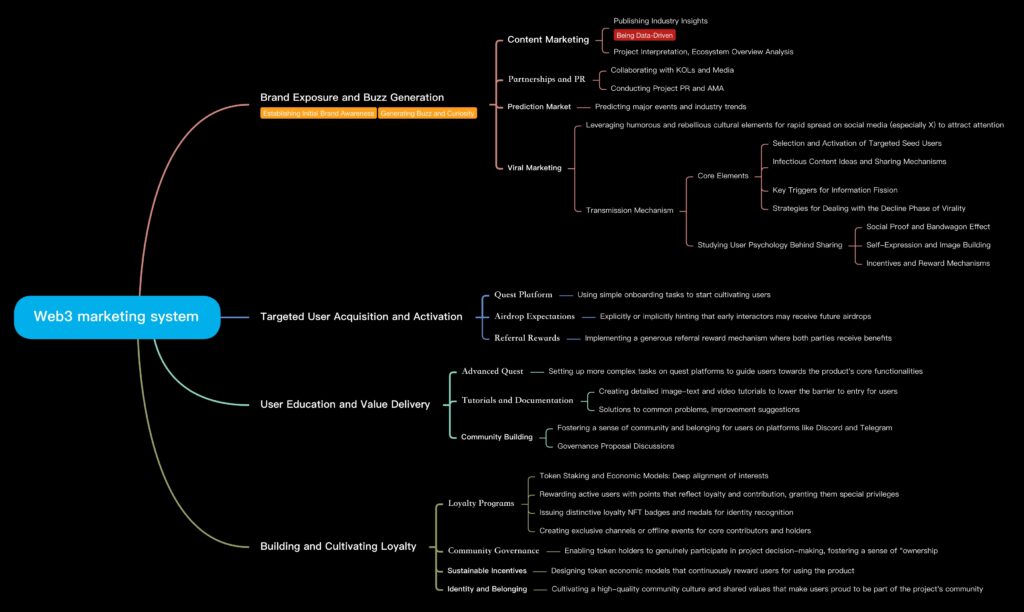
Among these levers, Quests may be the most effective tool for driving the marketing flywheel. Note that the term “Quest” here refers not only to a series of incentivized operational verifications on task platforms but also to on-chain transaction activities initiated by project teams.
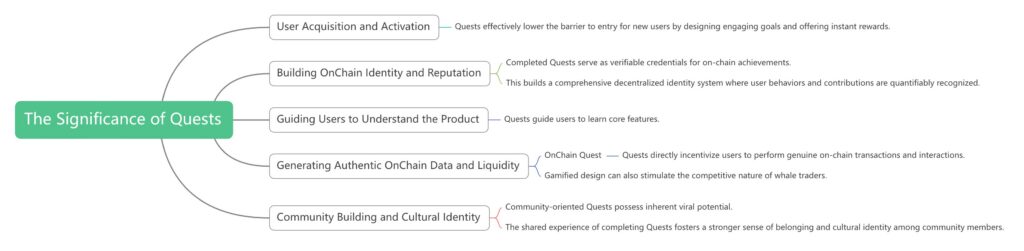
How Do Quests Drive the Growth Flywheel?
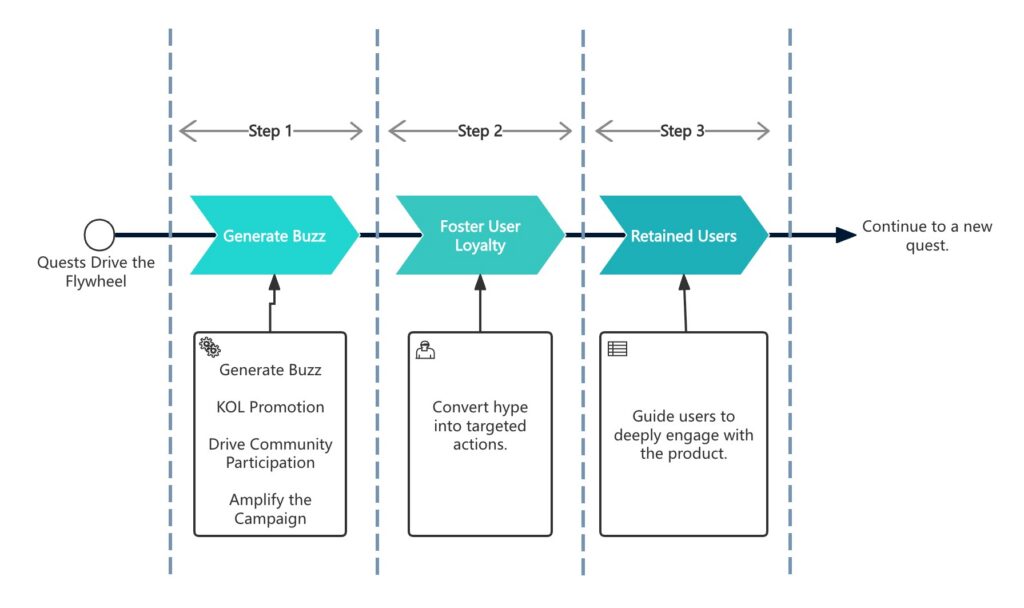
Quests are more efficient because they feature a complete closed-loop system: from traffic acquisition and demand capture to gamified incentives, user retention, and fostering a sense of belonging.
They are not just tools for user acquisition but also foundational structures for educating users, screening high-value contributors, and laying the groundwork for loyalty programs.
How to Create an Effective Quest?
A well-designed Quest can significantly improve user retention and community engagement. Data shows that a properly structured Quest can even lead to a 300% increase in retention and double the interaction rates.
However, in reality, many Quests quickly lead to user fatigue and a sharp drop in participation. Homogeneous social tasks fail to inspire genuine identification, much like most low-traffic Quests on Galxe or the countless silent live streams on Pump.fun’s list.
Let’s take TaskOn—a comprehensive and highly representative task platform—as an example to dissect how to build an efficient Quest on such a platform.
TaskOn has built a complete Quest ecosystem through gamified mechanisms, narrative guidance, value-driven task design, incentive systems, and data feedback.

Compared to other platforms, TaskOn’s core advantages include:
- Zero-cost launch and free data export
Supports free Quest creation and provides complete data export functionality, helping project teams accurately analyze campaign performance. - Result-oriented Performance Quest
Uses dynamic point rewards and API interfaces to track on-chain behavior, DApp registrations, and interaction data in real time.
For example: Users earn 10 points for every $100 deposited, deeply integrating the point system to ensure every contribution is rewarded, thereby enhancing community stickiness. - Automated verification and task execution
Greatly improves tool usability and operational efficiency, optimizing the user experience and promoting user retention.
To set up an effective Quest within this flywheel, the first step is to define the goal: Is it user acquisition, boosting engagement, or promoting a specific feature? A successful Quest requires a focused objective and a clear path.
Secondly, brands must clarify their core values and narrative logic, integrating these elements into the task design so that users perceive the brand’s essence through participation.
Let’s analyze a few specific successful Quest strategies:
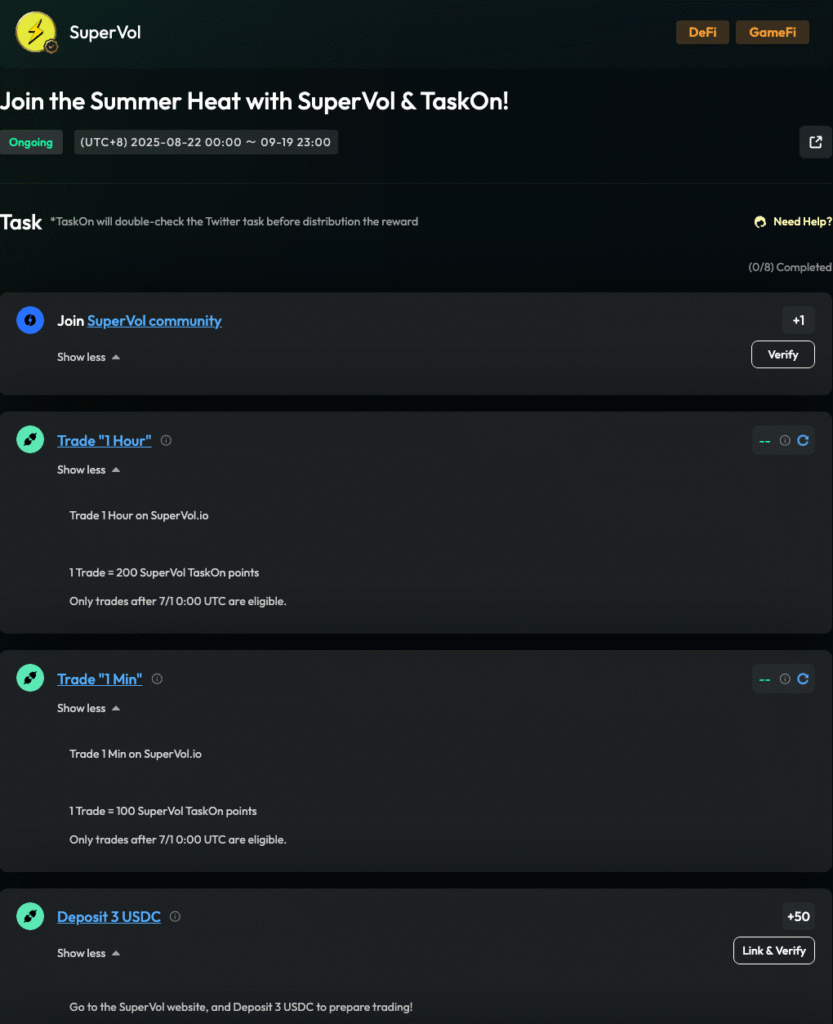
SuperVol uses Performance Quest to incentivize community-driven trading
As a gamified crypto options trading platform, SuperVol implemented a point reward mechanism on TaskOn based on the number of trades, quantifying user contributions and incentivizing frequent trading behavior through point redemption, significantly boosting user activity.
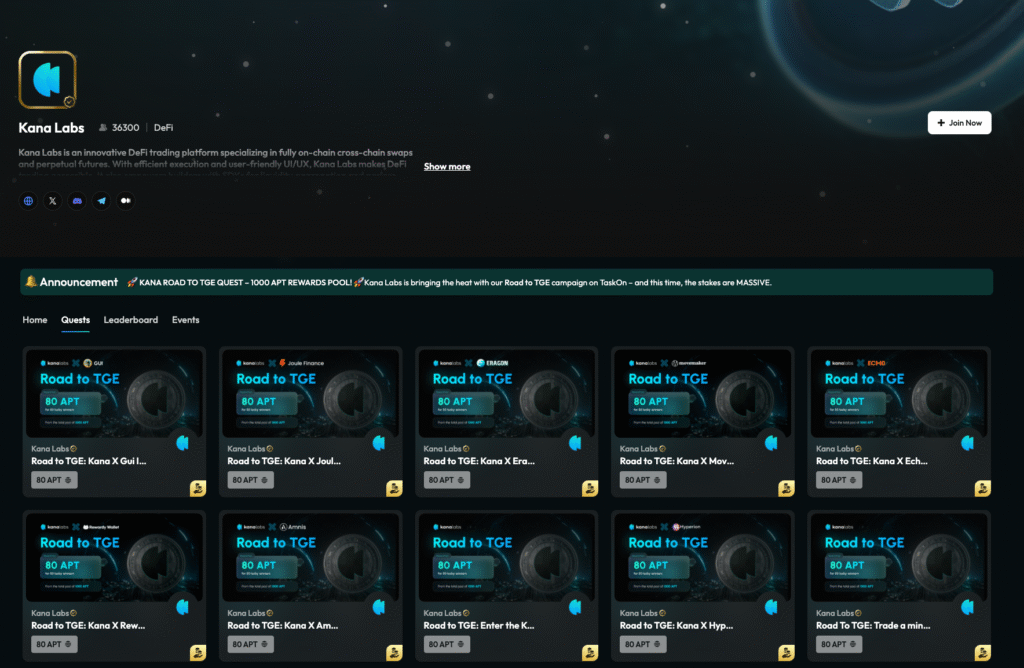
Kana Labs: Road To TGE
Ahead of its TGE, Kana Labs launched a series of Quests on TaskOn, using weeks of challenges to achieve precise rewards and community celebration. The brand narrative was woven into the task flow, helping users build emotional connections through participation.
Mamabull: Deep integration of community and Quests
Using TaskOn’s GTC white-label service, Mamabull embedded Quests directly into its official website. Through Meme culture and daily tasks, it triggered frequent user logins, effectively monetizing attention and fostering community retention.
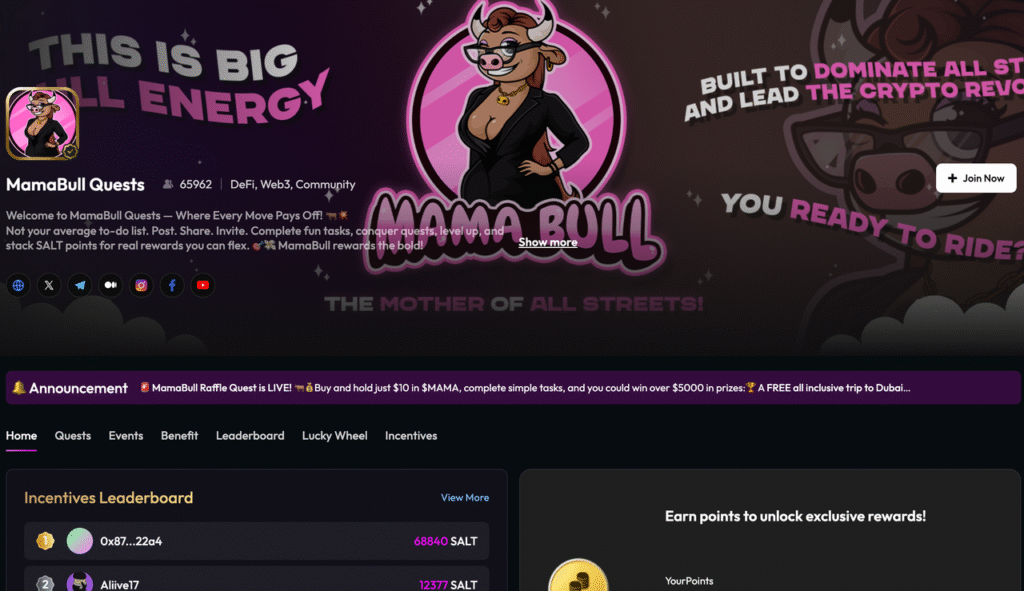
Data shows its GTC community has over 65,000 users, with 25,000 Telegram members and 13,000 on-chain task participations.
Spring Bloom: The scale effect of TaskOn’s quarterly campaigns

As a joint campaign by TaskOn, the latest Spring Bloom event brought together 54 projects, with a total prize pool exceeding 24,000 USDT, plus additional project token rewards. It attracted over 900,000 participants, demonstrating the platform’s powerful traffic aggregation and distribution capabilities.
For most project teams struggling to set up Quests precisely, TaskOn offers highly flexible task templates supporting on-chain/off-chain combinations and targeted audience features, enabling the setup of multi-level task systems within 15 minutes. Its “one-click deployment” template further lowers the barriers to launching and operating Quests.
Conclusion
In the current Web3 landscape, Quests have far surpassed the scope of marketing tools—just as Meme culture has become the spiritual torch of the Web3 revolution, Quests are evolving into core infrastructure for community development and traffic growth. The high-growth nature of task platforms continues to redefine the growth paradigms of the Web ecosystem. Leveraging Quests effectively will become the sharpest operational tool for every Web3 project.