

In the Web3 space, Twitter (X) serves as a hub for community information and a core platform for projects to build brand awareness and attract new users.
Why is Twitter Engagement crucial for Web3 projects?
Engagement (likes, retweets, replies) is not only a direct metric of visibility but also a key indicator of a project’s influence and community activity.
Especially during critical moments such as before TGE or exchange listings, community and Twitter activity become important factors in evaluating a project. Authentic engagement—genuine interactions between users and projects—matters more than artificially inflated metrics.
Most projects fall into the same trap on Twitter: “all noise, no real engagement.” Many tasks only require “follow + retweet,” resulting in inflated numbers but limited real reach.
Against this backdrop, BLOCX achieved remarkable engagement results through TaskOn, creating a reusable model for success.
Case Background: BLOCX’s Community Task Design
BLOCX is a Layer 1 blockchain platform aiming to integrate Web2 and Web3 tools into a unified digital operating system. With its upcoming exchange listing at the end of the month, market visibility and community consensus are critical—making Twitter engagement a key window into its momentum.
On TaskOn, BLOCX launched a series of tasks designed to boost Twitter engagement. The campaign centered around Quests, using a high-incentive Leaderboard Sprint to motivate users, supplemented by daily community Tasks to broaden participation and serve as a foundation for the sprint.
Key Engagement Design Elements:
- Unified Keywords: Tweets must include $BLOCX and @BLOCX_TECH.
- Closed-Loop Propagation: Quest tasks required tweets to include an activity link, driving click-throughs and return traffic.
- Originality Threshold: High-point tweet tasks required at least 100 words of original content to avoid low-effort copy-paste posts. Some tasks demanded at least 4 tweets in length, encouraging users to learn about the project through other tasks before creating substantive content.
- Incentive Mechanism: Participants received rewards for completing tasks, with a dual incentive structure of 200 USDT + 1000 USDT.
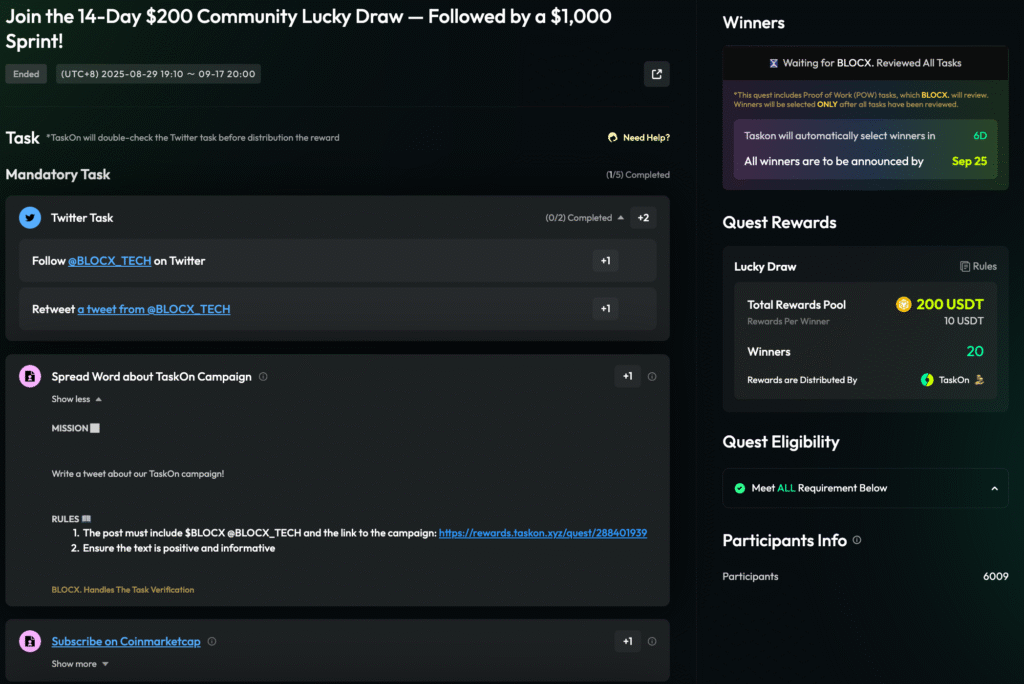
Quests act as both a user acquisition channel and a trigger for traffic redirection. The 200 USDT + 1000 USDT incentive structure attracted broad participation while encouraging deeper engagement.
The 200 USDT reward drove basic Twitter actions like follows and retweets, while the 1000 USDT Leaderboard Sprint incentivized deeper daily community involvement, strengthening activity and Twitter interactions.
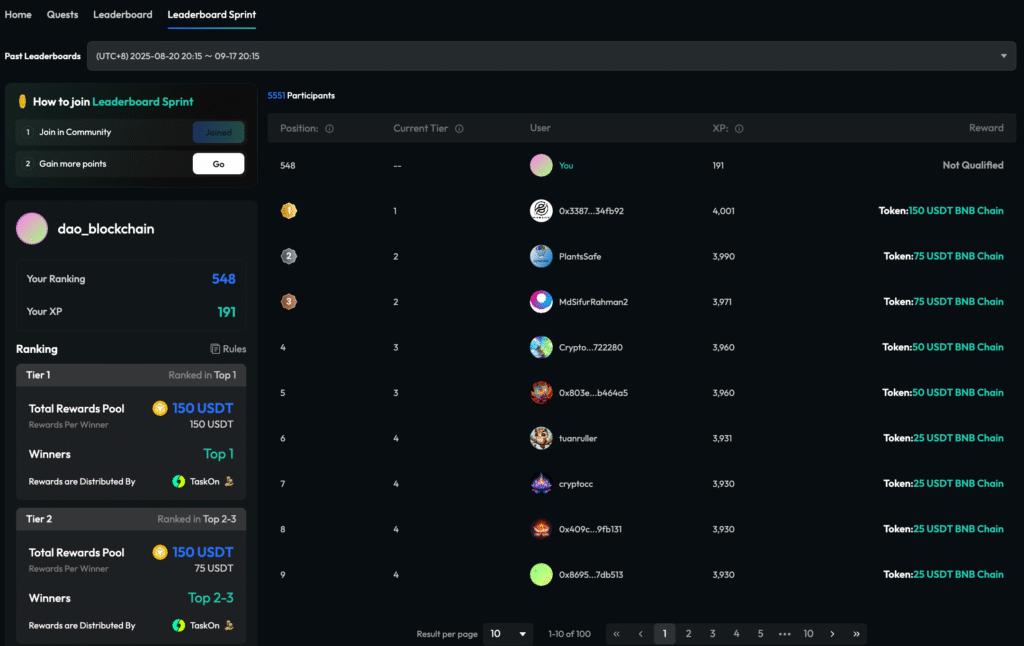
Twitter tasks are among the most frequently used scenarios in community Task campaigns.
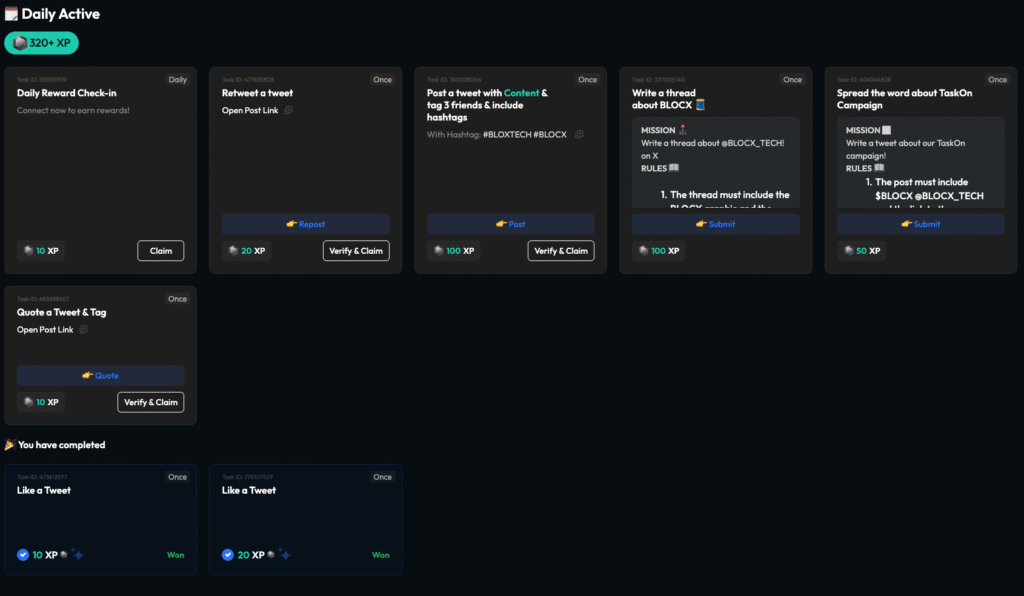
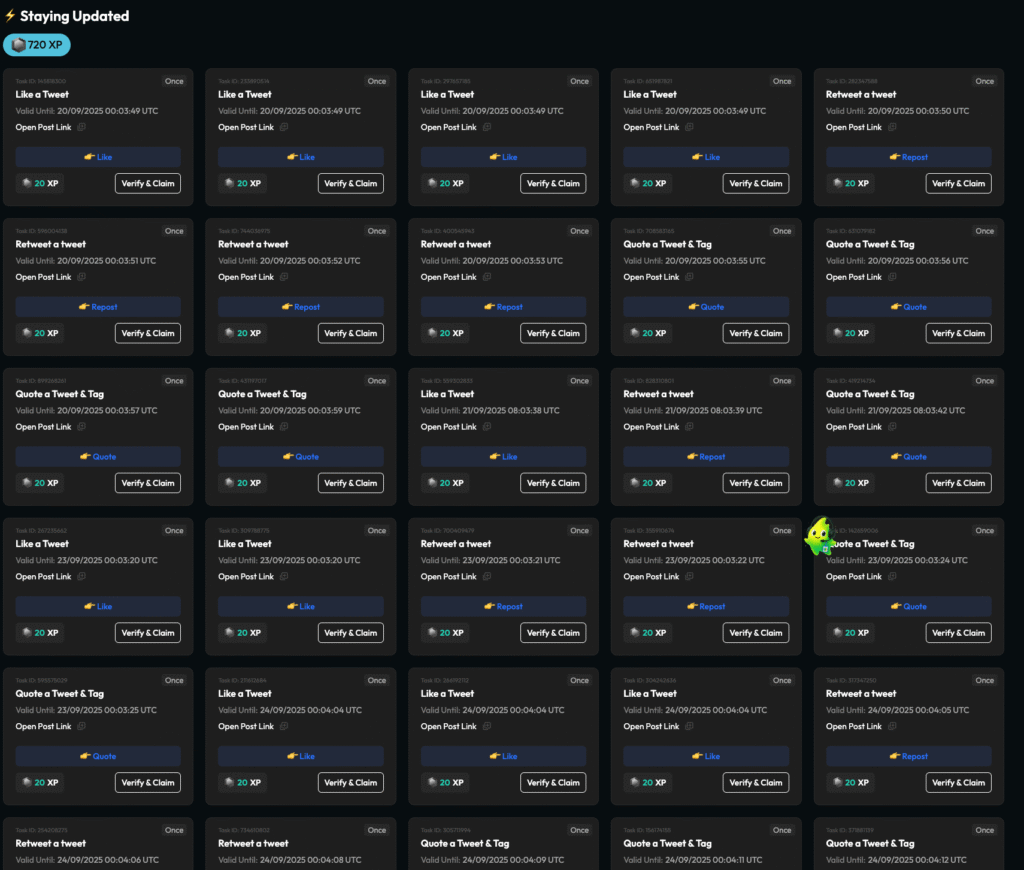
Why Did BLOCX Succeed in Driving X Engagement with TaskOn?
We analyze BLOCX’s campaign through a growth flywheel lens:
- Capture Attention
Unified hashtags($BLOCX、@BLOCX_TECH)and activity links ensured high-frequency exposure of BLOCX’s brand across Twitter timelines. Activity links redirected users back to the community to join the Leaderboard Sprint.
Centralized topic aggregation made it easier for algorithms to identify and recommend content to interested audiences. - Verification (Proof / Authenticity)
The 100-word minimum and 4-tweet requirements pushed users to share personal opinions, enhancing authenticity and diversity of content.
These “lightweight content creation” tasks sparked more discussion than simple retweets. - Value Conversion
The 200 USDT + 1000 USDT reward mechanism drove organic participation.
High-quality tweets earned the most points, and winning the Leaderboard Sprint required genuine content creation. Premium content was widely shared within the community, acting as an “amplifier.” - Attribution
Using TaskOn’s task tracking, the BLOCX team could accurately measure which users completed tasks and how much engagement and traffic they generated.
This made campaign effects quantifiable—moving beyond vague claims of “an active community.”
Methodology for Improving Engagement: Insights from BLOCX
First, projects should move beyond “follow + retweet” and enforce “lightweight content creation.” The key to engagement is “opinion sharing,” not mechanical actions. Setting originality thresholds and aligning rewards with content quality significantly improves tweet value.
Second, unified communication anchors—consistent keywords, accounts, and links—create topic clustering effects and amplify algorithmic recommendations.
Finally, incentives drive participation, but verification ensures quality. Combining incentives with validation is essential to turn engagement into real growth.
TaskOn’s templated task designs help projects quickly launch campaigns; full-chain tracking ensures verifiable engagement; and Leaderboard Sprints maximize outreach by motivating users through real-time ranking visibility.