
The derivatives market represents a sector caught in a triangular dilemma of liquidity, technology, and risk. On one hand, the rapidly growing crypto ecosystem brings vast trading prospects—by 2025, the daily trading volume of derivatives has already reached $53.89 billion—alongside a technology-driven core of innovation. On the other hand, however, the penetration of DeFi derivatives trading remains severely limited. Pool-based liquidity deficiencies, cross-chain isolation, and overreliance on incentives make the natural traffic growth of derivatives protocols inherently insufficient. At the same time, the sector is plagued by systemic risk accumulation, with liquidation cascade effects further exacerbating liquidity crises.
Awakening dormant liquidity requires more than technical or market-focused solutions. It also demands a careful balance between efficiency and security, as well as innovative operational strategies to unlock new sources of user growth. Beyond growth, raising awareness of the ecosystem itself is also a crucial aspect of public relations.
Hermetica is an innovative protocol focusing on Bitcoin-native DeFi (BTCFi). Its mission is to unlock trillions of dollars of idle capital within the Bitcoin ecosystem through the synthetic dollar USDh, transforming BTC from a passive store of value into a productive asset. At the same time, it fuels user growth with high yields, offering a 25% APY that attracts holders seeking alternatives to fiat currencies.
USDh has become the most liquid and largest-cap stablecoin on Stacks, deeply integrated into lending, derivatives, and other core DeFi scenarios. It has now evolved into the foundational liquidity layer of Bitcoin-native finance (BTCFi).
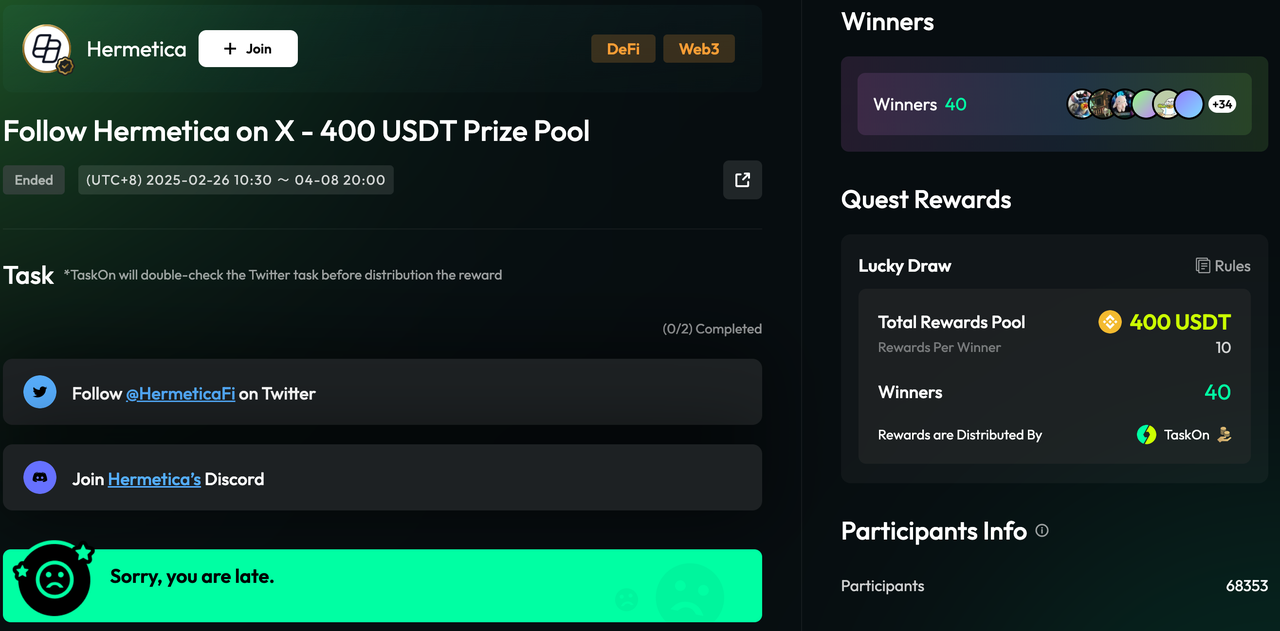
On TaskOn, Hermetica did not pursue on-chain tasks but instead focused on social media engagement and community building, such as following on X and joining its Discord. Beyond growing community reach and social following, TaskOn also served as an external PR channel for Hermetica, making the broader Bitcoin and Hermetica ecosystems more visible. By rewarding users to follow its X account and stay updated with its latest announcements, Hermetica was able to turn awareness into measurable engagement.
This approach—simple tasks paired with generous rewards—quickly resonated with users. Within a short time of joining TaskOn, Hermetica hosted only two campaigns yet attracted 130,000 participants, marking its initiatives as highly successful and achieving dual outcomes in both awareness and engagement.
Similarly, as a benchmark in the DeFi sector, Injective faces an even more urgent demand for user traffic. Injective Protocol is a high-performance Layer 1 blockchain designed specifically for DeFi, offering sub-second finality, high TPS, and zero gas fees to deliver a seamless high-frequency trading experience.
When running campaigns on TaskOn, Injective first needed to overcome ecosystem silos and reach users beyond the Cosmos network. TaskOn, as a multi-chain task platform, provided exactly the breadth of user base needed to expand Injective’s visibility.
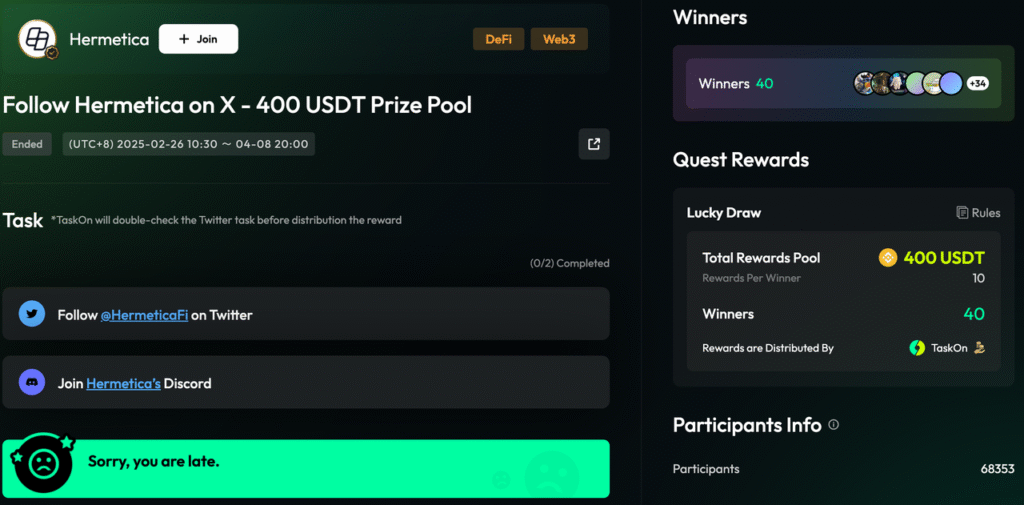
Second, as the number of active dApps on Injective remains relatively limited, its campaign design on TaskOn focused on driving traffic to Helix, the platform’s flagship DEX. This included requiring users to follow Injective’s X account and join its Discord community.
Moreover, while Injective’s high-performance advantages can only be appreciated through hands-on experience, ordinary users often face cognitive barriers with cross-chain operations. TaskOn’s quest design helped guide users through simplified onboarding steps, offering them a first-hand experience that effectively lowered entry barriers.
To sustain engagement, Injective also leveraged TaskOn’s Community feature. By requiring users to follow its Injective community on TaskOn, the project could retain users on-platform, build daily interaction loops through recurring tasks, and further gamify loyalty with TaskOn’s built-in points system—rewarding users who demonstrated greater participation and contribution to community growth.
Through well-structured tasks, a reward pool of 800 USDT, and additional exposure from Taskmas campaigns, Injective’s first campaign attracted over 180,000 participants. This delivered significant success in user acquisition, while boosting real, active engagement across social media and Discord.
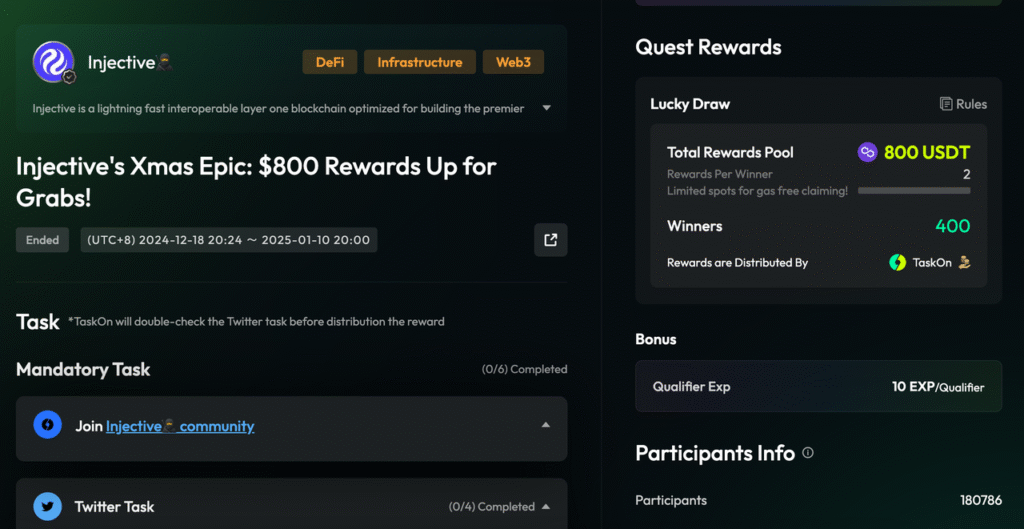
TaskOn Reconstructing the DeFi Growth Flywheel
A crucial factor enabling Hermetica and Injective to achieve significant exposure on the TaskOn platform was their participation in TaskOn-hosted celebratory events. The empowerment of dozens of projects across ecosystems broke down narrow user acquisition channels, combining incentive structures and facilitating cross-ecosystem user migration, thereby disrupting the “walled-garden effect.” Moreover, from a social media dissemination perspective, joint promotional campaigns across multiple ecosystems create psychological cues for users suggesting an “industry-wide event,” while simultaneously anchoring a sense of trust and relevance.
Within the broader DeFi landscape—beyond DEXs, lending protocols, and derivatives—there exists an entire range of supporting protocols: liquidity management, insurance, and infrastructure layers. Together, these projects underpin the prosperity of the DeFi ecosystem. Yet the deeper into the ecosystem’s middle layers, the more scarce and valuable the ability to acquire user traffic becomes.
Beyond low-cost user acquisition and advantages in community maintenance and marketing, TaskOn also serves as a stage for ecosystem collaboration, application expansion, and token promotion. Projects can jointly host campaigns, design quests that extend target user reach, and showcase their ecosystem use cases to both consumer (C-end) and business (B-end) audiences.
For example, PicWe is a decentralized, trustless, full-chain liquidity infrastructure targeting traders, developers, and AI agents. Its TaskOn campaign focused on showcasing its features, encouraging users to visit its website and experience its DeFi AI agent functionality. The campaign attracted 70,000 participants, successfully fulfilling its objectives.
The collaboration between TaskOn and PicWe demonstrates that with well-designed campaigns and precisely targeted user recommendations, DeFi adoption can be meaningfully accelerated. By prioritizing high-quality attention and strategic incentive distribution, TaskOn establishes a sustainable model for driving growth in the DeFi ecosystem.
TaskOn is evolving into the behavioral operating system for DeFi, converting technical potential into sustainable growth momentum. For DeFi projects, TaskOn has creatively realized a Web3 traffic flywheel and re-engineered growth engine.
TaskOn’s three core breakthroughs:
- Reconstruction of user acquisition costs
- Positive cycle between security and growth
- Enhanced multi-chain user stickiness
With TaskOn, the cost of user acquisition is far below industry averages. A single campaign with a reward pool of 1,000 USDT can mobilize tens of thousands—even hundreds of thousands—of users. Although some churn occurs post-campaign, the remaining user base is still significant. More importantly, the effective acquisition cost of on-chain users can be as low as just a few dollars.
Additionally, TaskOn’s quest-based onboarding improves user education, significantly reducing errors in interacting with smart contracts and thereby increasing asset safety. This creates a positive feedback loop between security and user growth.
Finally, multi-chain quest design enhances cross-chain user retention to over three times the industry average, proving the effectiveness of incentive-driven loyalty.
Looking forward, by combining the technical strengths of DeFi with the accessible, task-based entry model of TaskOn, the platform is positioned to become a new engine of the DeFi traffic flywheel. TaskOn transforms numerical growth on the front end into meaningful journeys of ecosystem co-building.