

In the Web3 world, a Community isn’t just a place for users to hang out; it is the core nexus for building decentralized ideals together—a value network that connects user action, incentives, and identity.
If a points system solves the problem of quantifying “how much a user contributed,” then the Level and Benefits system addresses a deeper psychological need: “What unique identity and ROI do I get for my grind?”
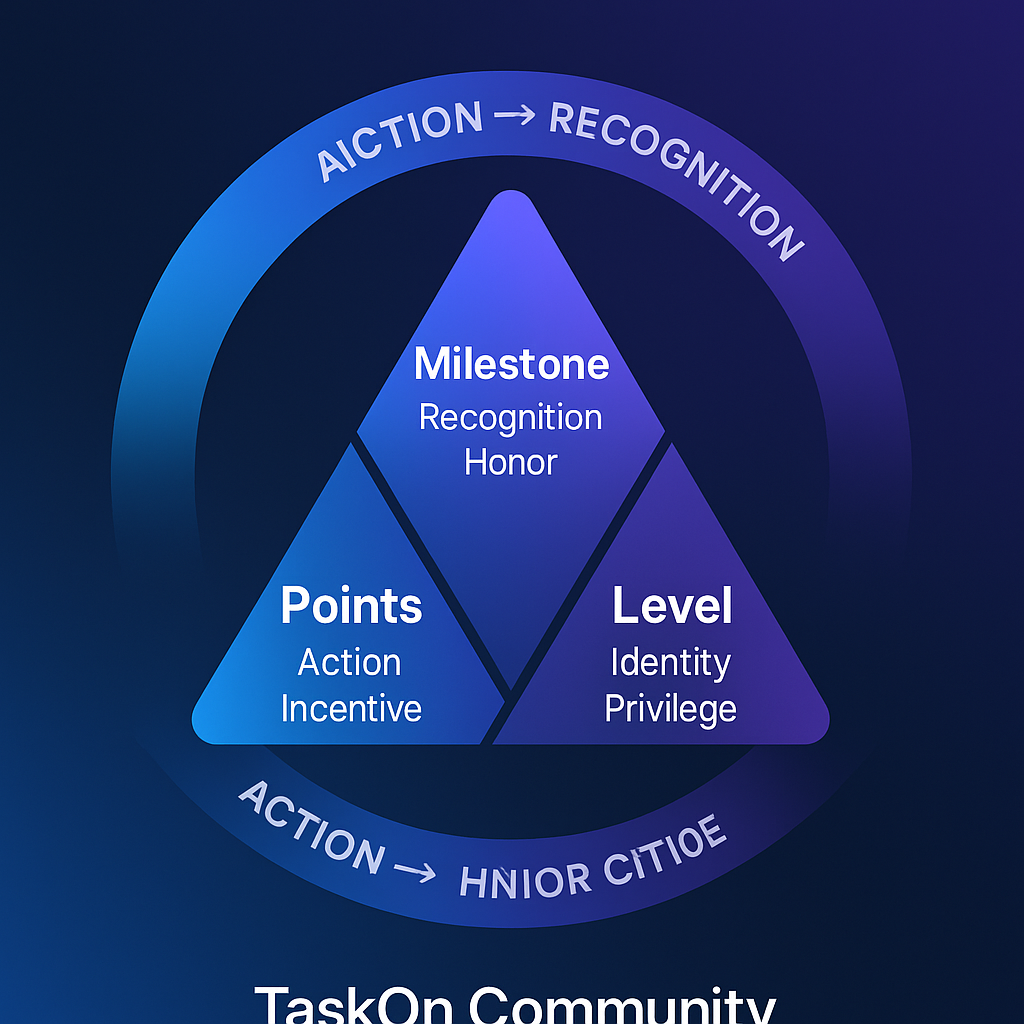
Within TaskOn’s growth model, the Points → Level → Milestone loop creates a closed circuit from behavior to value, and finally to identity. This makes user loyalty and contribution quantifiable.
- Community Level: An “identity badge” tiered by long-term contribution.
- Benefits: The keys to cashing in on that value.
Together, these three elements construct the Web3 user growth architecture. Users accumulate Points by actually using the product and completing tasks; reaching a certain Level unlocks higher-value tasks and exclusive rights; and at key Milestone stages, they receive extra honors and rewards.
This operates on a “the more you use, the more you get” incentive logic. Incentives are triggered only when users generate real interactions—such as swapping, staking, or contributing content. This forms a post-action rewards mechanism, tightly binding growth to value.
The Meaning of Long-Term Identity
Imagine a game where a fresh spawn and a battle-hardened veteran have the exact same perks, gear, and open-world access. No one would be willing to “grind” hundreds of hours for that.
The same logic applies to Web3 communities. If an “OG” with 100k points gets the exact same treatment and permissions as a “noob” who just snagged 10 points from a daily check-in, the points become meaningless. The motivation for users to contribute to the ecosystem will dry up.
To run a solid Web3 community, you need both gamified incentives and value alignment.
A sustainable growth system isn’t just about displaying an identity tag; it’s about hooking that tag into real Benefits. In TaskOn’s design, a Level is not just a badge—it is a consumable proof of rights.
When a user isn’t just a “participant” but a “Level X member” or part of a “specific tier,” and that identity comes with consumable benefits, a sense of identity and belonging begins to form.
For example:
- L2 Active User: Unlocks social tasks, enjoys a 2% transaction fee reduction.
- L3 Contributor: Gets Gas fee subsidies, priority for Airdrops, and Whitelist qualifications.
- L4 Honor Member: Enjoys cashback coupons, exclusive rates, and a “Mentor” status within the community.
- L5 Core Ambassador: Unlocks project partnership qualifications, governance voting rights, and brand co-creation opportunities.
These benefits peg the Level directly to the user’s actual interests. For instance, upgrading to L3 via on-chain transactions could trigger a Milestone that unlocks Token rewards to subsidize Gas fees. The incentive is no longer a one-off “do task, get reward” event, but a continuous loop of value feedback.
The Key to Binding Benefits
Short-term incentives often lead to high churn and low conversion. However, through a Level system, incentives are transformed into long-term identity assets that can be accumulated and consumed.
A Level identity without actual benefits is just vaporware. A truly effective ranking system must bind “Level” with “Benefits” to trigger and maintain that sense of honor. Reaching a specific Level should unlock premium tasks, higher reward ratios, exclusive Whitelist spots, etc.
Similarly, the Milestone module supports unlocking diverse rewards via Levels: Tokens, Discord Roles, Points, NFTs, and Whitelists.
Furthermore, through the Benefit Shop, you can gate specific perks behind Levels, ensuring that the users who contribute the most to the community enjoy the most utility and prestige.
Post-action incentives + Benefit consumption make the system fair and efficient: Projects reward the users, not the bots. The more frequently and authentically a user interacts, the richer their benefits become.
How to Design a Killer Community Level Mechanism
So, how do you architect a Level mechanism that clarifies goals and drives users to grind for the next tier?
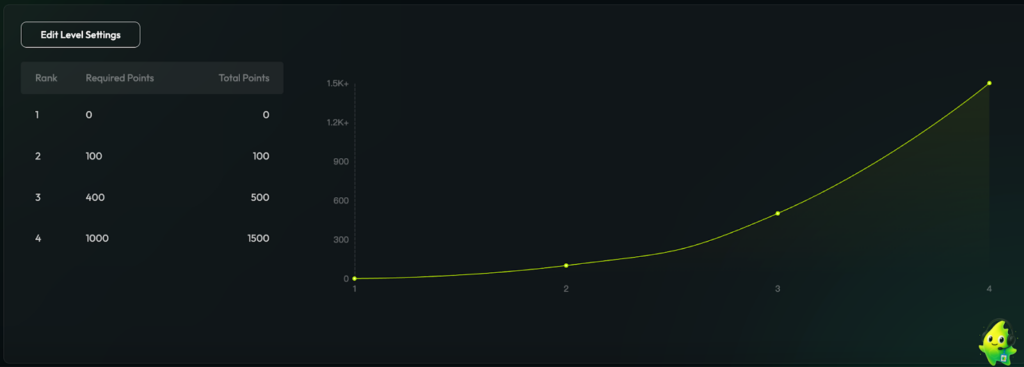
First, map out the growth trajectory. Every level needs a specific Points threshold and clearly defined benefit progression. The difficulty of these thresholds must be balanced with the rewards to build a qualified incentive system. For example, use an exponential difficulty curve for points—allow early growth to be fast to hook users, while making later stages more challenging to extend the lifecycle.
Level Upgrade Model:
- Level 1: 0 Points (New User)
- Level 2: 100 Points (Completed 10 tasks)
- Level 3: 300 Points (Completed 30 tasks or invited 10 users)
- Level 4: 700 Points (Contributed premium content/tasks)
- Level 5: 1500 Points (Community Ambassador, sustained activity + contribution)
Simultaneously, build a diversified task structure. Early stages can rely on check-ins and follows for quick leveling; the mid-game should require social interaction to leave a footprint; the endgame should demand creative contributions—content production, on-chain operations—to realize the incentive curve.
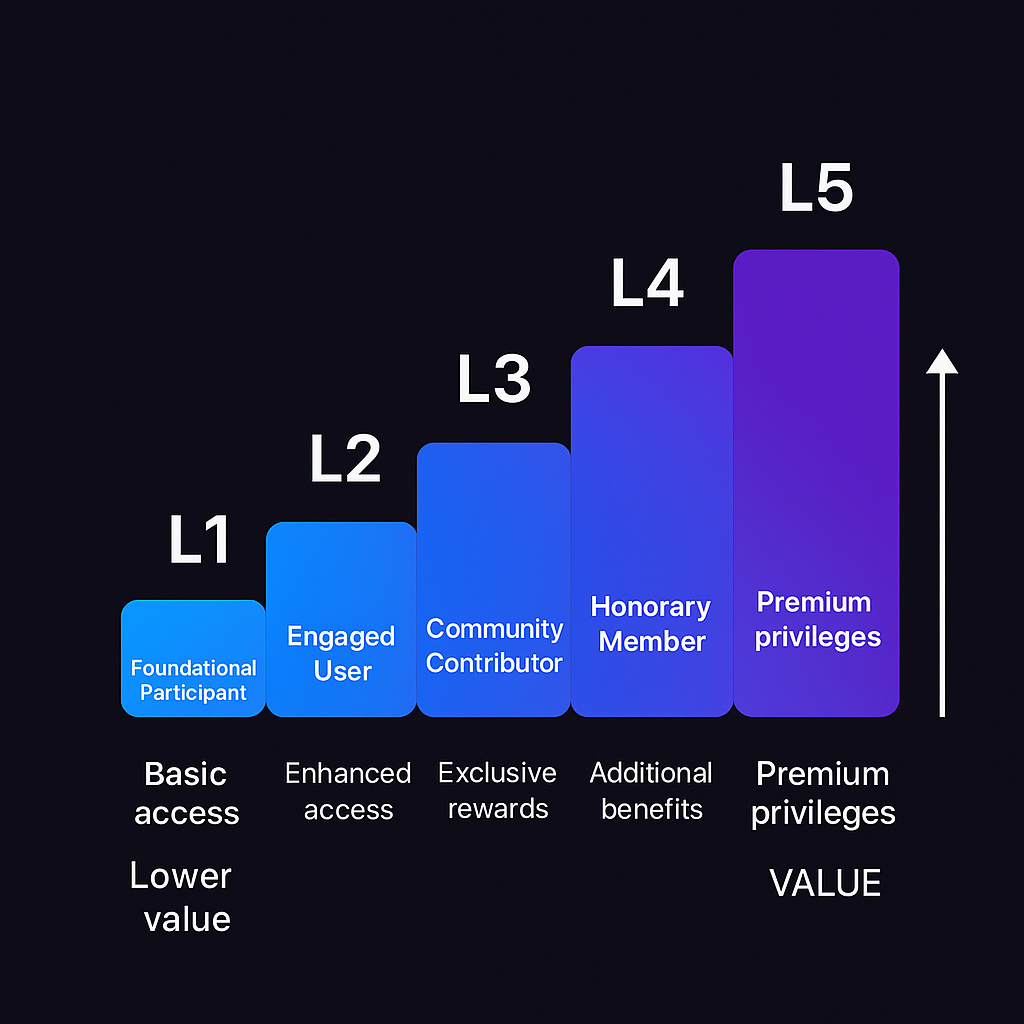
Typical Benefits Matrix for Levels:
- L1 Basic Participant: Access to basic tasks, earn basic rewards.
- L2 Active User: Unlocks active tasks + earns Community Badge / Discord Role.
- L3 Contributor: Exclusive tasks, priority Airdrops, Whitelist eligibility, Gas fee subsidies.
- L4 Honor Member: X% transaction fee reduction, exclusive community channels, distinct Discord roles, cashback coupons.
- L5 Core Ambassador: Ambassador status, community governance voting rights.
Users accumulate Points from standard tasks to rank up in Level, thereby unlocking higher Benefits (e.g., exclusive tasks, Whitelists, lower fees, Discord privileges).
Leverage the Milestone mechanism to grant extra achievements and public recognition when key Levels are reached (e.g., “Became the 100th Level 5 Member”) to boost the sense of honor.
Finally, amplify the prestige of high-tier members. Treat high-level users as loyal fans or KOLs. Give them priority invites to future events, airdrop rewards, and governance mechanisms. Invite them to represent the project, participate in governance, or onboard newbies as “Community Ambassadors.” This builds an “Identity as Asset” system, maximizing user stickiness and long-term value.
Conclusion
In the evolving landscape of Web3 community operations, the simple “Task + Reward” model is being rendered obsolete by the “Task + Growth + Identity + Benefits” model. The Points → Level → Milestone triangle architecture provided by TaskOn offers a solid foundation for projects to build this user growth system. By binding Levels to consumable benefits and designing post-action incentives, projects can convert short-term hype into long-term loyalty, ensuring every real interaction becomes a credential of user growth, while boosting stickiness, participation, and a sense of belonging.