

Over the past two years, the Web3 world has been flooded with marketing tools: airdrop platforms, quest platforms, incentive protocols, Discord bots… the list goes on.
Yet, almost every project founder is asking the same question: How do we actually execute a complete, closed-loop growth cycle? More importantly, how do we build a feasible growth flywheel that validates user pain points, product features, and business operations with minimal functionality and refined input?
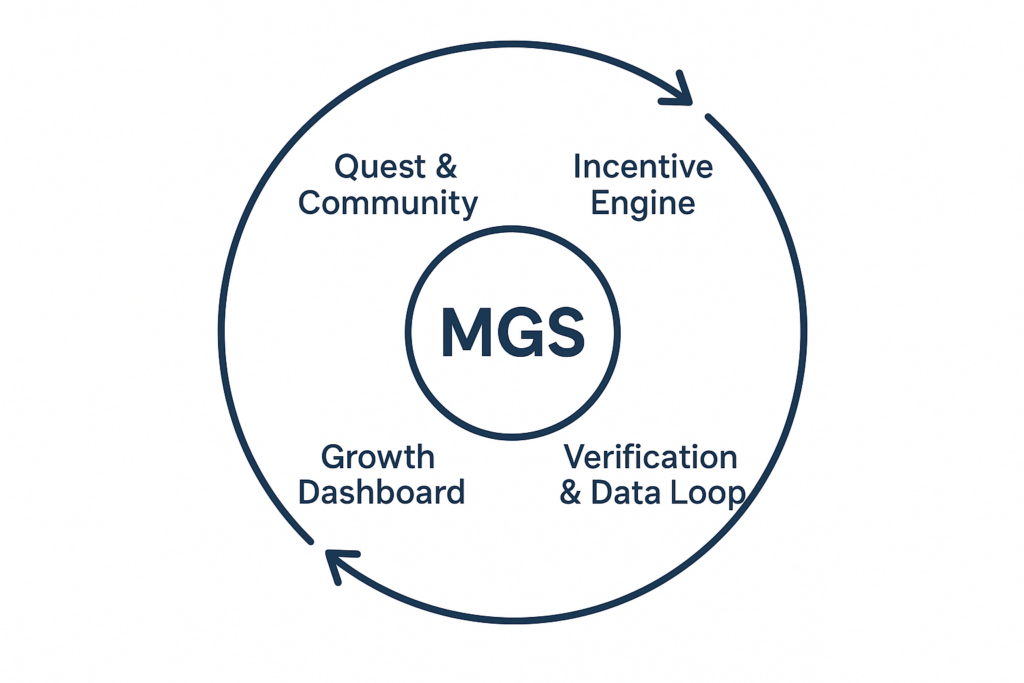
As a Web3 growth management platform, TaskOn offers a simple answer: The Minimum Growth Stack (MGS), composed of Quest & Community, Incentive Engine, Verification & Data Loop, and Growth Dashboard.
I. From Growth Chaos to Growth Self-Consistency
“If Web2 growth relies on ‘buying traffic,’ then Web3 growth relies on ‘co-building’.” — This is how Donald, Co-founder of TaskOn, once defined the key factor of Web3 growth in a Twitter Space.
The Web2 marketing stack has long been established: CRM + Ads + Data Analytics. However, in Web3, this logic fails almost entirely. Wallet addresses replace phone numbers, communities replace channels, and incentives replace ad budgets.
Many Web3 projects fall into the “Tool Stacking” trap: using a Discord Bot for community tasks, Zealy for distributing incentives, Notion for tracking progress, and Google Sheets for data…
The result? Fragmented data, difficult verification, and a fractured user experience. In the supposedly open network of Web3, there seems to be a missing bridge for direct communication between projects and users.
TaskOn’s MGS model is simple: “Make growth as easy as building blocks: four are enough.”
Given the complexity of the Web3 ecosystem, user attention is extremely fragmented. Expecting different ecosystems to use the same growth model is incredibly difficult. To achieve the best results, one must cut straight to the essence of growth.
| Dimension | Traditional MKT Stack (Web2) | TaskOn MGS (Web3) |
| User Acquisition | Ads, Channel Placement | Tasks + Incentivized Propagation |
| Data Tracking | Cookie / CRM | Wallet Address / On-chain Behavior |
| Incentive Form | Discounts, Cashback | Token / NFT / XP |
| Anti-Cheating | Account / IP Based | Wallet Signature / Anti-bot |
| Analytics | Google Analytics | TaskOn Dashboard |
| Cost Structure | Ad Consumption Model | Incentive Circulation Model (Budget $\to$ Data $\to$ Value) |
II. TaskOn’s MGS Model
In the TaskOn ecosystem, you can understand the MGS framework as follows:
- Quest & Community: The core of user activation and retention.
- Incentive Engine: Precise reward mechanisms driving high-quality participation.
- Verification & Data Loop: Automated, trusted, and scalable.
- Growth Dashboard: Data-driven growth optimization.
By reaching users through Quests, driving user behavior via the Incentive Engine, achieving sustainable flywheel development through the Verification & Data Loop, and finally optimizing the path via the Growth Dashboard, TaskOn realizes a complete MGS for user growth.
Quest & Community: Let Users “Play to Complete Tasks”
In TaskOn’s design logic, a Quest is not just a task, but a “Behavior-Driven System.”
It integrates acquisition, activation, retention, and conversion into a single link: Users register or connect their wallets, filter and participate in Quests on the platform; complete Quests (e.g., staking, following, interacting, inviting) to receive rewards (Tokens, NFTs, Points, etc.), with the system providing instant feedback rewards for user behaviors.
The footprints users leave on the platform accumulate growth through the Community Points / XP / Level System, eventually unlocking more diverse rewards and on-chain footprint growth within the community’s incentive system and TaskOn’s long-term growth plan.
“It’s like the Web3 version of a gamified CRM,” described a wallet product lead using TaskOn.
Compared to Zealy or Galxe, TaskOn’s Quest system emphasizes an “On-chain + Community” integration: tasks can bind not only Twitter and Discord behaviors but also directly verify on-chain interactions; campaigns can funnel traffic directly into the project’s community system, achieving a fusion where “Task is Community.”
Incentive Engine: Precision Rewards Driving Real Participation
The Web3 world cannot exist without incentives, but “distributing money” does not equal “growth.”
TaskOn’s Incentive Engine provides a customizable, tiered reward mechanism: it supports various types like Tokens, NFTs, XP, and Points; creates complex logic such as Quest regional limits, user restrictions, and Task condition unlocking; and allows rewards to adjust dynamically based on task difficulty, user activity, or community status.
For example, if a project wants to acquire on-chain data on TaskOn, using an OnChain Task will yield excellent positive feedback. Alternatively, if they choose to participate in a Trading Race campaign, the configuration of the TaskOn Incentive Engine can significantly boost precise on-chain volume and user numbers.
The core logic of this mechanism is: Transform incentive budgets into data assets. Every distribution and every claim becomes a trackable, recyclable growth behavior.
Simultaneously, due to the precise targeting, gamification, and competitive nature of the incentives, it is easier to achieve—and exceed—target completion rates.
Verification & Data Loop: From “Anti-Sybil” to “Trusted Growth”
In Web3, data must first become trusted before growth has any meaning.
Another major pain point in Web3 marketing is “Data Distortion.” Many campaigns look bustling but are filled with bot addresses and fake interactions.
TaskOn uses technical means to build a verifiable growth closed-loop:
- On-chain Verification: Confirms completion via smart contracts or block scanning.
- API Authentication: Supports data integration from multi-platforms like Twitter, Discord, and Telegram.
- Anti-bot System: Identifies fake tasks through abnormal behavior detection and multi-layer protection.
- Attribution System: Tracks user sources, channels, and task paths.
These features collectively construct a trusted data environment, allowing operation teams to truly know: “Which users are real.”
Growth Dashboard: From Behavior to Decision
Data isn’t just for viewing; it’s for verification and optimization. TaskOn’s Dashboard supports real-time visualization and multi-dimensional analysis: task completion rates, user retention rates, channel effectiveness, conversion costs, and more.
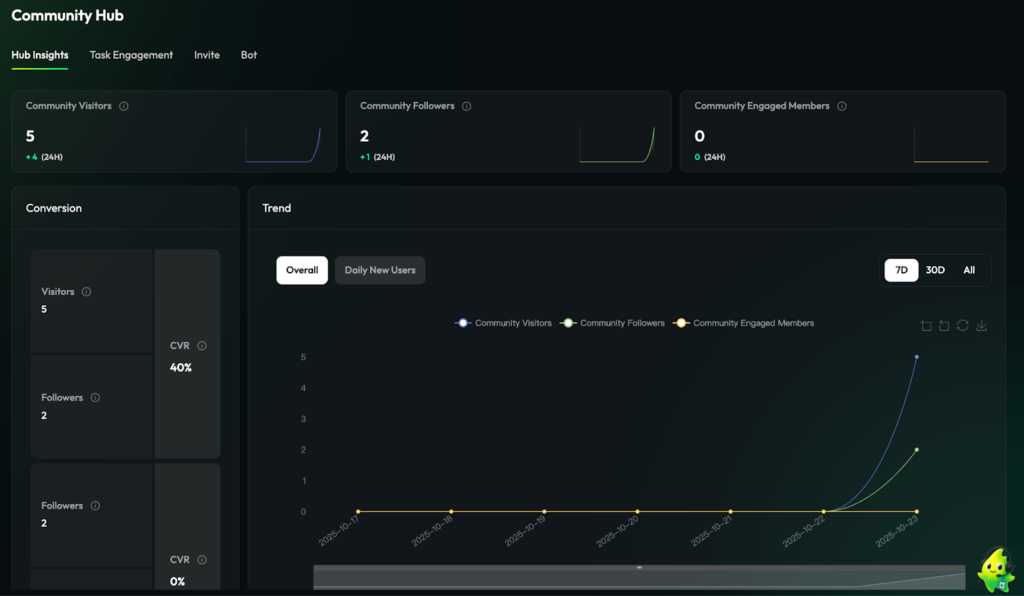
User data is tiered according to needs, allowing users to export as CSV or automatically sync to external analysis tools.
Operations teams can complete the full closed-loop of Campaign Execution $\to$ Effect Review $\to$ Strategy Optimization within a single interface. This means TaskOn is no longer just a “Task Platform,” but has become a Web3 Growth Analysis Terminal.
III. Running the Full Lifecycle with MGS
From the cold start to the maturity phase, a project’s growth path on TaskOn typically looks like this:
- Cold Start Phase: Use Quests to acquire the first batch of seed users.
- Growth Phase: Expand reach through the Incentive Engine and community tasks.
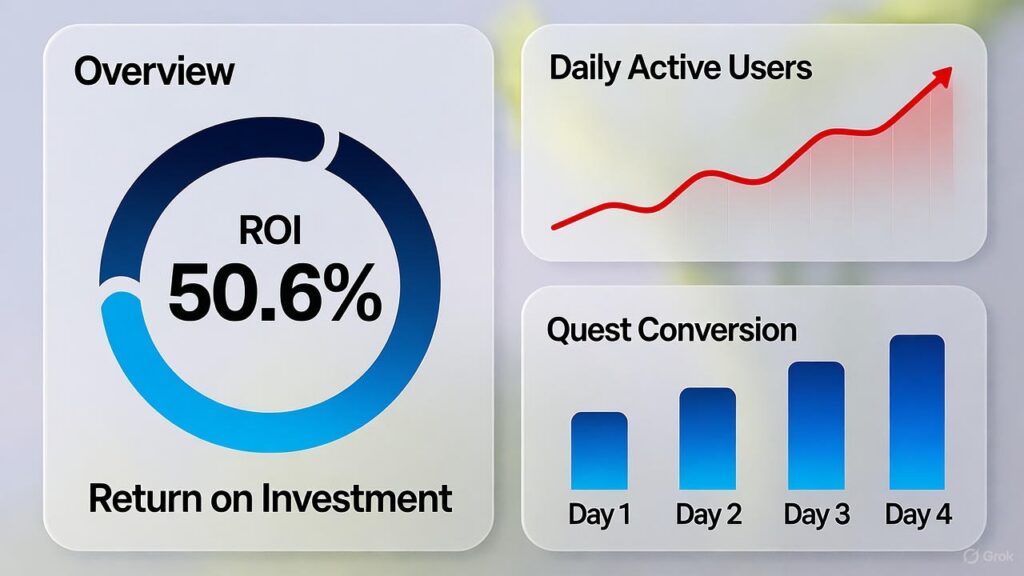
- Maturity Phase: Use the Data Dashboard to track ROI and identify high-value groups.
- Re-growth Phase: Adjust incentives and task designs through Anti-bot mechanisms and data analysis.
This process requires almost no external tool support. The MGS acts like a four-wheel-drive system, allowing growth to rely not on “manual operation,” but on “system rotation.”
Conclusion
TaskOn’s MGS isn’t about doing less; it’s about making sure everything done is verifiable, trackable, and reusable. In a Web3 era that craves real users, real interactions, and real value, these four tools might truly be the only growth stack you need.
Through this Minimum Viable Growth Stack, you can rapidly build your own user growth flywheel.