

In the growth world of Web3, Tasks and Incentives are never in short supply. What’s scarce is the ability to structure them into a self-driving engine—one that can truly sink its roots into the community’s value system.
Especially during the “cold start” phase, many projects in the past opted for the most brutish, simplistic method: massive airdrops to incentivize users. The result of this carnival-style hype is almost always a carnival-style dump.
A project’s launch should be a bilateral growth curve of effort and reward. TaskOn’s Task-Incentive Engine is exactly the ignition point for this efficiency. By combining Community Tasks, Automated Verification & Distribution, and Points & Benefits, it constructs a growth path of “Behavior → Value → Re-engagement.”
Not “Farming,” But an LTV Compounding Device
The problem with traditional incentives is that they are too “instant”—the moment a user receives the reward, their relationship with the project effectively ends.
TaskOn flips this logic: Users must use the product and take action before the incentive is triggered. The Task-Incentive Engine ties short-term motivation to long-term identity:
- Users complete On-chain or Social Media tasks and receive immediate, visible rewards (Direct Airdrops, Raffles, Whitelists, NFTs).
- Simultaneously, they accumulate Points, climbing levels and leaderboards.
- These Points can then be redeemed in the “Benefit Zone” for the high-value “Next Station” (higher quota campaigns, exclusive status, offline perks, etc.).
Completion → Points → Benefits → Re-engagement. This loop transforms incentives from a one-time subsidy into a compounding device for LTV (Lifetime Value). Rewards only hit the wallet when a user completes an on-chain task, submits content, or executes a trade. As their level rises and contributions settle, they can claim exclusive Gas subsidies, transaction fee reductions, coupons, or Whitelist spots in the Benefit Shop, or unlock exclusive status perks and Token subsidies via Milestones.
The Task System: A Comprehensive Model
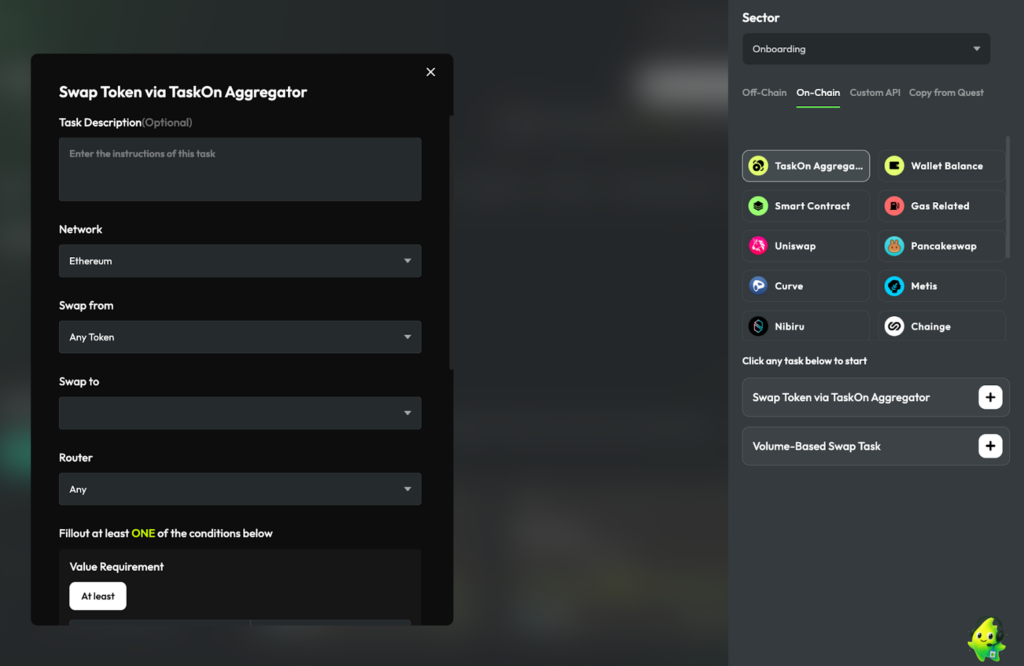
TaskOn’s task templates are clearly divided into OffChain, OnChain, Custom API, Proof of Humanity (POH), and Copy From Community, with OffChain and OnChain forming the absolute backbone.
- OffChain covers the vast majority of social media and educational actions required for daily growth: X/Twitter (Follow, RT, Tweet/Quote), Discord (Join/Invite), Telegram (Join, Mini App), YouTube, Facebook, Instagram, Reddit, Website Visits, Q&A/Quizzes/AMAs, and PoW content submissions.
- OnChain comes built-in with “Holdings/Min Balance, Swap, Add/Remove LP, Lending, Staking, Transaction Count/Gas Spent, Contract Interaction,” and provides ready-made templates for common protocols and ecosystems (Uniswap, Pancake, Curve, Aave, Compound, Raydium, Aerodrome, etc.).
- Custom API (API-Verified Task) is the third pillar: You can sync proprietary metrics like trading competitions, transaction volume, retention, or feature usage into TaskOn, verified via social account/email/ID mapping. This brings “off-chain but mission-critical” business metrics into the points and ranking system—perfect for trading competitions and driving product activity.
POH (Proof of Humanity) & Identity Credentials utilize Centralized Exchange (CEX) KYC, BABT, zkMe Citizenship, and other common credentials to set thresholds or weightings. When combined with Eligibility settings, this effectively crushes Sybil density.
From a publishing and execution standpoint, tasks prioritize real-time/automated verification with PoW manual checks as a fallback. It supports instant on-chain validation and API validation, and even allows for “Task Testing” on the same page. This ensures the workflow is “Shippable, Verifiable, and Reviewable.”
From OffChain to OnChain, TaskOn’s Task system covers the full ecological dimension of a project, meeting any Task demand and serving as a truly universal engine.
The Skeleton of the Engine: Systematizing the Incentive Structure
Do tasks, get points, build a benefits system around consuming those points. TaskOn turns benefits into a “Benefit Shop” and “Lucky Wheel,” where community points can be redeemed or burned for a chance to win, giving rewards a “visible next destination.”
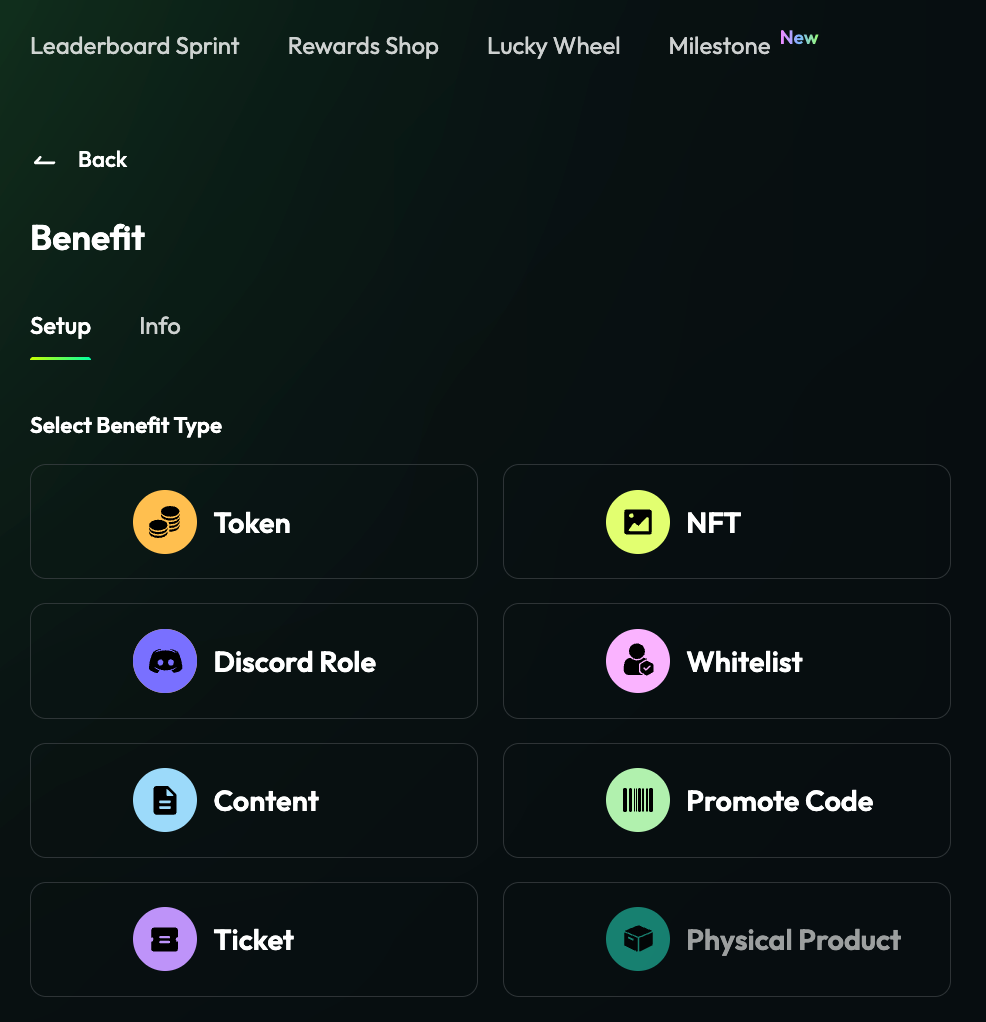
Currently, the official list of benefit types includes Tokens, NFTs, Whitelists, Discord Roles, Content, Promo Codes, Tickets, etc. It supports custom exchange rates, time limits, and thresholds based on leaderboard rankings. This means you can gate the most scarce benefits solely for high-quality participants.
For fixed-level rewards, the flywheel of Points, Levels, and Rewards can be linked to accurately incentivize user contribution. Community tasks can measure contribution value via points, offering Gas subsidies, fee reductions, or Whitelist spots only to those levels achieved through high contribution—a true cyclic compounding engine where the more you use, the more you get.
- The “Lucky Wheel” converts points into high-frequency lucky perks, boosting return rates and the marginal utility of points.
- Leaderboards publicly display “Task Completions, Points, Invites,” while the creator side has “Incentivized Leaderboards” driven by points to release Tokens based on rank—often used by trading/activity-heavy projects for monthly settlements.
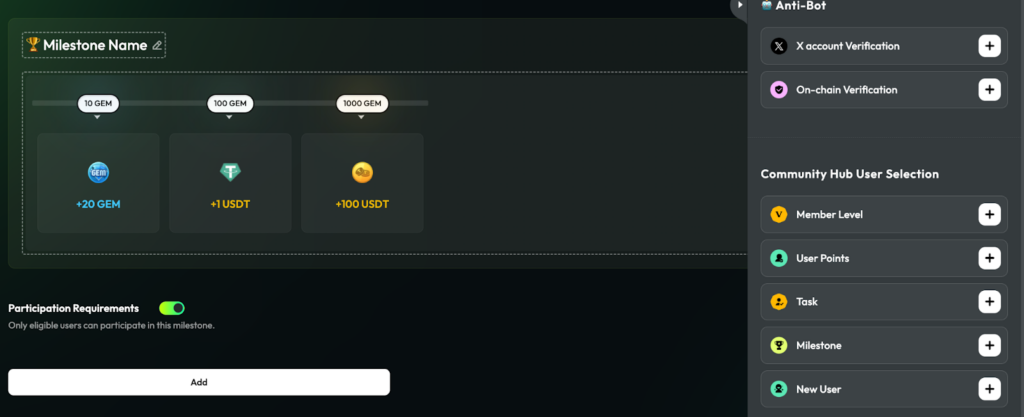
- Milestones complete the loop of “Phased Goals—Direct Claiming”: supporting thresholds based on points or levels, with rewards selectable from Token/Role/Points. This is perfect for breaking down long-term tasks into executable small steps, rewarding long-term user contribution—the more interaction, the greater the reward.
Task incentives allow you to use future, non-cash equity (like Whitelists, rights to claim future tokens, commemorative NFTs) as early-stage rewards. You leverage a “promise” to pry open users’ current “attention” and “social graph.” This is the most highly leveraged, cost-effective growth mode available. Compared to marketing campaigns with six-figure budgets, the cost of a well-designed incentive campaign is negligible.
At the same time, binding critical on-chain behaviors (Swap/LP/Staking/Voting/Holding) to high-value benefits ensures true on-chain users are rewarded heavily, placing these rewards at the back end of the Benefit Shop and Milestones. Users must do “real work” to get the “real goods.” Using leaderboard percentiles as redemption/claim thresholds (e.g., only the top 5% can redeem tickets or WLs) naturally tilts resources toward power users.
Automation and Trust: Distribution is No Longer the Weak Link
On-chain growth campaigns often fail at the uncertainty of the “distribution phase.” The Task-Incentive Engine patches this link with two layers:
On the user side, they see a “Deposited” tag. Creators can pre-deposit/stake rewards into TaskOn, which the system automatically distributes after the campaign ends. The distribution method supports “TaskOn Automatic” or “Project Manual,” clearly noted on the campaign page. For participants, this boosts predictability; for projects, automation reduces manpower and disputes.
Furthermore, the automated reward program ensures instant arrival upon meeting conditions. Even for PoW tasks that cannot be fully automated, manual spot checks serve as a backstop, improving efficiency and lowering trust friction.
Conclusion
The Task-Incentive Engine combines the Task system and the Incentive structure into a reusable growth machine. It turns a one-time budget into a compounding relationship. By stabilizing the psychology of “Did real work → Got real benefits → Willing to come back,” the value of the task and the value of the incentive amplify each other.
That is the economics of positive feedback.