

In the Web3 world, sparking user “participation” follows a fairly standard playbook. However, converting those initial incentives into long-term eligibility rights—and ultimately achieving user retention—is a tough nut to crack. This creates the infamous “Airdrop Effect”: users swarm in when the incentives drop and vanish the moment the rewards stop.
The growth platform TaskOn offers a concise, retainable, and reusable incentive system. By leveraging Community features like Level, Milestone, and Benefit Shop, alongside reward modules like Whitelist/NFT/Token, it builds a framework that actually sticks.
1) Mapping Incentives to TaskOn Implementation
On the TaskOn platform, the typical retention path looks like this: Users are hooked via a Quest, leading them to discover the rich project ecosystem within the community. Through completing tasks, they earn points and level up, creating a strong bond with the community. Meanwhile, point redemption in the Benefit Shop and Milestone rewards establish a positive feedback loop.
This incentive system deeply integrates Material Incentives, Identity Incentives, and Emotional Incentives, finally mapping them directly onto the TaskOn platform.
Material Incentives TaskOn natively supports various reward forms: Token, NFT, and Whitelist. Project owners can distribute these instantly or via a raffle system.
- Specs: Supports reward distribution and validation across 56 networks, covering a massive range of scenarios.
Identity Incentives
- Level/EXP: Users accumulate Points/EXP through tasks to level up. Higher levels unlock more opportunities and potential yield.
- Discord Roles/Channels: Configured as rewards in the Benefit Shop, creating a “Identity as a Right” dynamic.
Emotional Incentives
- Milestone Instant Claim: Once a stage goal is met, rewards are claimable immediately. No “waiting for the list”—it makes “effort visible.”
- Leaderboard: Visualizes the goals achieved through grinding levels and points. It can even serve as the incentive standard for a Sprint, becoming a visualized badge of honor.
- POX Score: A visualized personal identity tag and an on-chain hall of fame.
2) Composite Incentives: Turning “One-offs” into Long-term Commitments
When users grab a reward on a task platform, it’s generally hard to keep their attention focused there for the long haul. TaskOn’s design philosophy is to engineer a way to turn one-time rewards into composite incentives. The key modules involved here are: Benefit Shop × Level × Milestone.
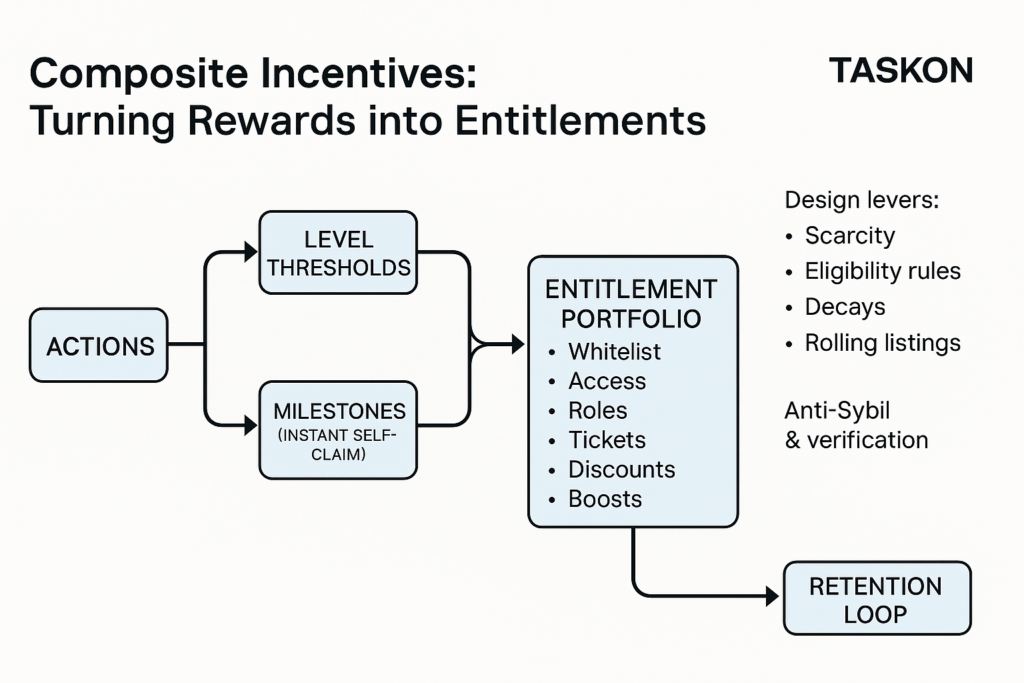
- Benefit Shop: Supports redemptions for Tokens, NFTs, Whitelists, Discord Roles, Tickets, Promo Codes, etc. By constantly rolling out new “rights/eligibility,” it manufactures reasons for users to return.
- Level/EXP: Strongly binds higher-value eligibility/spots to higher levels, encouraging sustained commitment.
- Milestone: Configurable by Point/Level thresholds. Achieved targets allow for self-service claiming, forming a “short-cycle positive feedback loop.”
On the TaskOn platform, incentive rewards can become a kickback for community contribution or a basis for privileges like access rights. Project owners can set Task thresholds based on Level, allowing users with higher contribution values to enjoy exclusive treatment.
3) Stage Matching: The Right Incentives for the Right People
Beyond a circular incentive system, we need a comprehensive methodology to take a community from zero to one—from cold start acquisition to habit formation, creating sustained return visits, and finally forging a loyal user base.
- Cold Start / Acquisition (Week 1–2): Low barrier tasks + small instant rewards; First Milestone binds basic WL/Channel access, claimable upon completion.
- Activation / Habit Formation (Week 2–3): Set a clear Level ladder with “How much more to upgrade” prompts; guide users to the Benefit Shop for point redemption to claim level-specific exclusive rewards.
- Retention / Value Deepening (Week 3–4): Increase the weight of high-value rights in the Shop (Premium WL/Roles/Tickets), open only to qualifying Levels or historical Milestones. Implement advanced rewards like transaction fee waivers or rebates and gas subsidies. This realizes a path of post-interaction incentives, boosting the sense of honor in retention.
- Propagation / Virality (Full Cycle): Combine Invite/Share with eligibility thresholds (e.g., must reach a certain Level to invite), preventing “hit-and-run farming.” Bind interactions with consumption-based rights, ensuring post-incentives run through the entire cycle.
| User Stage | Business Goal | Primary Incentive | Rights Design | Typical Task/Action | Validation & Risk Control | Key Metrics | Notes & Tips |
| Acquisition (Week 1–2) | Lower barriers, complete first effective action | Small Token/Points, Entry-level NFT, Raffle | Basic WL/Channel Access, Newbie Exclusive Tickets | First On-chain Interaction, Follow + Bind, Join Discord | Bot check, X/Discord Account Age, Basic On-chain History | First completion rate, Reg → First Action conversion, CAC | After first interaction, unlock “Newbie Milestone” to gamify the onboarding experience. |
| Activation (Week 2–3) | Form usage rhythm & multi-scenario touchpoints | Consecutive Check-ins, Staged Points, Task Group Rewards | Level 1–2 unlocks more rights, exclusive roles, and point rewards | 3–7 Day Consecutive Activity, Complete TaskChain | Unlock TaskChain, DayChain | 7/14 Day Retention, Task Completion Depth | Make progress bars visible; upgrade DayChain rewards progressively to cultivate stickiness; use instant self-claims to reduce waiting. |
| Growth (Week 3–4) | Expand contribution & cross-usage | Combo Task Bonuses, Limited-time Boosts | Mid-tier WL/Roles, Priority for Testnet/Minting | Staking/Governance/Cross-chain, UGC Co-creation | Balance/NFT Holding conditions, Governance Signatures | Target Action Completion Rate, DAU → WAU Lift | Put WL/Roles/Rebates in Benefit Shop, strongly bound to Level to create “Delayed Gratification.” |
| Retention (Week 4–5) | Stable returns, Value deepening | Seasonal Point Rebates, Composite Milestones | Premium Rights: Exclusive Identity, Voting Rights, Ecosystem Perks, Exclusive Channels/Tickets | Repurchase/Re-interaction, Long-term Tasks (Hold for N Days) | Historical Behavior Weighting, Blacklist/Risk List | Monthly Retention, Visit Frequency, Rights Redemption Rate | Keep the Shop fresh so “Window Shopping” becomes a habit; Set high Point/Level incentives in Milestone to unlock during this period; Pin Level privileges to attract upgrades. |
| Contributor / Propagation | Amplify reputation & diffusion | Incentive Schemes | Invite Rebates, Contribution Recognition, Rights Binding | Valid Invites, Complete Pinned Tasks | Invite Cooldown, Validity Thresholds | Valid Invite Rate, Contribution Task Volume | Open invite permissions only to those who reach a specific Level or historical contribution standard. |
4) Incentives & Retention: Making it “Worth Coming Back Every Week”
Ultimately, the key to user retention lies in the product structure’s ability to incentivize continuous visits. How does TaskOn turn a tool into a platform users keep returning to?
- Visible Upgrade Path: The Level/EXP page displays current values and requirements for the next level, reducing uncertainty.
- Instant Milestone Realization: Self-service claiming upon achievement reduces the anxiety of “waiting for the draw.” The rights enjoyed at each level are always visible, creating a mental anchor for the user.
- Shop Always Fresh: The Shop rotates inventory (Tokens/NFTs/WL/Roles/Tickets/Codes), creating a motive for sustained visits. Differentiating rewards by tier and setting hard anchors in the task chain (e.g., “must complete X to upgrade”) makes the effort-to-reward ratio crystal clear.
- Short-Rhythm Positive Feedback: Weekly/Monthly Milestone + clear thresholds (Points/Level) = Claim on achievement. This avoids the long wait associated with “Grand Prizes.”
- Advanced Task Gating: Use conditions like Level / Past Completion / Proof of Holding (supports specific NFT, balance, level, region checks) for high-tier tasks. This makes qualification and tiered rewards transparent. Token/NFT rewards stop being just “targets” and become linked to consumption-based rights. The more the user does, the more they get—a post-interaction incentive that drives a positive loop.
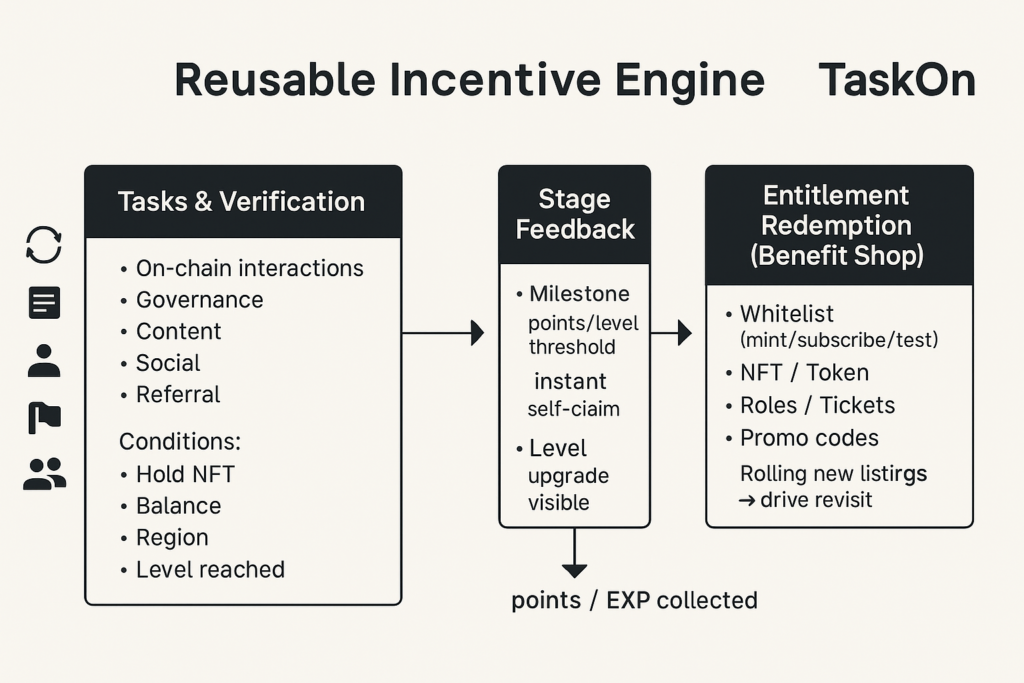
Figure: The Reusable Incentive Engine (Visualization of the feedback loop: Action -> Reward -> Right -> Retention)
Conclusion
At TaskOn, we re-engineer “Retention” into “Rights/Benefits,” then cash them out cyclically using Level × Milestone × Benefit Shop. Incentives handle the cold start; Rights handle the retention. We have built a comprehensive incentive retention system. And this system is ultimately the key to unlocking your project’s growth flywheel in Web3.