

In the context of on-chain growth, the cycle of “one-off airdrop → short-term acquisition spike → rapid churn” has become a classic growth trap, draining the budgets of countless teams. The real question is: How do we achieve sustainable incentives? The key lies in shifting rewards from “one-time subsidies” to an “equity system bound to real interactions, which is reusable and accumulative.”
The growth platform TaskOn offers a GTC configuration template centered around incentives, acquisition, and retention. It serves as a powerful tool for project teams to build a genuine growth flywheel.
01 | Why “Short-Term Incentives” Lead to User Churn
The fundamental issue with short-term incentives is a flaw in the setup. When you reward users merely for “showing up,” there is no retention value once that action is complete. Conversely, if your incentive system focuses on rewarding “value interaction” and ensures fairness through mechanisms that are “performance-based (more use, more rewards), post-settled, and compounding,” the outcome changes.
While the absolute number of users might see a slight dip compared to vanity metrics, you are essentially rewarding user value. This makes user value persistent and significantly boosts retention rates.
| Traditional Approach | Direct Consequence | Mechanism Flaw | Sustainable Alternative |
| Pure acquisition airdrops, social media tasks | Users churn immediately after task completion. | Weak interaction with the product; contribution cannot be verified. | Use TaskOn Quest/TaskChain to bridge shallow → deep actions in one go, with Post-Settlement. |
| Uniform rewards, no quality distinction | Diluted by airdrop hunters/farmers. | No weighting for “Contribution Strength.” | Distribute based on Automated Verification + Quality Score (e.g., on-chain volume, holding duration). |
| One-off deals | High cost of re-acquisition. | No accumulation of Points/Levels. | Use the retention loop of Points → Level → Milestone → Benefit Shop. |
02 | Three-Layer Structure: Instant Incentive + Continuous Growth + Long-Term Benefits
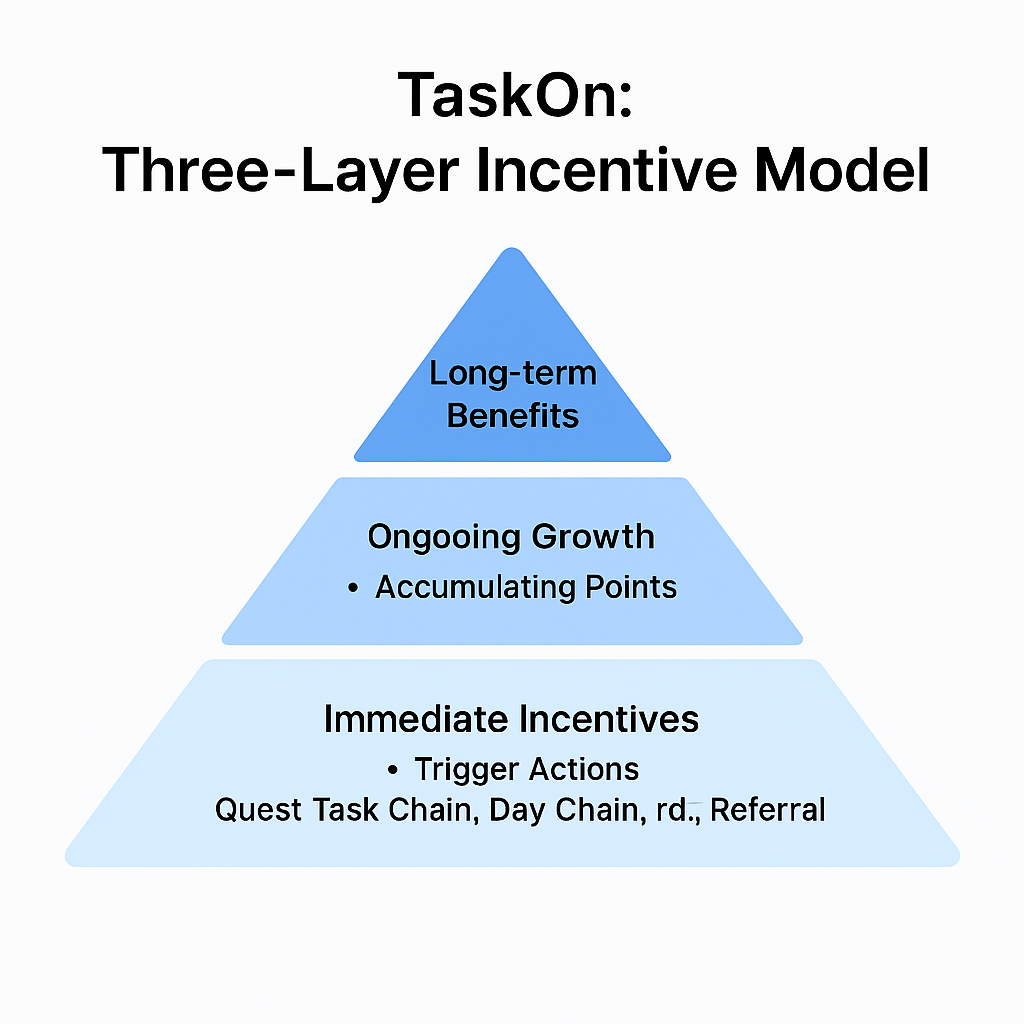
To build a comprehensive and effective user growth flywheel, the focus must be on constructing a solid incentive and feedback path. Users need to see a complete trajectory: Contribution — Incentive — Growth — Long-term Equity. This ensures user contributions are fully recorded.
- Instant Incentive: First, make contributions quantifiable. On the TaskOn platform, every action receives feedback. From a tooling perspective, completing real interactions via Quest, TaskChain, DayChain, or Referral triggers real-time feedback that links explicitly to the points system in the next layer.
- Continuous Growth: Through the link of Points, Levels, and Milestones, you can build a continuous growth curve for users. Especially with community tools like DayChain (which can be set for daily unlocks) or Points + Level weighted tasks, you can lock in engagement. Quarterly milestones can grant extra benefits to high-level users.
- Long-Term Equity: Tools like Level, Milestone, Benefit Shop, and Leaderboard allow long-term user growth to be quantified. Different stages of growth are matched with different specifications of incentives.
03 | Three-System Synergy: Task-Incentive (Trigger) → Points (Accumulation) → Level (Retention)
If Tasks in the community are the frontend tentacles reaching users, then Points are the proof of accumulation for their contributions. This proof ultimately settles into the Level system, constructing a complete user profile. The incentive system can then distribute rewards based on this stratified profile.
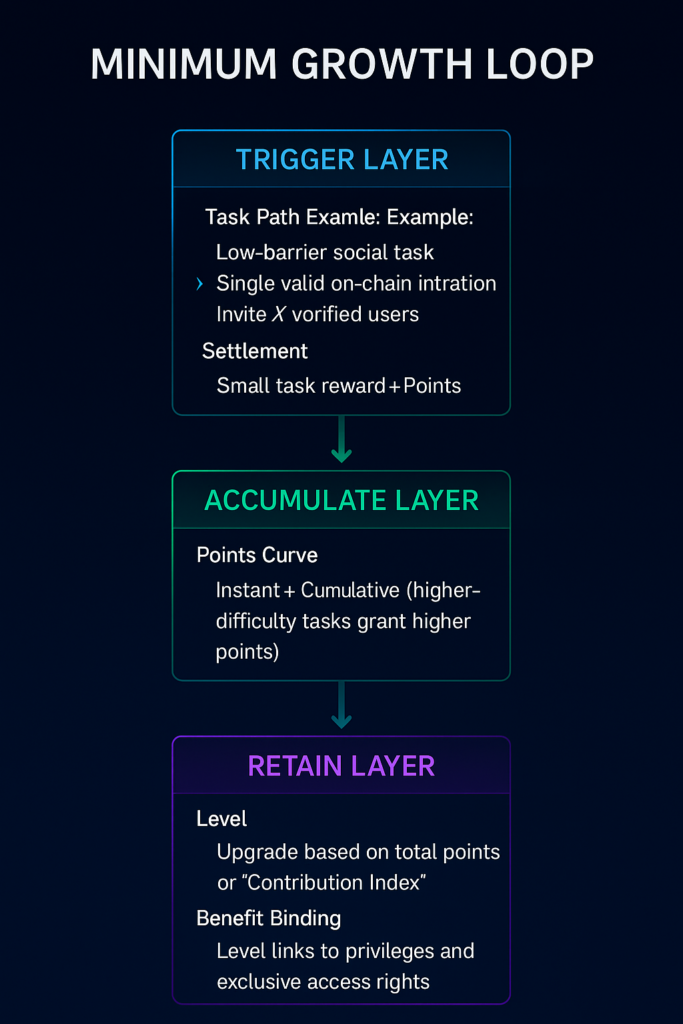
Understanding this logic allows you to implement a minimum viable loop and path on the TaskOn platform to realize an incentive-retention system.
- Trigger Layer:
- Task Path Example: Low-barrier Socials → Single real on-chain interaction → Invite 1–2 valid users (Referral requires validity verification).
- Settlement: Small task rewards + Visible Points credit.
- Accumulation Layer:
- Points Curve: Instant + Cumulative (e.g., 20 points for a transaction, +10 points for holding 3 days, +30 points for governance voting).
- Milestone: Reaching 300 points monthly unlocks a Milestone qualification (redeemable for “Consumption-type Benefits” in the Benefit Shop).
- Retention Layer:
- Level: Upgrade based on accumulated points or “Contribution Index.”
- Milestone & Benefit Shop Binding: Level is linked to benefits like fee rebates/subsidies/priority access via Milestone and the Benefit Shop.
- Leaderboard: Amplifies honor and social visibility.
04 | Economic Foundation: Why “Post-Settlement, Stratified, Compounding” Works Better
Why is retention such a complex story? From an economic perspective, it’s quite simple. Uniform, pre-paid subsidies naturally attract arbitrage users who “take the money and run.” In contrast, Post-Settlement + Automated Verification significantly reduces “fake contributions.”
For users, the behavioral logic of diminishing marginal utility and habit formation can be cultivated. Small, compounding points/milestones are better at driving the “do it again” behavior, forming behavioral inertia (e.g., DayChain/Streaks).
- “Activation Cost” of Network Effects: Anchoring rewards to key actions that drive product network value (Trading Volume, Staking, Governance Participation) turns incentives into a function of LTV (Lifetime Value) rather than a one-off cost.
- LTV/CAC Structure Optimization: As the Level rises, the unit reward’s impact on retention/repurchase increases—essentially spending the budget on “people more likely to stay long-term.”
05 | Actionable Configuration Templates
A. 7–14 Day Acquisition & Activation
| Target | Task Path (TaskOn) | Verification | Settlement | Benefit Linkage |
| Acquisition + One Real Interaction | Low-barrier Socials → First On-chain Interaction (Swap/Deposit) → Invite 1–2 valid users | Contract Event + API, Anti-Sybil | Small Task Reward + Points Credit | Reaching 150 points in the week allows redemption of a Gas Subsidy Coupon in the Benefit Shop. |
B. 30 Day Trading Activation
| Target | Task Path (TaskOn) | Weighting | Settlement | Benefit Linkage |
| Boost Trading Depth & Retention | Hold for N Days → Cumulative Volume Threshold → Governance/Proposal Voting | Volume > Holding > Socials | Weekly Points, Monthly Milestone | Reach target by month-end to hit Level 3, enjoying a 5% Fee Rebate Coupon next month. |
C. Content Co-creation
| Target | Task Path (TaskOn) | Verification | Settlement | Benefit Linkage |
| Generate High-Quality Content & Social Buzz | PoW Content Production → Official Selection/Starring → Monthly Milestone | Manual Check + Social Data API | Points + Milestone | Level 4 users can claim “Feature Trial Vouchers / Priority Beta Access.” |
06 | Level-Benefit Binding Example
| Level | Role Definition | Upgrade Suggestion (Cumulative Points) | Typical Consumption-Type Benefits (Configured & Redeemed via Benefit Shop) |
| L1 | Basic Participant | 0–99 | Newbie Gas Subsidy Coupon (Small amount), Exclusive Newbie Task Portal |
| L2 | Active User | 100–299 | Fee Rebate Coupon (1–2%), Limited-Time Whitelist Raffle Qualification |
| L3 | Community Contributor | 300–699 | Fee Rebate Coupon (3–5%), Higher Gas Subsidy, Feature Beta Spots |
| L4 | Honor Member | 700–1499 | Fee Rebate Coupon (5–8%), Dedicated Support/Fast Track, Reservation for Next Batch Allocation |
| L5 | Core Ambassador | 1500+ | Fee Rebate Coupon (10%+ Project Cap), Ecosystem Pass/Annual Benefit Pack |
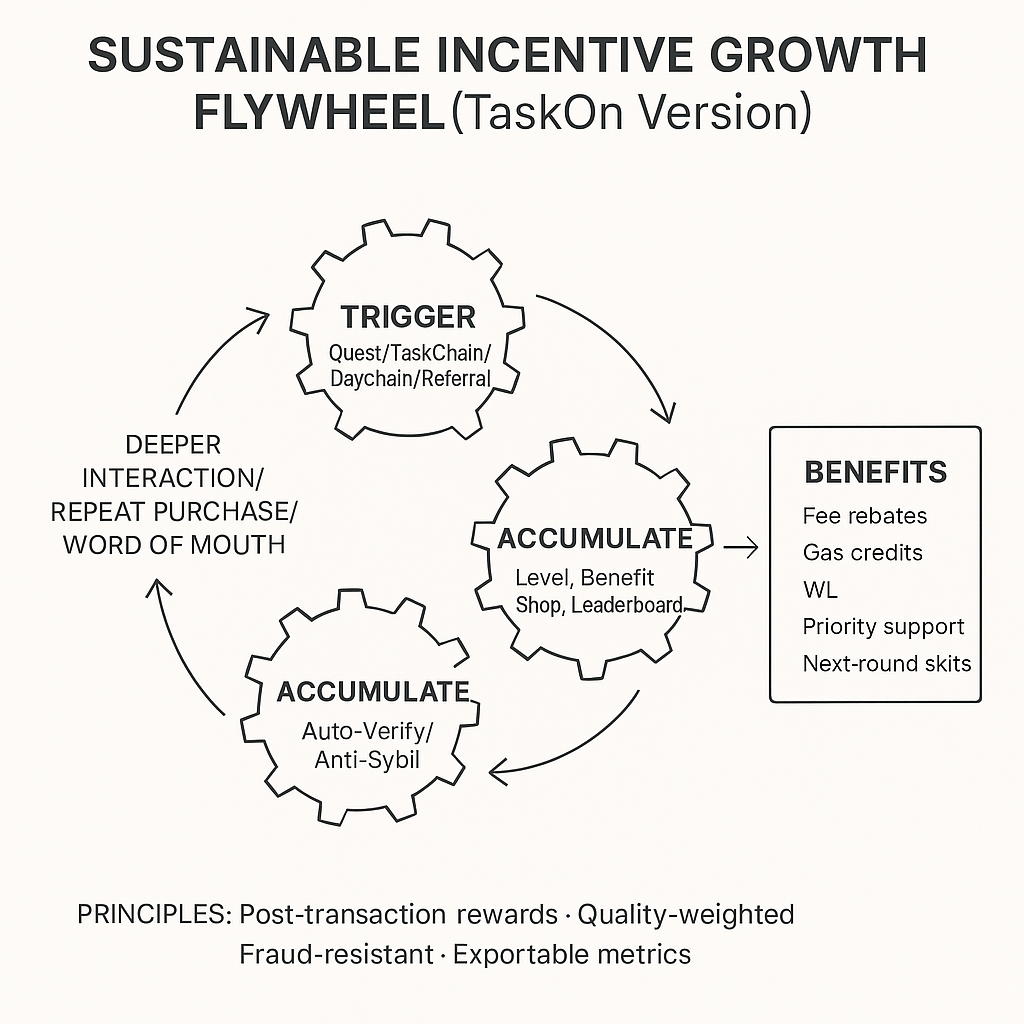
The Sustainable Incentive Growth Flywheel
Based on this, we can configure a growth flywheel capable of positive retention. The core requirements in the setup process are:
- Link rewards to user behavior.
- Post-settle the rewards.
- Incentivize interaction: The more interaction with the product, the higher the incentive.
Simultaneously, the system of Points and Levels must be bound to “Consumption-type Benefits.” Points are the indicator for leveling up and the quantification of user behavior (adjusting weights toward “Trading/Holding/Governance”). Meanwhile, privileges like fee rebates, Gas subsidies, and Whitelist spots—determined by Level—are visible and redeemable in the Benefit Shop.
Conclusion:
The essence of sustainable incentives is transforming your budget into “compounding equity assets” strictly bound to real interactions. By utilizing the three-layer structure of TaskOn: Task-Incentive (Trigger) → Points (Accumulation) → Level (Retention), combined with the consumption-based benefits of the Benefit Shop, you can upgrade from one-off subsidies to a long-term growth engine that drives repurchases and reputation.