

In the attention-scarce world of Web3, the best stories aren’t just told—they’re lived.
When a new project drops, it needs more than just traffic or liquidity. It needs a story that users can actually participate in—a pathway where they feel the value rather than just hearing the narrative.
This is exactly TaskOn’s alpha: transforming “task design” into a new form of Narrative Infrastructure.
From Tasks to Narratives: The Shift from “Promotion” to “Experience”
Historically, most Web3 campaigns treated “tasks” as purely transactional: follow an account, join a group, claim a reward.
The result? Short-term hype, long-term hollowness. Communities would pump overnight, only to turn into ghost towns just as quickly.
To break this death spiral and genuinely capture user attention, TaskOn’s design philosophy is simple: A task isn’t just an action; it’s a scene in a story.
Every Quest isn’t merely a campaign; it’s a narrative path—guiding users from “Discovery” to “Action,” and finally to “Trust and Participation.”
Picture a three-act structure:
Discovery — Interaction — Belonging
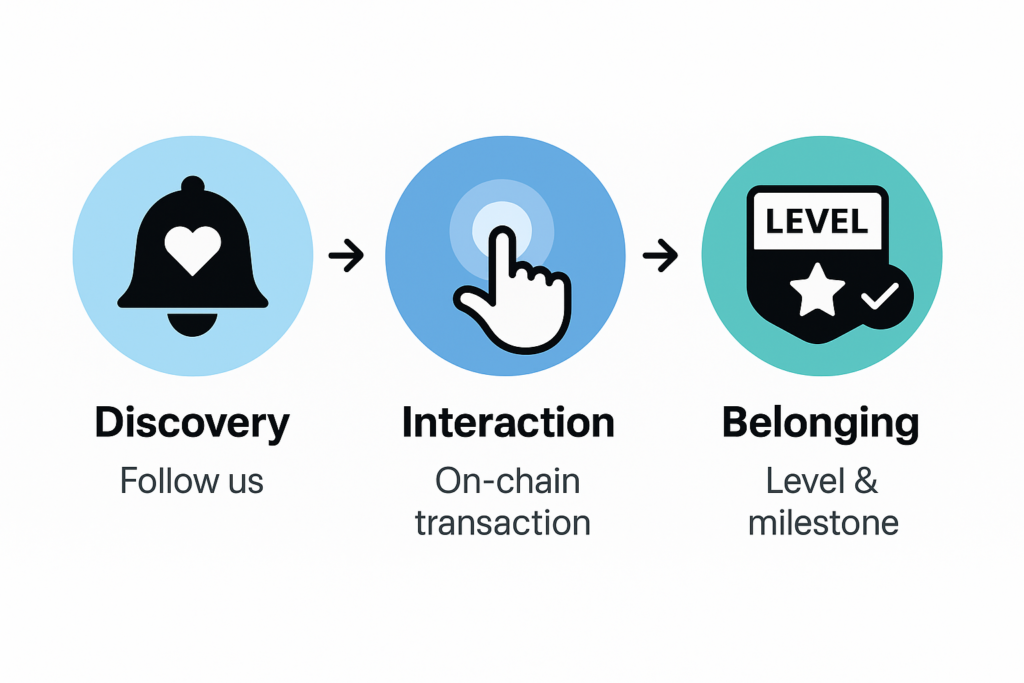
Starting with “Follow Us” as the opening hook, moving to on-chain interactions as plot twists, the user’s Level and Milestones become their chapter markers—every bit of growth is a footprint of their “Proof of Trust.”
In the grand scheme of Web3 narratives—from cold starts and user acquisition to retention—every successful project excels at packaging these elements into gripping plotlines. The inherent viral nature of a good story becomes the bedrock for secondary distribution.
Projects like Bitcoin.com, Verse DEX, EPHYRA.AI, and Hyperliquid have leveraged TaskOn to turn cold-start tasks into stories that users are eager to spread.
The Quest Architecture of a Great Story
To elevate a task into a “story,” three elements are non-negotiable:
| Narrative Element | TaskOn Feature | Purpose |
| Trigger | feed flow/Quest | Define the first action representing “interest.” |
| Progression | TaskChain / DayChain | Give the user experience rhythm—from shallow to deep. |
| Resolution | Milestone / Benefit Shop | Let users “see their value.” |
The charm of a good story lies in its “layering.” Juicy rewards are clickbait, sure, but the real hook is a product where values, incentives, and a spiritual core work together. That’s where you get that 1+1 > 2 synergy.
TaskOn’s TaskChain can weave 3–5 tasks into a coherent rhythmic line—from Social Exposure → On-chain Verification → Community Interaction → Long-term Participation.
For instance, a project might design a TaskChain like this:
1️⃣ The Social Arc: Follow X / Read Tutorials;
2️⃣ The Action Arc: Complete the first transaction;
3️⃣ The Co-creation Arc: Share results / Create content;
4️⃣ The Deep Dive Arc: Hold or Vote for X days.
This isn’t just a task list; it’s a narrative curve, allowing users to understand, identify with, and eventually become part of the project.
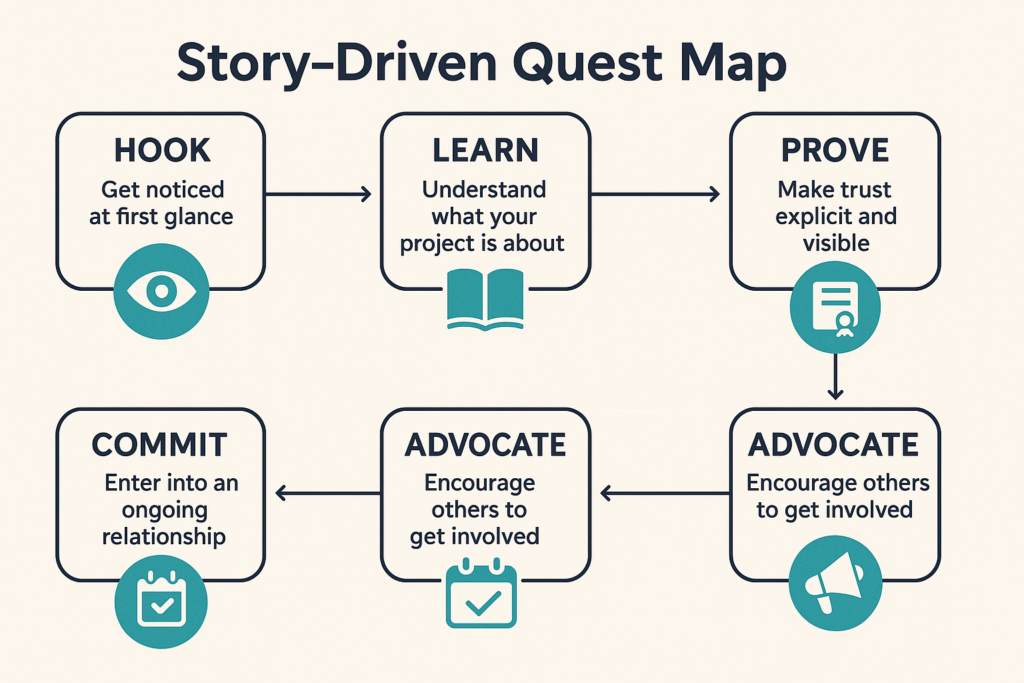
Telling Stories with Data: Turning Behavior into Narrative
Stories in Web3 don’t rely on slogans; they rely on the conviction behind the data.
TaskOn’s automated verification system (API / Contract Events / Signature Verification) turns every action into verifiable narrative evidence. Every completed task is a line of dialogue the user writes for the project.
On TaskOn’s visual dashboard, you can read these “stories”: Which task triggers the most action (completion rate, conversion rate)? At what stage do users stick around (retention rate)? Which users level up the fastest (growth in Level and Milestone)?
These aren’t vanity metrics; they are “Story Validation.” They tell you: What chapter is the user in right now? And what plot twist will keep them reading?
Why “Story Power” Beats “Traffic”: How Bitcoin.com Built a Growth Narrative with TaskOn
In the Web3 battle royale, every project is fighting for attention, but the real winners are the teams that spark Belief.
And belief doesn’t come from a tagline. It comes from repeated, meaningful participation experiences.
TaskOn makes this experience tangible: It allows projects to write stories using Tasks, letting users feel the warmth of the narrative through their actions.
Through TaskOn, a Web3 user lifecycle management platform, Bitcoin.com utilized On-Chain verified Quest systems, point levels, milestone rewards, and community tools. They launched a series of Quests linking rewards to product usage. Through sustained participation and Leaderboard incentives, they shifted user behavior from “passively claiming rewards” to “actively contributing value.”
With the continuous injection of points, leveling systems, advanced tasks, and community interaction tools, TaskOn’s automated verification and reward distribution mechanisms ensured continuity in user behavior. The data dashboard provided real-time feedback on retention and engagement. The result? Community activity spiked, and core users began taking on roles in content contribution and governance, achieving long-term value accrual.
When Bitcoin.com launched the Verse DEX campaign on TaskOn, their goal wasn’t just “get users to trade.” It was to tell a story—decentralized liquidity, making trading freer and simpler.
Their Quest design:
- Follow → Understand the brand narrative
- Trade → Experience the low-fee DEX
- Stake → Participate in liquidity incentives
- Share → Spread the belief
Ultimately, over 150,000+ real participants joined in, massively boosting Bitcoin.com in a short period, with social interaction rates skyrocketing by 200%+.
In this growth story, every completed task wasn’t just a stat pad; it was the accumulation of trust, a proof of participation. The best campaigns aren’t about how many people show up, but making sure every participant remembers—why they started.
Conclusion
The next wave of Web3 growth won’t be decided by “who airdrops more,” but by “who turns participation into a story.”
TaskOn’s mission is simple: Make every action—from a click to an on-chain interaction—a story fragment worth recording.
Because in the Web3 world, stories aren’t written on paper. They’re written On-Chain.