
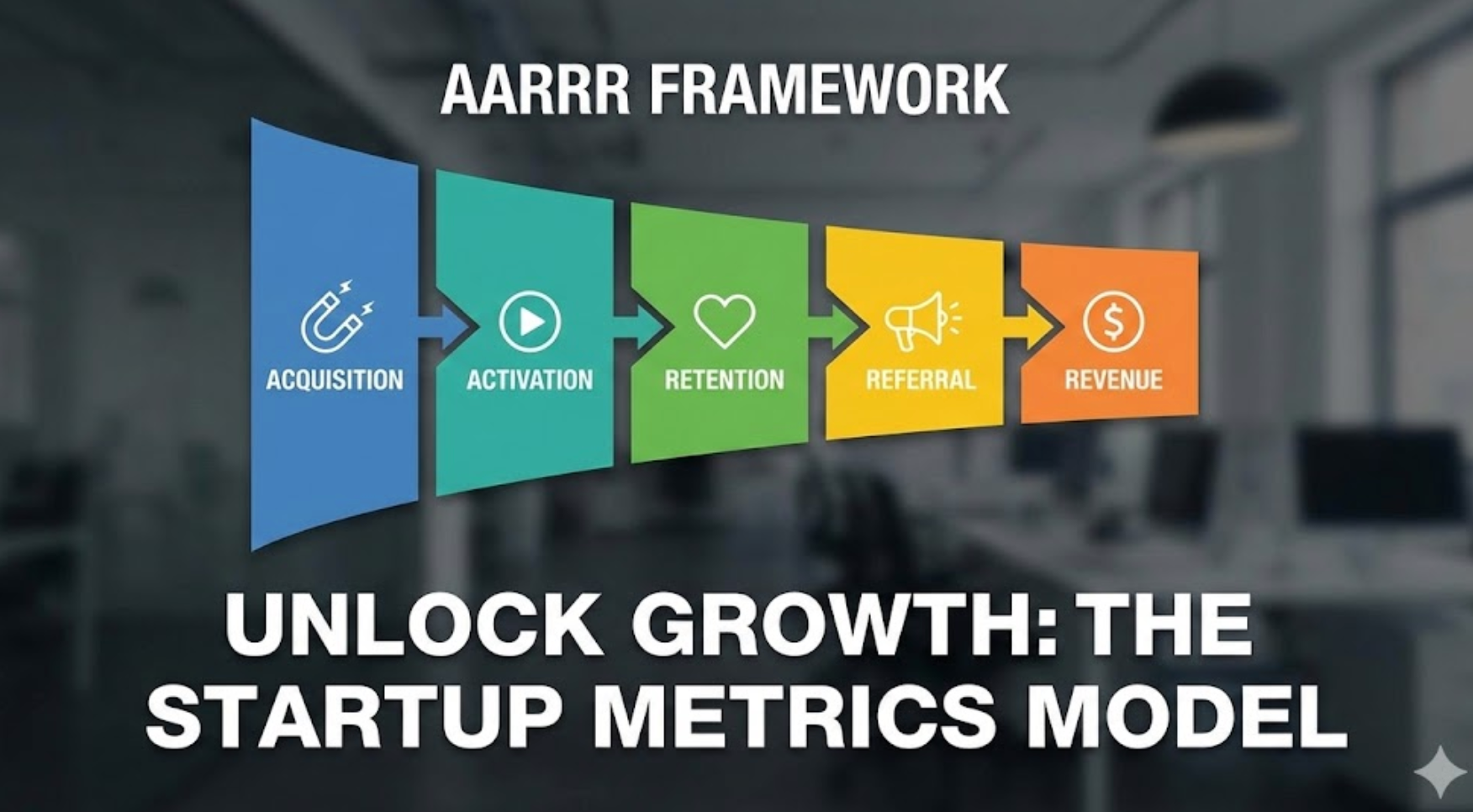
In the realm of Web3 on-chain user growth, AARRR (Acquisition / Activation / Retention / Revenue / Referral) is no longer just a traditional marketing framework—it’s a growth path that can be verified, quantified, and automated.
However, finding the most effective growth trajectory amidst the noisy, attention-saturated Web3 world, and leveraging AARRR to power your own growth flywheel, remains a massive headache for builders.
TaskOn transforms AARRR from “theory” into an “executable growth engineering system” via tools like Quest, TaskChain, DayChain, Point Levels, Automated Verification, Benefit Shop, and Leaderboard/Referral.
1) AARRR × TaskOn: Modules & Metrics at a Glance
| AARRR Stage | Key Objective | Quantifiable Metrics (Examples) | TaskOn Module |
| Acquisition | Reach and import valid new users | Visitor → Registration conversion rate, First Quest start rate | Quest Template, Invite Tasks (w/ Link/QR Code sharing), Campaign Landing Pages |
| Activation | Complete the first “verifiable” core action | First on-chain tx/Signature completion rate, Key step completion rate | TaskChain (Sequential tasks), Automated Verification (Contract Events/API/Signatures) |
| Retention | Form a rhythm of continuous engagement | 7/14/30-Day Retention, Streak check-ins | DayChain (Streaks/Check-ins), Points (EXP) |
| Revenue | Monetizable value from real interactions | Transaction vol./Valid interactions, Redemption rate | Benefit Shop (Redemption), Ranking/Gated Tasks |
| Referral | Identity-driven trusted fission | Invite validity rate, Tiered contribution | Invite/Referral, Leaderboard, Level/Role stacked rewards |
- Invite/Referral: Supports creating user-centric invite links for sharing. The more you invite, the higher your platform Level, unlocking more campaign eligibility and reward opportunities. Invite Tasks allow for seamless sharing (including QR codes and direct social media posts).
- Benefit Shop: Supports exchanging Points for Tokens, NFTs, Discord Roles, Whitelists (WL), and Codes. Projects define the reward pool, perfectly adapting to “Consumption-based Benefits” (e.g., Trading fee discount codes, Gas subsidy codes, Partnership coupons).
- EXP/Level: Serves as platform loyalty and access filtering, used to gate campaign eligibility and priority access.
The platform’s recent updates also reinforce the logic linking Token rewards with Points distribution (e.g., auto-switching to Points once the Token pool is exhausted).
2) Redefining AARRR in the Web3 World
Unlike the traditional Web2 marketing stack, AARRR in Web3 demands a fresh definition, emphasizing “Verifiable Interaction” and “Value Sedimentation.”
- Acquisition → “Traceable Entry”: Acquisition isn’t just about following a generic account or joining a group. It’s about guiding the user to the first verifiable action (e.g., binding a wallet, first signature, following on X and verifying via API).
- Activation → “Minimum Viable Action (MVA)”: Design a real interaction (like a small Swap/Stake or a first Bridge test run) as a milestone node within a TaskChain. Scores are only awarded upon passing automated verification.
- Retention → “Rhythmic Commitment”: Use DayChain to drive continuous engagement and themed Weekly/Monthly campaigns. Drive long-term behavior with back-loaded Points, rather than one-off airdrops.
- Revenue → “Redeeming Utility over One-time Candy”: Use the Benefit Shop to convert points into consumption-based benefits (fee discount codes, Gas subsidies, partner vouchers). This turns the “Use More → Get More” back-loaded incentive into a product growth “Pricing Mechanism.”
- Referral → “Identity-Driven Propagation”: Invites drive Platform Level and Campaign Eligibility upgrades (Identity). By stacking Leaderboards with phased thresholds, you create a triangular fission of “Good Content + Good Identity + Good Benefits.”
3) “One Chart to Understand It All” — Key Operational Flows
Chart A: AARRR × TaskOn (Mini Workflow)
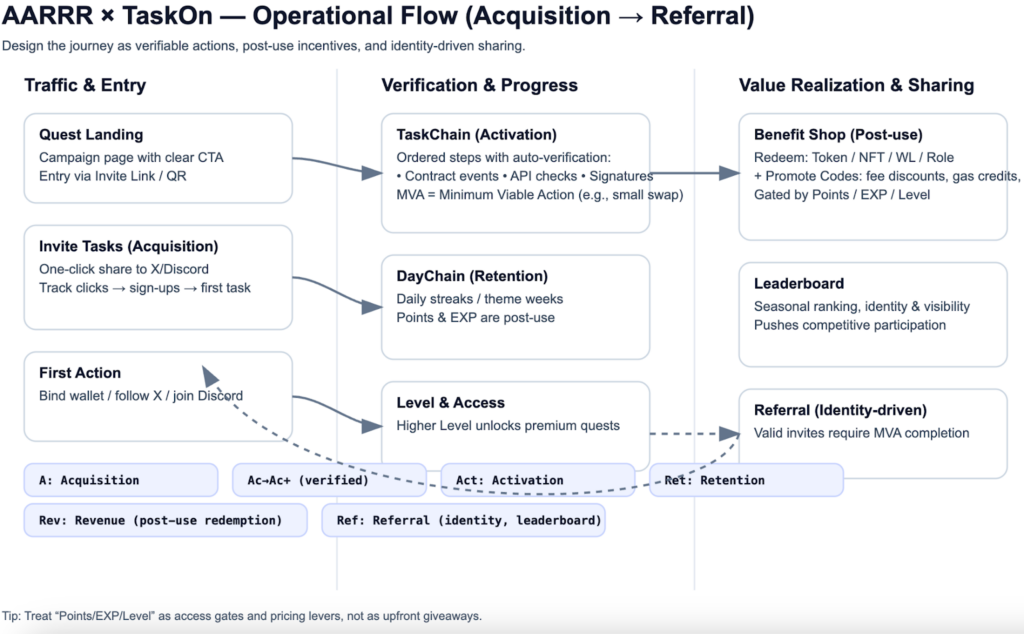
Acquisition: Invite Link / Socials → Activation: TaskChain (MVA Verification) → Retention: DayChain (Streaks) → Revenue: Points -> Benefit Shop (Swap for Gas/WL) → Referral: Level Up -> Higher Invite Weight
Chart B: Binding Consumption-based Benefits (Back-loaded Incentives)
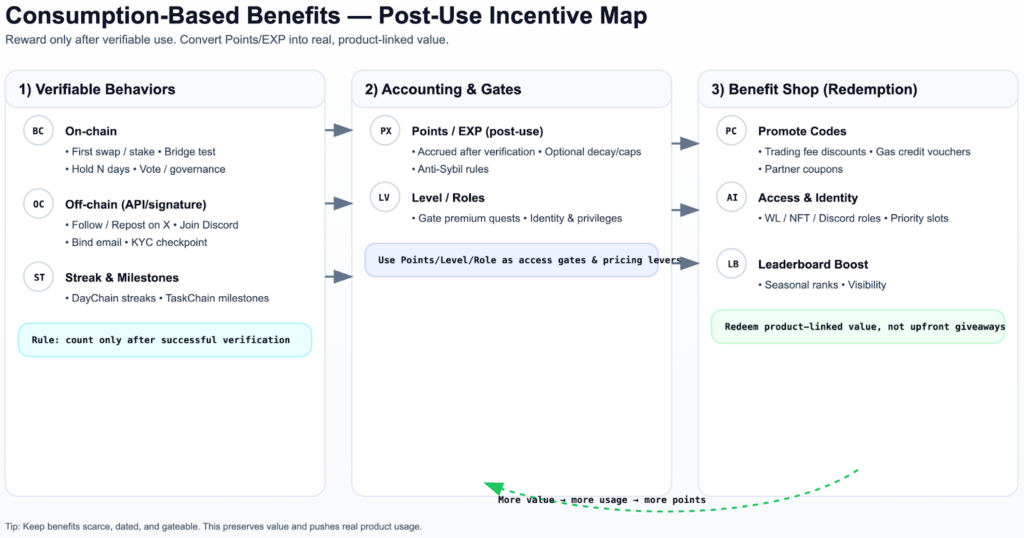
User Action (On-chain Interaction) → Earn Points (Not Tokens immediately) → Accumulate → Benefit Shop → Redeem Utility (Discount Codes / Premium Access) → Re-invest in Protocol
4) Actionable Metric Dashboard
| Stage | Must-Watch Metrics | How to Implement in TaskOn |
| Acquisition | Invite Clicks → Registrations → First Quest Start Rate | Use Invite/Referral & Invite Tasks, monitor landing page entry; design First Quest as a low-barrier verifiable action. |
| Activation | MVA Completion Rate, TaskChain Completion Rate | Place key actions at the front of the chain with Automated Verification (Contract Event/API/Signatures). |
| Retention | Consecutive Participation Days, W/M Retention Rate | Use DayChain / Themed Weeks; issue back-loaded Points, set “Streak Bonuses.” |
| Revenue | Redemption Rate, Re-engagement Rate post-redemption | Use Benefit Shop for benefit monetization; track redemption and return usage of Code-based rewards. |
| Referral | Invite Validity Rate, Tier Contribution, Leaderboard Coverage | Use Platform Invite Links & Leaderboard mechanics, stacking Level/Role thresholds and bonuses. |
5) Referral’s “Identity-Driven” Propagation: More Sustainable than “Link Spamming”
- Invite → Level Up → More Access & Opportunity: TaskOn invites directly impact User Levels and participation eligibility, boosting the positive feedback loop of “Propagation = Self-Gain.”
- Visibility & Social Currency: Leaderboards, Roles, and NFT Badges give propagation a “Display Slot.”
- Compliance & Anti-Sybil: Bind “Valid Invites” to the completion of key tasks. Leverage automated verification and threshold tasks to eliminate pure bot farming.
6) The Three-Stage Design of “Back-loaded Incentives”
Incentives are back-loaded not to withhold rewards, but to filter for high-value users.
① Minimize Barriers (Day 1–3)
- Entry: Invite Link / Social Tasks + 1 Verifiable On-chain Action (Small amount/Low risk).
- Incentive: Complete to get Base Points (No direct Token drop).
- Goal: Import cold start traffic into verifiable behavior.
② Deepen Behavior (Day 4–14)
- Task: TaskChain (Moving from “Trying” to “Using”), designing 2–3 key milestones.
- Incentive: Hitting milestones grants Bonus Points + Stage Redemption Eligibility (Benefit Shop).
- Goal: Use Point thresholds to guide users to redeem “Consumption-based Benefits” (Fee Codes/Gas Vouchers).
③ Long-term Rhythm (Day 15–30+)
- Mechanism: DayChain Streaks + Leaderboard Seasons, setting progressive rewards and limited slots.
- Incentive: High Level/High Contributors get priority unlock for specific perks (WL, Roles, Time-limited Vouchers).
- Goal: Stabilize the “Use More → Get More” pricing mechanism.
7) Execution Checklist (5 Steps)
- Define MVA: Clarify the “Minimum Viable Action” (e.g., a small Swap/Stake).
- Orchestrate TaskChain: Front-load the MVA; ensure all actions plug into Automated Verification.
- Plan Benefit Pool (Benefit Shop): Focus on consumption-based benefits (Gas subsidies/WL/Roles/NFTs).
- Build Referral System: Enable Invite/Referral & Invite Tasks (Link/QR/Social Direct), configure “Valid Invite” logic (must complete MVA to count).
- Dashboard & Review: Track the five segments “Entry → MVA → Streak → Redemption → Fission,” rolling out optimizations for thresholds and reward structures.
Closing Thoughts
The correct way to open AARRR in Web3 is to replace “surface-level tasks” with verifiable product interactions, and then use back-loaded consumption-based benefits to return value to “people who actually use the product.”
TaskOn has packaged these capabilities into a reusable toolstack: You just need to fill in the blanks, go live, review the data, and continuously optimize the marginal incentive of “Use More → Get More.”