

In the traditional Web2 world, the North Star Metric (NSM) represents the singular key metric that best captures the “core value a product creates for its users.” It serves as the anchor for a team’s direction and the core output of any growth model. However, for Web3 projects, identifying that unique North Star and building an effective user framework around it remains a major hurdle.
This is where the growth platform TaskOn steps in. It helps projects construct a comprehensive North Star Metric system, reconstruct LTV/CAC under an incentive-driven model, and utilize a robust toolchain to close the loop between “Metrics—Tasks—Benefits.”
01 | North Star Metric: Define It by “Verifiable Results”
A solid North Star Metric generally consists of three logical layers: the Mission Layer, the Value Layer, and the Behavior Layer. It flows from the product’s ultimate goal, to the value the user derives from the platform, down to the measurable behaviors that support this core value. These are the “constituent dimensions” of your NSM.
A killer NSM must be:
- Value-Aligned: Directly reflects the value the protocol/product creates for the user.
- Verifiable: Validated automatically via On-Chain events, API callbacks, signatures, etc.
- Incentivizable: Can be positively driven by Quest/Benefit design, rather than just wash trading or farming.
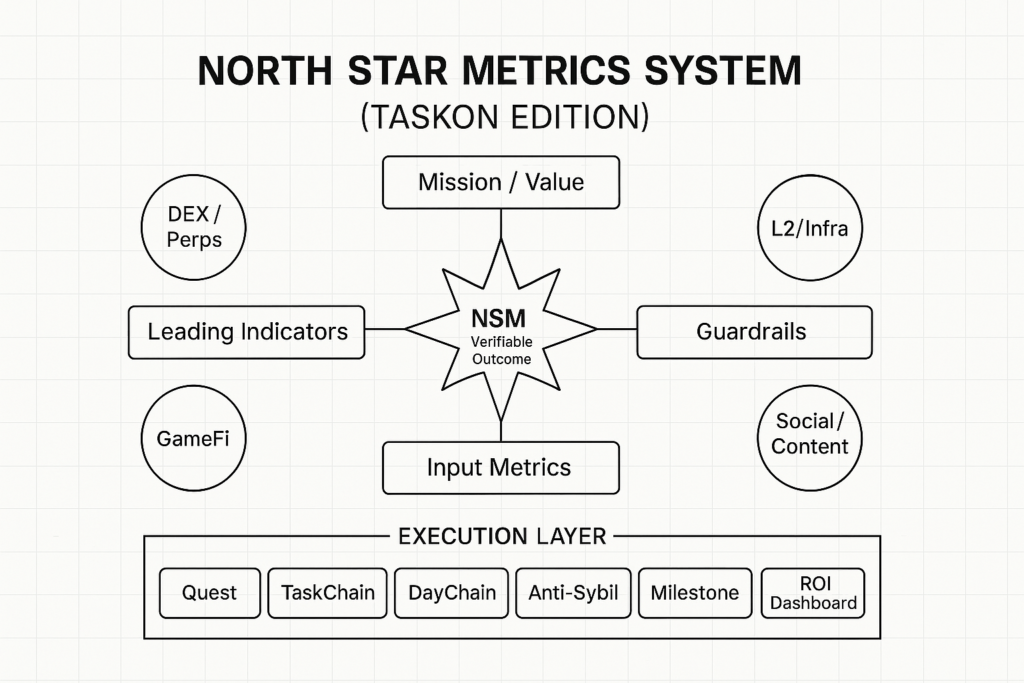
Common Project NSM Frameworks (Examples)
| Project Type | NSM (Outcome-Based) | Verification Method |
| DEX/Perps | Qualified Volume/Valid Tx Count (Excluding self-trading/wash trading) | Contract Events + Risk Rules (Min volume, time windows, counterparty filtering) |
| L2/Infra | Monthly Valid Active Wallets (Completed ≥1 qualified interaction + Sybil check) | Event Listening + Signature Validation + Wallet Fingerprinting |
| GameFi | Day-2/Day-7 Retention & Monthly Level/Quest Completion Rate | Account Binding + API Progress Callbacks |
| Social/Content | High-Quality Content Output/Adoption Rate | Off-chain API (Official Platform) + Manual Spot Checks |
| RWA/Launchpad | Qualified Subscription/Holding Duration | Subscription/Lock-up Events + KYC Status |
Executing on TaskOn
So, how do you build this NSM stack on TaskOn?
First, use Quest / TaskChain / DayChain on the TaskOn frontend to deconstruct the “pre-requisite behaviors” of your NSM (e.g., Deposit → Trade → Hold → Share).
Connect all actions to Automated Verification (Contract events, API callbacks, Signatures) and overlay Anti-Sybil Strategies. Then, map these “verifiable results” to growth values via Points → Level → Milestone, binding them to the Benefit Shop.
By mapping your incentives directly to the results of user behavior, you are effectively paying only for interactions that matter. This builds a genuine value loop.
02 | LTV/CAC in the Incentive Era: From “Spent Tokens” to “Value Loop”
The classic Web2 LTV/CAC model requires a rewrite for Web3 in two key areas:
2.1 iCAC (Incentive-adjusted CAC)
$$iCAC = \frac{\text{Paid Ads} + \text{Ops Labor} + \text{Incentive Cost} – \text{Recoverable Incentive Value}}{\text{Effective New Users}}$$
- Incentive Cost: Points, NFTs, Tokens, Whitelist (WL) spots, etc.
- Recoverable Incentive Value: The portion users reinvest into the ecosystem (e.g., points that can only be redeemed for ecosystem benefits, or locked rewards requiring target behaviors to unlock).
- Effective New Users: Retained users remaining after anti-bot filtering and quality scoring (e.g., minimum volume thresholds).
2.2 iLTV (Incentive-shaped LTV)
$$iLTV = \sum (\text{Net Cash Flow/Contribution in Period } k) – \text{Present Value of User’s “Redeemable Incentives”}$$
- Contribution Includes: Trading fees, subscriptions, TVL weight from holding duration, governance participation, etc.
- Redeemable Incentives: For incentives that can only be consumed/swapped within the ecosystem, deduct the value loop formed by “locking and reinvestment” (avoiding treating “non-cashable” rewards as pure cost).
How to Measure on TaskOn
The ROI Dashboard tracks the conversion funnel by Campaign/Channel/Task: Incentive Distribution → Verification Passed → Goal Achieved.
By leveraging POX (Proof of Execution) quality scores and blacklists, the TaskOn platform effectively filters out “fake growth,” allowing projects to pay for real interactions by real users. In terms of benefit design, the trend leans towards creating Milestones for high-value incentives, back-loading the rewards to boost iLTV.
03 | Reverse Engineering Growth from Data: Using the “Chain of Evidence”
TaskOn’s standard flow creates a behavioral path: Entry → Task Direction → Goal Achievement → Benefit Redemption → Final Retention. Within this chain:
- High Entry, Low Completion: Simplify the first two steps. Consolidate verification from “multi-signature” to a “single-pass contract event callback.”
- High Completion, Low Achievement: Raise the “Qualified” threshold (Minimum amount/Holding days) and push high-value incentives back to a Milestone.
- High Achievement, Low Retention: Activate DayChain (Streaks), Level-ups, and Weekly Leaderboards to turn activity into a “habit.”
- Benefits Not Consumed: Move high-value assets to the Benefit Shop as “Redemption Tiers” and bundle them with scarce resources like next-round WL spots to create FOMO.
04 | TaskOn Dashboard: Unifying Tracking & Benefits
Key Modules & Their Impact on Growth
| Module | What You Can Do | Metric Alignment | Benefit Bonding |
| Quest / TaskChain / DayChain | Design the full path from awareness to conversion; support sequential/continuous participation. | Step Completion Rate, Streak Rate, Goal Achievement Rate. | Step Rewards, Streak Bonuses, Staged Airdrop Spots. |
| Automated Verification & Anti-Sybil | Contract Events/API/Signatures; Rate limits/Min Amounts/Address Clustering. | Effective Users, Bot Ratio, Quality Score. | Release rewards only for “Qualified Achievements.” |
| Points / Level / Milestone | Map results to a growth curve; unlock higher-tier campaigns. | Level Distribution, Level-up Speed, Return Rate. | Back-loaded Incentives: Open high-value benefits only upon hitting Milestones. |
| Benefit Shop | Close the loop on “Points → Visible Value.” | Point Burn Rate, Redemption Structure, Re-engagement Rate. | Ecosystem Benefits (WL/Mint Pass/Priority Access) to boost iLTV. |
| ROI / Conversion Dashboard | Audit Input vs. Output by Campaign/Channel. | iCAC, iLTV Factors, Channel Comparison. | Adjust Budgets & Incentive Structure. |
05 | Three Charts to Get You Started
Table A | NSM Selection Checklist
| Dimension | Self-Check Question | Standard |
| Valuable | Does it directly represent the value the user receives? | Yes/No |
| Verifiable | Can it be auto-validated via Contract Events/API/Signatures? | Yes/No |
| Incentivizable | Can it be stably driven by Quests/Benefit design? | Yes/No |
| Anti-Gaming | Are there “Min Thresholds/Rate Limits/Clustering Filters”? | Yes/No |
Table B | iCAC Accounting Framework
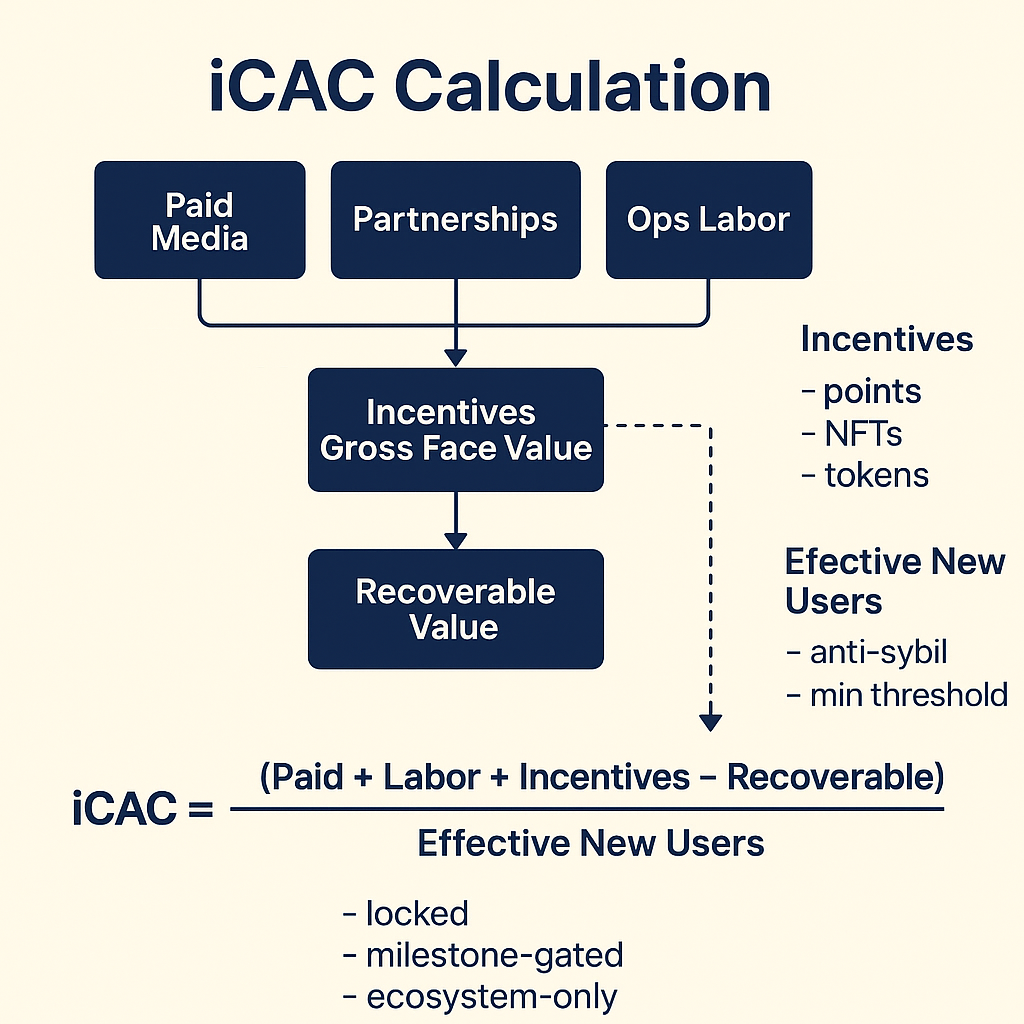
Table C | Benefit Design (Back-loaded/Unlockable)
| Stage | Behavior Threshold (Verification) | Incentive | Objective |
| Onboarding | Wallet Bind / First Qualified Interaction | Small amount of Points | Maximize Top-of-Funnel |
| Growth | 7-Day Streak (DayChain) | EXP Boost, Upgrade to Lv2 | Habit Formation |
| Milestone | Hit NSM (e.g., 30-day Qualified Vol ≥ X) | Unlock WL / Scarcity Spots | Drive Value Behavior |
| Long-Term | Lv3/Lv4 Users | Exclusive Campaigns, Governance Priority | Boost iLTV |
Final Thoughts
Select the right NSM (Verifiable Results) → Shape iLTV/CAC with Incentives → Lock the “Data—Behavior—Value” loop using TaskOn’s Task, Verification, and Benefit systems.
When rewards shift from “upfront subsidies” to “back-loaded unlocks,” and when every cent of incentive pays only for a “verifiable result,” that is when your growth truly starts to compound.