

In the Web3 world, 80% of DAU/MAU volatility can be explained by the “Growth Accounting Trio” — New / Churn / Resurrection.
How do we build an executable decomposition method and form a positive growth flywheel?
The growth platform TaskOn constructs a comprehensive growth flywheel through features like Quest, Level/EXP, Eligibility, API-Verified, Anti-Bot, Leaderboard, and Benefits distribution. This creates a closed loop of “Operational Action — Metric Change — Incentive Bonding.”
I. The Growth Accounting Model (Web3 Context)
The Core Identity (Applicable to Daily/Weekly/Monthly):
$$MAU_t = MAU_{t-1} + New_t + Resurrection_t – Churn_t$$
The split for DAU follows the same logic, simply shrinking the window from 30 days to 1 day.
- New: “Active addresses/accounts” participating in your ecosystem for the first time (e.g., completing a Quest for the first time).
- Churn: Existing active users who haven’t appeared within the current window period.
- Resurrection: Users who were formerly active, went silent, and returned during this period.
TaskOn’s project console and help center explicitly provide entrances for data download and analysis, task data export, and user eligibility/completion dimensions, supporting this exact breakdown and recalculation. It also covers Dashboard modules, data export capabilities, and task templates/eligibility settings.
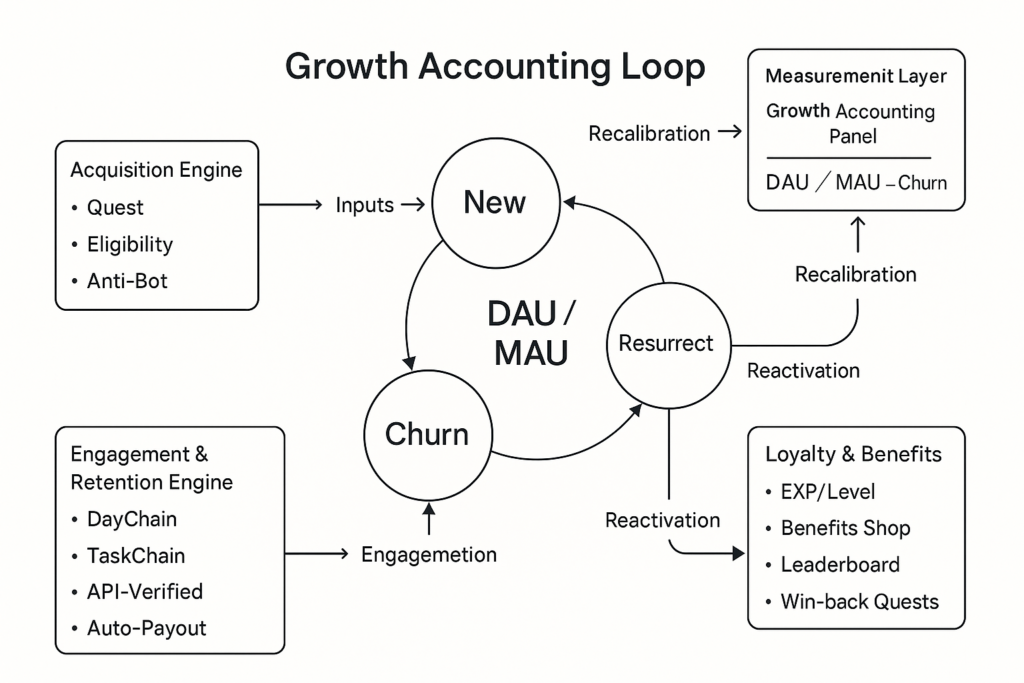
II. Mapping “New/Churn/Resurrection” to TaskOn Product Capabilities
| Attribution | Where does the data come from? | TaskOn Capability | Context & Trustworthiness |
| New | First-time qualified participation of a new address/account | Quest (Acquisition campaigns), Eligibility (Gating), Anti-Bot | Supports KYC-less acquisition, but uses Level/Holdings/NFT/Geo as gates, layered with Google reCAPTCHA + TaskOn’s proprietary algo to ensure authenticity. |
| Churn | Existing users inactive for the last N days | DayChain (Streaks), API-Verified Task, Auto-Reward | Front-load short-term incentives via continuous streaks/interactions and automated settlement to reduce churn; API verifies real product usage. Docs list “API-Verified Task” integration and auto-reward specs. |
| Resurrection | Active $\to$ Silent $\to$ Returns this period | Win-back Quest, Leaderboard, Benefits (Redemption/Spots) | Stimulate returns via leaderboard competition and benefits store/point perks; “leaderboard/benefits” routing and community case pages are visible on-site. |
Level/EXP & Incentive Bonding: EXP constitutes TaskOn’s points system, linked to Level. It serves as a reward for tasks and a threshold for campaign entry; reaching higher Levels unlocks more events and subsequent benefits.
III. Four Common Causes of DAU/MAU Fluctuations
1. Change in Acquisition Density
- Signal: New spikes $\to$ DAU/MAU synchronizes upward.
- On TaskOn: Check the qualified submission count for new addresses in that cycle, the source task type (Twitter/Discord/On-chain/API), and the Anti-Bot pass rate. Documentation provides task template lists and eligibility/anti-cheat settings.
2. Incentive Release Curve & Reward Rhythm
- Signal: Activity boosts during the reward window and announcement period; if it’s a one-time airdrop without a roadmap, activity drops off.
- On TaskOn: Use Auto-Reward + Phased Targets (Milestones); sustain engagement via Benefits/welfare spots. Official docs support auto-distribution and phased management.
3. Verification Intensity Adjustment (Anti-Sybil/Scripting)
- Signal: After ramping up verification, “vanity metrics” (surface activity) drop, but real conversion rates/retention improve.
- On TaskOn: Enable Google reCAPTCHA + Proprietary Risk Control, and use On-chain/API-Verified to validate real interactions, cutting out “fake activity.”
4. Benefit Structure/Threshold Changes (Level Gate)
- Signal: Binding premium rewards to Level/EXP. New user growth might slow, but Resurrection/Retention rises, making the activity “thicker” (higher quality).
- On TaskOn: Enable conditions like TaskOn Level, NFT/Token Balance in Eligibility. The docs list four types of eligibility templates.
IV. Operational Actions $\rightleftarrows$ Data Changes $\rightleftarrows$ Incentive Bonding
| Goal | Primary Impact | Recommended TaskOn Action | Incentive & Benefit Bonding | Data Change |
| Short-term Acquisition | New | Launch new Quest (Social + Light On-chain), Open Eligibility (Low barrier) | EXP Base Points + Small Pool, enable Auto-Reward | New $\uparrow$, DAU $\uparrow$; If Anti-Bot is on, quality pass rate $\uparrow$. |
| Curbing Churn | Churn | Configure DayChain (Streaks); Bind API-Verified to real features (e.g., Swap/Stake) | Streak Rewards $\to$ EXP/Level Up $\to$ Unlock more events | Continuous Activity Rate $\uparrow$, Next Day/7-Day Retention $\uparrow$. |
| Boosting Resurrection | Resurrection | Targeted Win-back Quest (Visible only to silent users), overlay Leaderboard Season | Leaderboard Spots/OG Roles/Whitelists placed in Benefits | Resurrection $\uparrow$, ratio of vintage users increases. |
| Purifying Activity | Real Activity Rate | Increase Anti-Bot settings/Eligibility; More On-chain/API verification | High-value Benefits (WL, NFT, Token) bound to higher Level | Surface activity might $\downarrow$, but Effective Conversion/Retention/ARPU $\uparrow$. |
V. The MVP “Growth Accounting” Dashboard
The Instrument Layer (Weekly/Monthly view):
- MAU/DAU Overview + MoM (Month-over-Month)
- New / Churn / Resurrection (Three-line chart)
- New Contribution by Task Type (Twitter / Discord / On-chain / API)
- Eligibility/Anti-Bot Pass Rate (Crucial when adjusting verification intensity)
- Level/EXP Structure (Ratio of L1–L5 users, to judge if benefit thresholds are reasonable)
Basis: TaskOn ToB documentation outlines Dashboard/Data Export, Task Templates (including Twitter/Discord/On-chain/API), Eligibility (Level/NFT/Token/Geo), Anti-Bot, and Auto-Reward capabilities, which are sufficient to recalculate and plot the charts above.
VI. About “Incentive Bonding”: Creating the “Use More $\to$ Get More $\to$ Want More” Loop
- EXP/Level: Officially defined as the loyalty point and tier system. Higher Level brings access to more campaigns and potential perks. Projects can also set Level as an Eligibility gate, back-loading scarce benefits to “Real Value Users.”
- Benefits: Used to handle the “Points $\to$ Rights” conversion (many communities on-site already have /benefits and leaderboard pages). This extends one-time rewards into visible, climbable long-term returns.
- Anti-Bot + API-Verified: Upgrading “Incentives” from a “Complete Button” to a “Completed Fact” (Compliant social actions + On-chain/Product API usage), avoiding “Fake Activity.”
VII. Implementation Paradigm: Two Tables + One Cycle
Table A | User Segmentation (Based on last 30 days)
- New30: First qualified task completion within 30 days.
- Active30: Active within the last 30 days.
- Silent30: Inactive for 31–90 days.
- Dormant90+: Inactive for over 90 days.
Table B | Task Type & Verification Matrix
- Dim 1: Social (Follow/RT/Join)
- Dim 2: Light On-chain (Sign/Interact)
- Dim 3: API-Verified (Swap/Stake/Bridge/…)
- Dim 4: DayChain (Streaks) / TaskChain (Sequential)
- Dim 5: Eligibility (Level/NFT/Token/Geo)
Action: Use Table A to define the specific logic for Resurrection/Churn; Use Table B to design the Quest mix. Create via templates in the TaskOn Console, enable Anti-Bot, and configure Auto-Reward and data export. Relevant capabilities are disclosed in the official docs and help center.
Conclusion
Don’t just treat “Activity” as a counter. Use Growth Accounting to decompose DAU/MAU into New/Churn/Resurrection, then use TaskOn’s task verification, eligibility gates, point levels, auto-rewards, and benefit spots to translate “Data Changes” into “Executable Product & Operational Actions.”
When “Use More $\to$ Get More $\to$ Want More” becomes the consensus in your community, growth stops being a short-lived spike and becomes a sustainable slope.