

In the Web3 operational playbook, moving from a social “cold start” to a fully functioning operations system requires a cohesive strategy. You need to initiate retention from the very “first day of real usage,” creating a positive flywheel effect. However, the “intensity and benefits” must be ramped up in stages.
Within the TaskOn toolkit, this logic is codified: DayChain ensures users “come back daily,” TaskChain organizes the “completion of the critical path,” and Milestone handles “phased achievements + back-loaded major benefits.”
This is a growth flywheel built around user behavior, contribution value, and the corresponding points/levels—a user retention system that utilizes back-loaded rewards bonded with consumption-based benefits.
1 | Structuring the Retention System: Deconstructing Growth Stages
Acquisition and retention are actually parallel systems. You can only build a user benefit hierarchy if you anchor rewards to user behavior from the get-go, ensuring reward steps and on-chain actions move asynchronously but in the same direction.
However, the barrier to entry and the intensity of benefits must rise with each stage to prevent “premature burnout” of your budget and ensure there’s enough fuel for the long haul. It is a slow-growth curve.
| Growth Stage | Typical Trigger Signal | Primary Objective | Suggested Intensity |
| Cold Start (Week 1–2) | First batch of real users (from first Quest/Partnership) arrives. | Form a habit of continuous visits. | Lightweight DayChain (Check-in/View/Follow), small EXP amounts. |
| Prelim Validation (Week 3–6) | Clear “Key Actions” occurring (Swap/Stake/Game 1st win). | Solidify the core usage path. | TaskChain (Linking 3–5 steps), API-Verified to validate real usage. |
| Product Fit (Month 2–3) | Retention improving, features stabilizing. | Establish phased goals and achievements. | Milestone S1 (30/60/90 day targets), stacking Level rewards. |
| Scale (Month 3+) | Channels increasing, campaigns becoming routine. | Maintain high-quality activity and win-backs. | DayChain + TaskChain + Milestone as permanent fixtures; Leaderboard Seasonal Rewards. |
2 | How to Build the Modules? — The Combo Strategy for DAU/WAU
The goal is: “Light Daily Touchpoints + Critical Weekly Progress + Phased Achievements & Back-loaded Benefits.”
| Frequency | Task Form (TaskOn Module) | Core Verification | Incentive Structure (Bound to Benefits) | Function |
| Daily | DayChain: Check-in, View/Retweet, Light interactions | reCAPTCHA / Basic Risk Control | Base EXP, Small prize pool auto-distribution | Establish Habit |
| Weekly | TaskChain: 3–5 Step Critical Path (e.g., Deposit→Swap→Stake) | API-Verified / On-chain | EXP ×2~3, Stage Badges, Leaderboard Scoring | Solidify Core Usage |
| Monthly/Seasonal | Milestone: 30/60/90 Day Cumulative Targets | Review (On-chain accumulation/Frequency/Volume) | Level Up → Unlock Benefits Shop scarce slots (WL, NFT, Raffle entry) | Back-loaded High Value Return |
3 | “Incentive & Content Focus” by Stage
Incentivizing users isn’t about blindly pumping the budget; it’s about binding rewards to “Real Usage + Growth.” Ultimately, this forms user behavioral habits and loyalty.
| Stage | Content Focus | Incentive Strategy (Binding Method) | Common Pitfalls (Don’t do this) |
| Cold Start | Teach usage, build trust | Small EXP + Instant Auto-Rewards (Visible, Tangible) | Dropping “Big Rewards” immediately, causing “Farm and Dump.” |
| Prelim Validation | Drill the Critical Path | API-Verified tasks give multiplier EXP; TaskChain completion badges | Verification is too loose, leading to bloated/vanity metrics. |
| Product Fit | Set Phased Goals | Milestone unlocks Levels; Benefits back-loaded to Benefits Shop | Dumping all benefits at once; lack of follow-up engagement. |
| Scale | Quality & Resurrection | Leaderboard Seasons; High-value benefits bound to higher Levels | Only chasing cosmetic DAU, ignoring “Effective Active Rate.” |
4 | How to Bind Benefits? — “Use More → Get More → Unlock More”
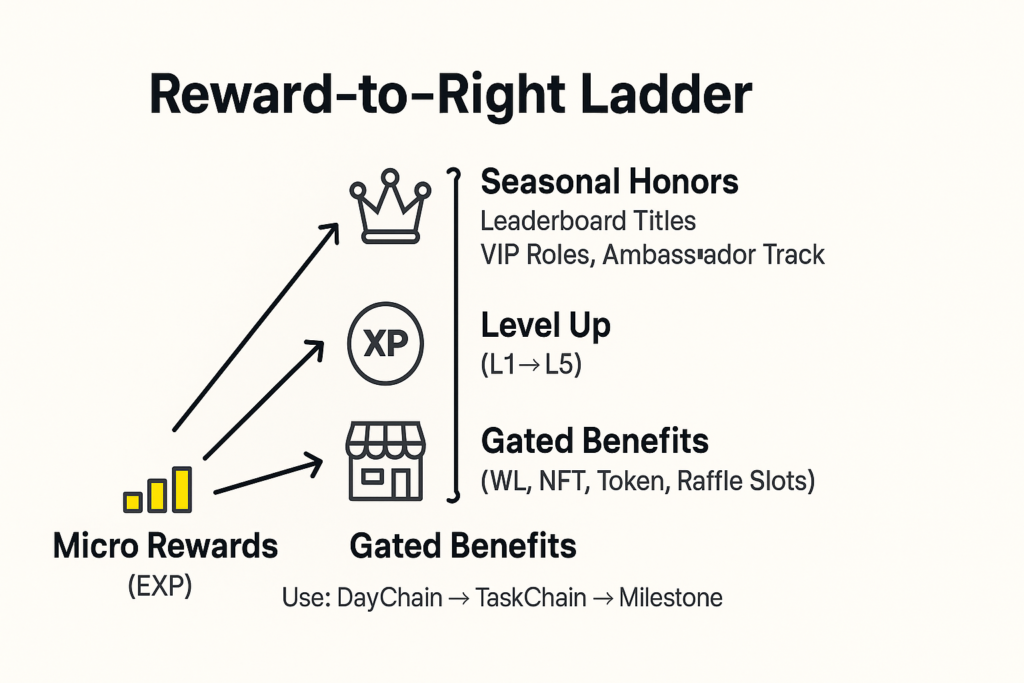
The Three-Step Formula: Front-loaded visible micro-incentives → Tangible growth via Levels → Back-loaded scarce Benefits.
EXP / Level (Internal Growth)
- DayChain, TaskChain, and Milestone all generate EXP; accumulation raises the user’s Level.
- Level Gate serves as Eligibility: Higher levels allow participation in higher-value campaigns (prevents freeloading).
Benefits Shop (Back-loaded Benefits)
- Place high-value assets like Whitelists (WL), NFTs, Tokens, or Raffle qualifications in the Benefits Shop. Give users a visible target to grind for.
- Can be pegged to Leaderboard / Milestone results to create a “Seasonal Settlement” experience.
Risk Control & Authenticity
- Anti-Bot + reCAPTCHA as the basic threshold; On-Chain / API-Verified tasks ensure “Fact of Completion.”
- Ensure rewards go to the “Right People,” mapping budget spend to verifiable growth assets.
5 | Matching Project Rhythm: The 30-60-90 Day Execution Paradigm
Here is a plan you can land immediately; review and pivot every 30 days.
| Cycle | Key Actions | Observation Metrics | Adjustment Points |
| Day 1–30 (S1) | Launch DayChain + TaskChain (1 Core Path) | DAU, Day-7 Retention, API-Verified Completion Rate | Cut low-quality entry points, increase verification intensity. |
| Day 31–60 (S2) | Publish Milestone (30-day targets), Start Leaderboard Season | Weekly Active Users (WAU), On-chain cumulative behavior, Win-back rate | Adjust multiplier coefficients and Level Gates. |
| Day 61–90 (S3) | Win-back Package (Targeting 14/30 day dormant users), Benefits Shop New Arrivals | Resurrection, Effective Active Rate, Redemption Rate | Review ROI of benefits and Season pacing. |
6 | Two Quick-Reference Charts
Chart A | Retention Launch Matrix (When to launch what)
| Signal | DayChain | TaskChain | Milestone |
| First real users acquired | ✅ (v1) | ⏳ (Prep) | - |
| Key action identified (e.g., Swap/Stake) | ✅ | ✅ (v1) | - |
| Weekly usage stabilizing | ✅ | ✅ (v2) | ⏳ (Design) |
| 30-day cohort > baseline | ✅ | ✅ | ✅ (S1) |
Chart B | Reward-to-Right Ladder
7 | Implementation Checklist
We know how to start the retention plan, now let’s use an MVP approach to map it out:
- Create DayChain: (Check-in + 1–2 light actions) to kickstart user habits.
- Build TaskChain: Deconstruct the “Real Critical Path” into 3–5 steps; guide users to achieve key goals.
- Publish Milestone: Define phased objectives and “Settlement Benefits.”
- Set Eligibility: Use Level / NFT / Token Balance as entry conditions to progressively refine user quality.
- Open Leaderboard: (Seasonal Mode).
- Data Analytics: Monitor follower data changes and DApp retention data in real-time.
Conclusion
Retention isn’t about “adding money in equal measure.” It’s about turning “Continuous Actions → Critical Paths → Phased Achievements” into a visible journey where leveling up matters.
Use DayChain to drive daily frequency, use TaskChain to shepherd users toward “True Product Value,” and then use Milestone + Benefits Shop + Level Gate to back-load and amplify the returns.
This way, users stay because the logic is clear: “The more I use, the more I get, and the more I unlock.”