
I. Project Background: From Tech Narrative to User Action
As a Layer 1 blockchain project focusing on cross-chain interoperability and performance, Layer One X (L1X) aims to lower the complexity and risk of multi-chain interactions through “bridge-less cross-chain communication.” The tech narrative is strong, but converting these capabilities into real users and an active community requires a clear, concrete, and executable growth lever.
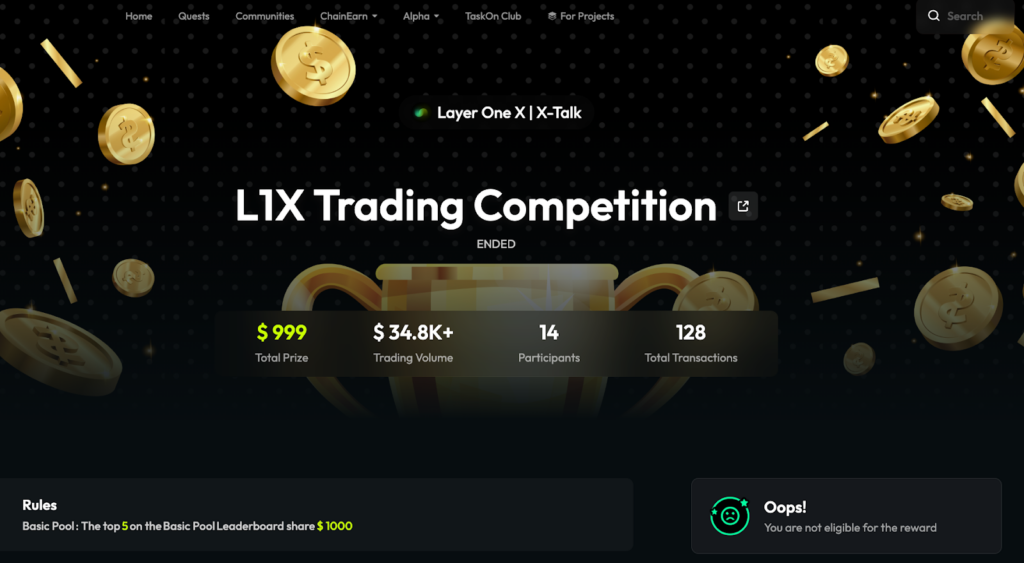
Recently, Layer One X chose the TaskOn Trading Race as its core growth engine. In a trading competition based on real on-chain interactions, they not only successfully activated the community but also achieved significant breakthroughs in trading volume and active wallet addresses. Layer One X leveraged a 1,000 USDT reward pool to generate 34.8K in real trading volume.
The X-Talk campaign (Layer One X | X-Talk on TaskOn) was the experiment designed for this purpose:
- Use simple, clear tasks to help users complete basic education and settle into the community.
- Use the TaskOn Trading Race mechanism to inject volume from active on-chain traders and continuously drive traffic to the GTC (Global Trading Campaign).
- Use TaskOn’s automated verification and reward processes to ensure a seamless and continuous GTC experience.
II. The Growth Challenge: Why Did Layer One X Need TaskOn?
For Layer One X, leveraging TaskOn’s growth tools wasn’t just about “getting eyeballs”; it was about solving specific pain points:
- How to let new users know exactly: “What do I get for each step?” Too many Web3 campaigns rely on vague promises like “complete tasks for potential future benefits,” which kills user motivation.
- How to control incentive costs while still delivering a sense of real value? Relying entirely on airdrops or massive rewards tends to attract mercenary capital and short-term speculators; conversely, zero instant gratification makes it hard to drive participation. By utilizing the Trading Race model, users naturally generate on-chain interaction. Binding this with the GTC Tasks creates a natural bonding relationship—offering the dual benefit of “immediate rewards + future expectations.”
- How to ensure behavior is authentic and not bot-farmed? Social follows, community joins, and on-chain interactions drag down campaign quality if they can’t be verified.
What TaskOn provided was a suite of infrastructure tailored for this type of lightweight campaign: Trading Race + Task System + Automated Verification + Points System + Benefit Shop + Lucky Wheel.
III. Solution Design: Trading Race, Tasks, Points, and a Visible Reward Path
1. Clear and Simple Task Structure: Lowering the Barrier to Entry
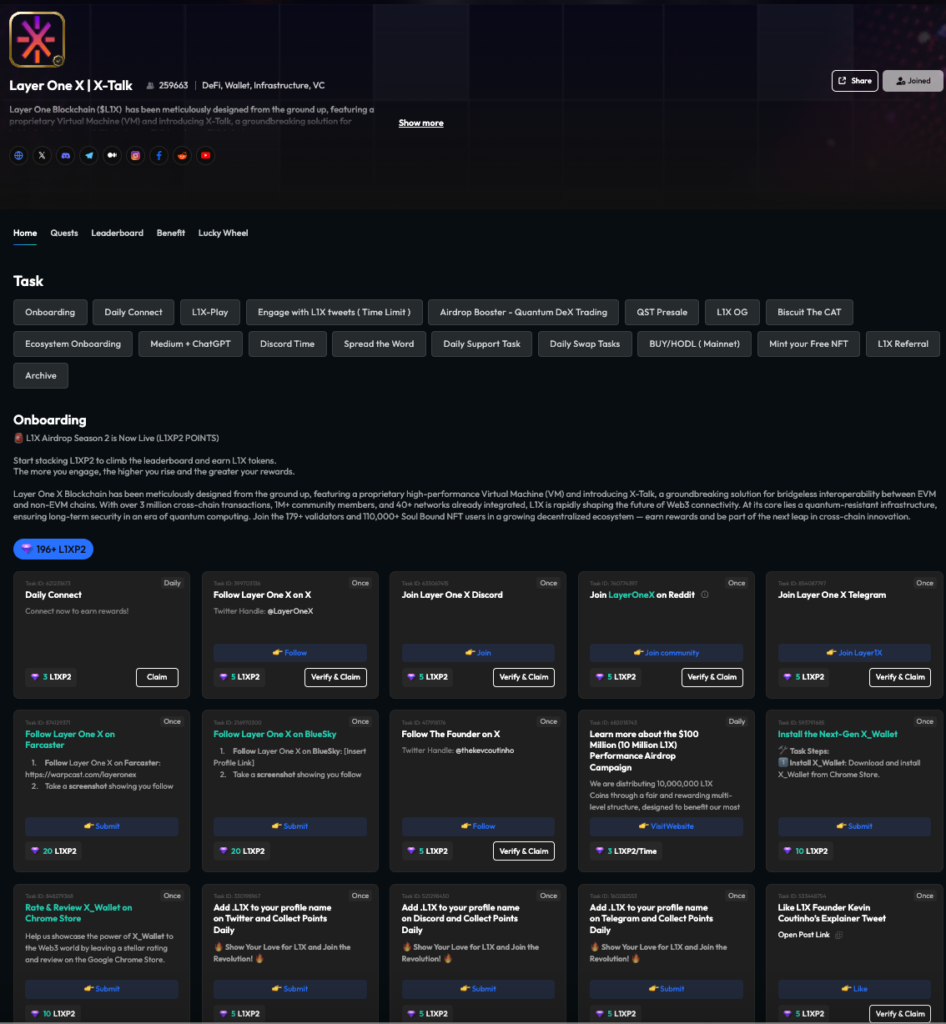
In Layer One X’s GTC, they set up low-threshold, intuitive Tasks, including but not limited to:
- Following the official Layer One X account on X;
- Joining community channels (e.g., Telegram, Discord);
- Browsing X-Talk related content to complete basic educational actions.
All Tasks were verified via TaskOn’s automated verification, eliminating manual counting and reducing the room for cheating. For the user, it’s straightforward: follow the list, finish the steps, and earn the corresponding Points. For the project, every action is tracked, ensuring cleaner data.
2. Core Incentive Logic: Complete Tasks → Earn Points
Unlike many “emotional airdrop narratives,” Layer One X chose a clearer reward structure in their GTC setup:
- Complete Tasks = Earn Points
- Points = Value Vouchers redeemable for actual USDT
They designed three point systems: L1XP for Quest rewards, L1XP2 used in the GTC, and L1XG for specific tasks. Notably, the points introduction explicitly stated that the primary L1XP2 is tied to airdrop equity. In this way, Points aren’t just virtual numbers or “vanity metrics”—they are a “pass” for users to enter the benefits system later. This is key to making the campaign experience valid.
This design has three distinct characteristics:
- Predictable: Users know exactly how many points each step yields.
- Cumulative: Completing multiple tasks stacks Points continuously.
- Redeemable: Points ultimately have a direct correlation with USDT rewards & future airdrop expectations.
3. Reward Realization: The Combo Play of Benefit Shop & Lucky Wheel
On TaskOn, Layer One X activated both the Benefit Shop and Lucky Wheel modules, creating a complete incentive loop.
✅ Benefit Shop: The Deterministic Value Exit In the Benefit Shop, users can use their Points to directly redeem USDT rewards.
- Redemption rules are open and transparent;
- The ratio of Points to USDT is clearly visible;
- Users have autonomy: hoard Points for a big redemption, or redeem in small batches.
This gives users a “visible settlement window,” making the path of “Do Tasks → Get Points → Convert to USDT” a calculable equation.
🎲 Lucky Wheel: Delivering a Lightweight Gamified Experience Distinct from the certainty of the Benefit Shop, the Lucky Wheel offers probabilistic incentives:
- Users spend a certain amount of Points to spin the wheel;
- A chance to win larger USDT rewards;
- The process itself adds entertainment value and uncertainty.
This design allows users, after grinding tasks and stacking Points, to not only “redeem pragmatically” but also choose the “let’s roll the dice for higher returns” option. Stacked together, they form a dual experience of “Deterministic Rewards” + “Randomized Rewards,” satisfying both the rational user’s yield expectations and enhancing the campaign’s fun factor and stickiness.
IV. Campaign Results: A Lightweight but High-Conversion Field Test
Although X-Talk didn’t set up complex leveling systems, long-term growth curves, or multi-stage task chains, this campaign delivered strong signals:
- High Task Completion Rate: The simple, clear task list + automated verification made users more willing to complete the entire flow.
- Active Point Consumption: Many users immediately redeemed USDT via the Benefit Shop after completing tasks, proving the reward loop had direct appeal.
- Lucky Wheel Boosted Frequency and Engagement: Users would return to the campaign page multiple times to try and extract extra rewards with remaining points, forming a “secondary participation round after the tasks.”
- Community Perceived “Real Reward Experience”: Unlike “pie-in-the-sky future airdrops,” the benefits of this campaign were instantly perceptible and verifiable. For new users, this significantly boosted trust in the project and the campaign itself.
For Layer One X, this was a field drill to “test user willingness to participate and incentive efficiency using a minimalist structure.” For TaskOn, this perfectly demonstrated that even when a project only enables the most foundational modules, excellent growth results can still be achieved.
V. Insights for Other Web3 Projects
1. It doesn’t have to be complex; clarity is often more effective. If a project is early-stage with limited resources and limited time—despite a big narrative—a basic structure of “Tasks → Points → USDT Redemption” is sufficient to run a high-quality campaign.
2. The reward path must be visible, calculable, and verifiable. Vague promises of “potential airdrops” struggle to move the needle for today’s Web3 users. X-Talk’s approach was to break the reward logic down visibly:
- Trading Race → Leaderboard changes in real-time, rewards calculated based on total volume.
- Complete Tasks → Reward Points → Redeem for USDT in the Benefit Shop; plus potential returns via Lucky Wheel.
- Points → Future Airdrop Expectation.
3. Instant gratification and entertainment can coexist. The Trading Race satisfies the competitive urge and instant rewards of the moment. Public on-chain competition with real-time dynamic reward pools drives user enthusiasm while offering deterministic yield expectations. The Benefit Shop satisfies rational calculation, while the Lucky Wheel satisfies gamification and emotional value. The two are not contradictory; stacking them creates a more memorable participation hook.
VI. Conclusion: Using TaskOn to Pave the Path “From Task to Value”
Layer One X | X-Talk wasn’t a massive, thunderous ecosystem event, but rather a bounded, targeted, cost-controlled, and verifiable growth experiment.
They used a very simple structure to validate a specific path: Design tasks → Let users know “Why am I doing this” → Record contributions via Points → Realize actual value via Benefit Shop & Lucky Wheel → Generate participation and behavioral data within a tight loop.
For Web3 projects looking for lightweight solutions to test user engagement and incentive efficacy, this is a case study worth copying directly. And TaskOn will continue to provide the infrastructure for such projects, making the road “from task to value” increasingly clear and efficient.