

In the Web3 world, every chain is competing for users, but all entry points eventually converge on one place: the Wallet. Wallets are the control panel for user assets, the gateway for on-chain behavior, and the main stage for new narratives and ecosystems.
However, wallet growth is arguably the “hard mode” of Web3 growth.
First, migration costs are incredibly high. Once a user commits to a wallet, migrating a diverse portfolio of assets is a heavy lift. Furthermore, managing multiple wallets leads to fragmented usage frequencies. For new users, the experience is often unfriendly—features are complex, and the learning curve is steep.
TaskOn serves as a platform for real traffic growth, constructing a complete closed-loop for growth: Acquisition → Activation → Retention → Value → Referral.
So, how can wallet projects leverage TaskOn’s Quest, TaskChain, DayChain, Points/Level, Automated Verification, and Benefit Shop to build a scalable, replicable, and sustainable wallet growth system?
I. The Wallet Growth Dilemma
Wallets and exchanges sit at the very front of the Web3 ecosystem—the first step for users touching the network. However, compared to exchanges, wallets face a much grimmer growth reality.
Wallet migration costs dwarf those of any dApp.
Once users form a habit with a wallet, stickiness is high; convincing them to migrate requires strong motivation. Especially for new user acquisition, the challenge lies in building a complete “strong motivation” link: Education → Incentives → Usage Habits → Level/Identity → Trust and Reliance.
Wallet growth requires the “Step-by-step → Verifiable → Accumulative → Rewarding” path offered by TaskChain.
In the Web3 ecosystem, traditional marketing relies on airdrops for acquisition and activation. However, while a wallet ecosystem airdrop might bring in 100,000 new users, next-day retention often drops below 5%.
True retention comes from value, not just simple incentives.
Therefore, projects should follow user habits and use TaskOn to cultivate user behavior. The path within TaskOn’s Community platform tools—DayChain → Consecutive Usage → Behavioral Habit → Level Identity Binding—provides exactly this complete trajectory.
Wallet incentives must be “differentiated,” otherwise users will only look at the rewards and ignore the product. On this foundation, the focus should be on building: Consumption-based Benefits (Gas Coupons / Swap Coupons) + Premium Level Benefits to cultivate user loyalty.
II. The Growth Infrastructure TaskOn Provides for Wallets
TaskOn is naturally compatible with the wallet ecosystem because its modules perfectly cover the critical growth paths for wallets:
| Wallet Growth Needs | Capabilities Provided by TaskOn |
| New User Onboarding | Quest + Low-threshold verifiable tasks |
| Product Education | TaskChain (Multi-step education chain) |
| Habit Formation | DayChain (Consecutive interaction) |
| User Segmentation & Value System | Points / Level / Milestone |
| Incentive System | Benefit Shop (Consumption-based benefits) |
| Social Propagation | Referral + Leaderboard |
| Anti-Sybil / Verification | Auto-verification (On-chain signature / API / Event), Asset thresholds, Social account filtering |
TaskOn is not just a short-term campaign tool; it is a workable, verifiable, and reusable Growth OS.
III. Wallet Case Studies: Different Paths to Growth
Case 1 | Coin98: Joint Campaigns to Expand Brand Influence & Cross-Pollinate Traffic
1) Joint Campaigns for Brand Reach: The Traffic Superposition Effect Across Ecosystems
Coin98’s growth strategy is clear: single-ecosystem traffic is limited; cross-ecosystem collaboration is the source of “Alpha.”
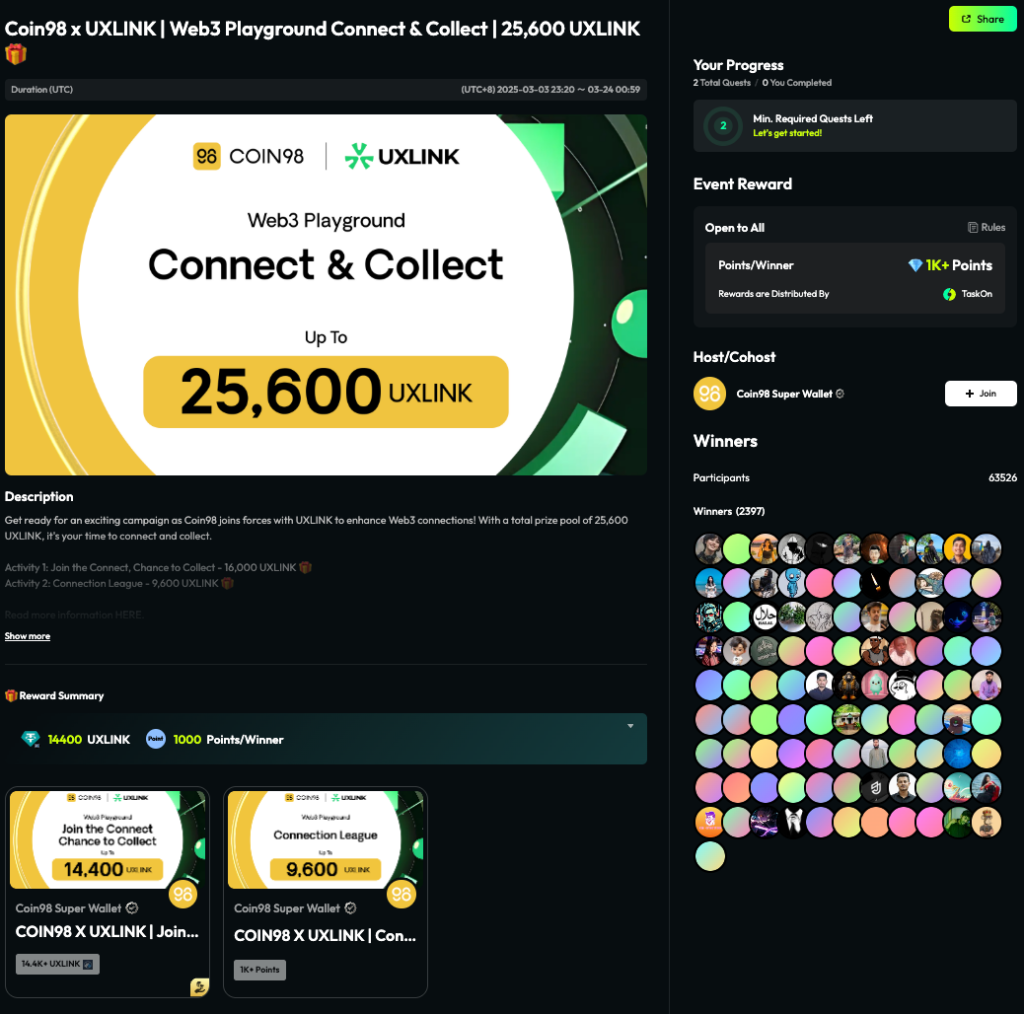
In the massive Coin98 × UXLINK joint event, two major ecosystems collaborated for the first time, stacking their reward pools. The TaskChain covered multiple links including Follow, Join, interactive participation, and content dissemination. Ultimately, the event attracted over 60,000 participants, achieving reach several times that of a standalone event.
Coin98 leveraged TaskOn’s “cross-project synergy” capabilities to successfully funnel UXLINK’s active users into its own wallet ecosystem, creating a significant “user cross-osmosis.”
2) User Education: Turning Complex Wallet Functions into a “Decomposed Task Path”
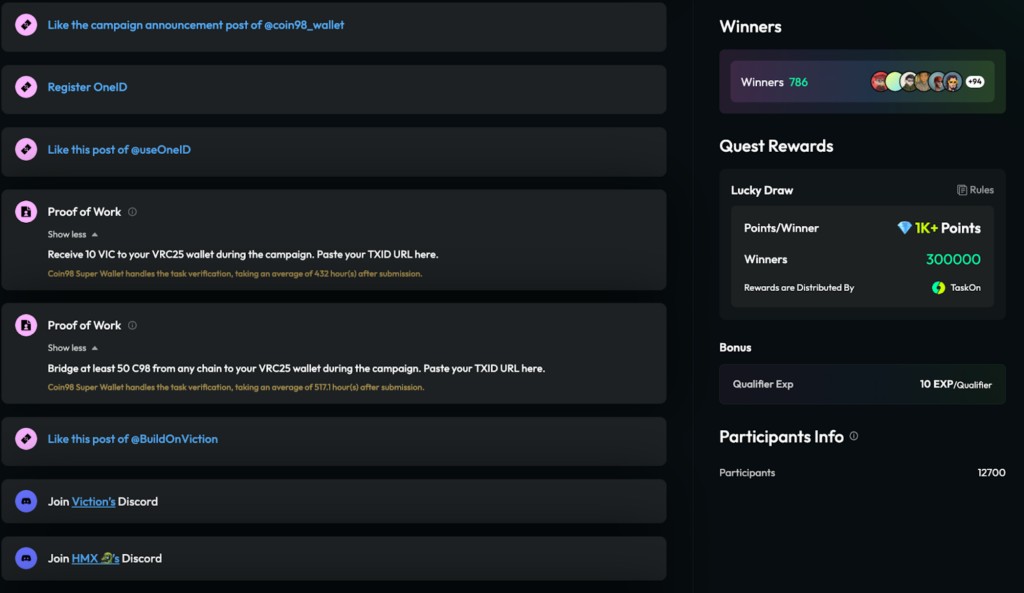
Coin98 has powerful features and broad chain support, which often makes user education difficult. On TaskOn, they used TaskChain to break the education path into digestible pieces:
- Step 1: Follow, Join, Read event details (User knows “Who Coin98 is and what the event is”).
- Step 2: Register & Download & Initial Setup (User completes the first wallet operation).
- Step 3: Deep Tasks (Interaction, Browsing, Exploration) — User understands the ecosystem and gains preliminary usage capability.
When the rewards are attractive enough, TaskChain becomes the best Onboarding tool. Coin98 relied on this “Education → Interaction → Incentive” link to convert simple event participants into genuine wallet users, forming growth that actually settles.
Case 2 | Portkey: High Incentive, High Difficulty—Rewarding Real On-Chain Behavior
Portkey has a distinct target for user growth: they don’t chase all users, they chase “High-Quality Users with On-Chain Intent.”
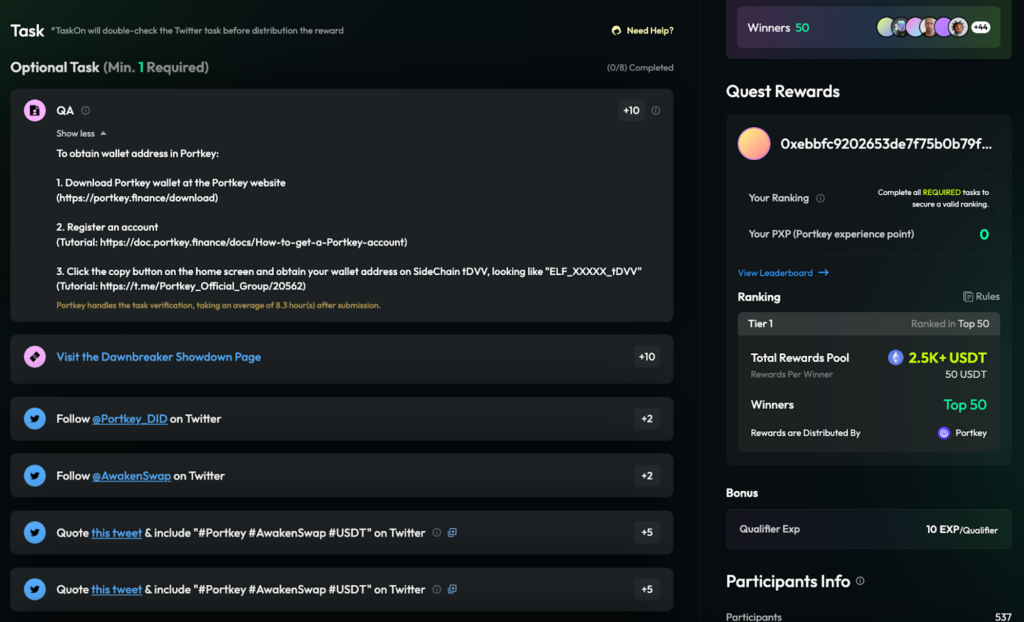
This demand is directly reflected in their task style. In their on-chain trading competitions:
- Prize Pool: 2,500 USDT, with per-capita rewards reaching the $50 level.
- Task Combo: “Light Social + Strong On-Chain Interaction.”
- Verification: Includes real trading, interaction, and holding behaviors (Onchain).
Portkey’s growth logic is crystal clear: High incentives are reserved for those who can complete deep on-chain operations, not for shallow participants.
The user volume for such events may not be massive, but the user quality is universally high. For a wallet ecosystem, this is “High Leverage Growth.” By using high incentives and clear goals to filter for real on-chain trading users, they align perfectly with their wallet’s features (easy crypto trading, multi-chain support), thereby achieving precise conversion of wallet users.
Case 3 | Bitget Wallet: Whitelist Airdrops × Collab Exposure for Long-Term Brand Building
As a “Trading Wallet,” Bitget Wallet’s core is deep on-chain interaction, similar to a CEX but more reliant on authentic on-chain behavior.
1) Whitelist Airdrops: The Most Suitable Activation Method for Wallet Ecosystems
Their growth strategy on TaskOn is very specific: Whitelist Airdrop = Activation Point × Behavior Entry.
Users must complete a series of verifiable tasks (Follow, Join, Onchain, etc.) to:
- Gain WL or Airdrop eligibility.
- Form a high-quality, authentic, and traceable onboarding process.
2) Joint Campaigns: USDD × Bitget Wallet Co-Built Prize Pool
Real-world data shows that during the USDD Anniversary event, Bitget Wallet:
- Co-built the prize pool with the project team.
- Used “Strong Incentives + Strong Verification” to attract a massive volume of on-chain users.
- Achieved a bidirectional traffic swap (Users flow from USDD → Bitget Wallet).
This is a classic TaskOn “Ecosystem Synergistic Growth Model.”
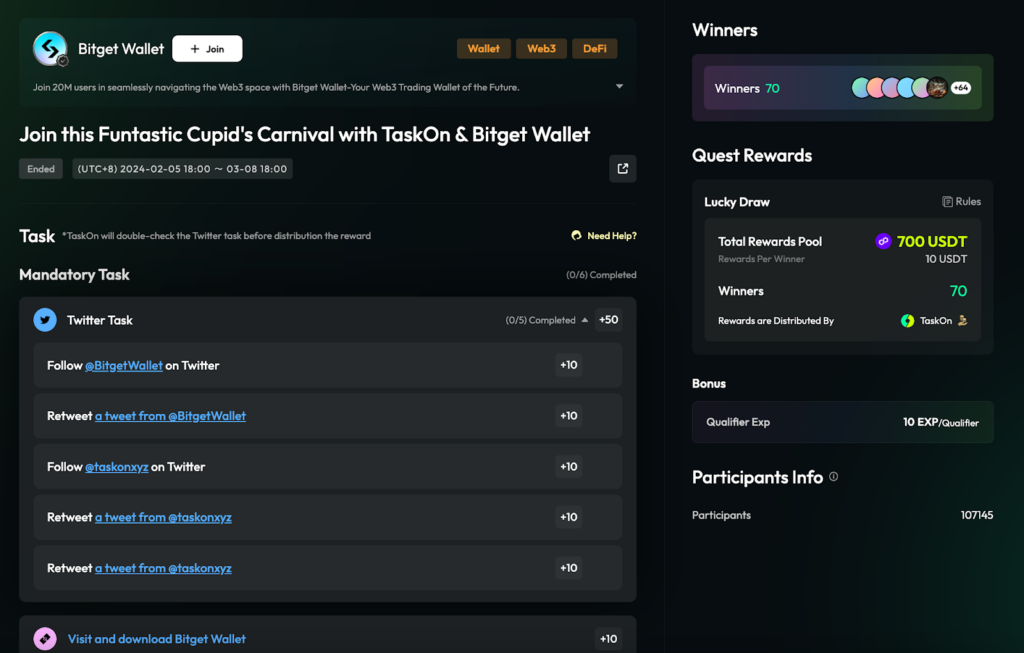
3) Landmark Events: Explosive Exposure via Cupid’s Carnival
Subsequently joining TaskOn’s official EPIC event—Cupid’s Carnival—gave Bitget Wallet exposure from a higher dimension: official traffic boosts, instant display on event pages, and multi-ecosystem linkage amplified their voice, greatly expanding their traffic pool.
This caused Bitget Wallet’s exposure curve to spike noticeably in a short period—not the result of a single activity, but the natural outcome of “Continuous participation in collabs → Constantly expanding the ecological niche.”
IV. The Wallet Growth OS: A Replicable Methodology
Based on TaskOn’s tools and user flow, we can summarize the true logic for wallets on TaskOn:
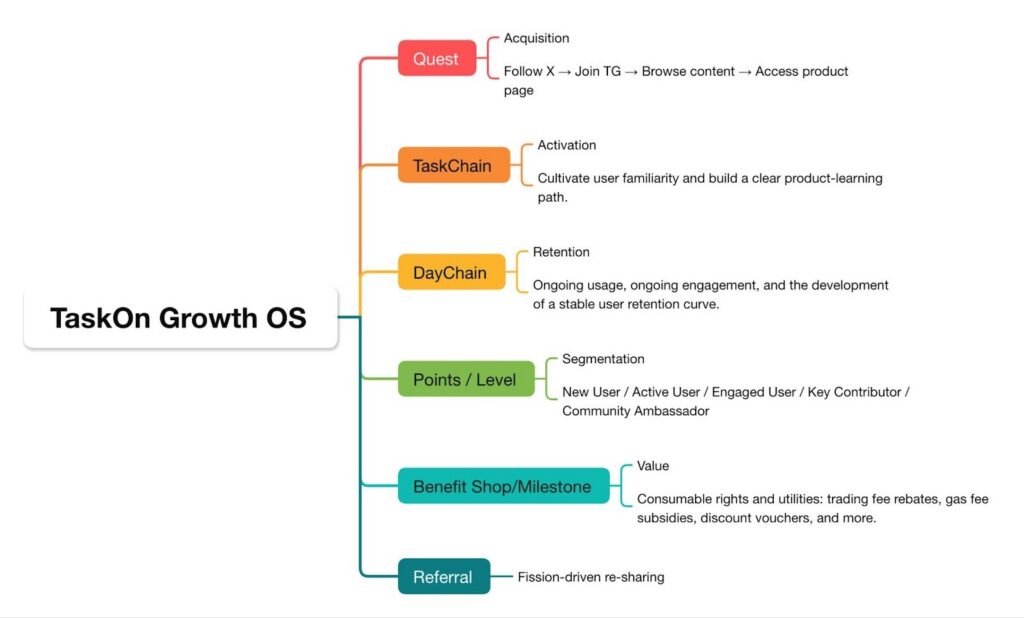
Conclusion
Wallet growth is never about “running a campaign”; it is about “building a system.”
TaskOn helps wallets achieve this by turning complex wallet education, deep functionality, incentive systems, user segmentation, and virality into a verifiable, automated, and reusable growth link.
The wallet ecosystem growth flywheel has been formed: Content → Cognition → Community → Behavior → Habit → Identity → Referral = A Sustainable Growth Path.
Coin98 solved the education puzzle, Fearless solved governance conversion, Portkey opened the social gateway, and Bitget Wallet turned Swap into a growth engine. Through TaskOn’s growth engine and precise targeting, they have each run their own unique upward curve on TaskOn.