

01|From Zero to Launch: Key Design Points for a Quest
Designing a Quest is not about simply setting up tasks. It’s about orchestrating verifiable actions, rewards, and social loops that drive measurable growth.
Below are the key points from idea to launch:
- Define the Goal:
Choose a single measurable objective — user acquisition, education, or activation. Every task and reward should trace back to this north star. - Audience & Entry:
Identify who joins and from where: landing pages, partner referrals, or wallet-based entry. - Task Structure:
Combine on-chain and off-chain tasks into one flow. Use TaskChain for sequential steps and DayChain for streak-based participation. - Verification:
Apply auto-verify rules (API, contract events, or signatures). All actions must be provable. - Reward System:
Mix instant micro-rewards with limited grand prizes. Visibility of rewards boosts motivation. - Social Loop:
Embed share buttons and referral codes. Ensure each action has a “show-off moment.” - Anti-cheat Setup:
Configure rate limits, wallet fingerprinting, and referral quality checks before launch. - Preview & QA:
Test every verification endpoint and settlement flow before going live. - Monitor & Optimize:
Track conversion, share rate, and fraud signals in real time. Iterate weekly.
02|Activity Creation & Applicable Scenarios
Different goals require different Quest types:
Each scenario starts with a verifiable signal (KVA) and ends with a clear reward and share action.
03|Quest PRD Template (Fields, Logic, Risk Control)
| Field | Description |
| Quest Name | Short, descriptive name (e.g., “7-Day Onboarding Quest”). |
| Objective | The specific, measurable goal (e.g., Acquire 3,000 new users). |
| Duration | The defined Start and end dates, including the time zone. |
| Eligibility | Restrictions on participation (e.g., KYC / wallet / region restrictions). |
| Task List | The sequential steps users must complete, each requiring verification logic. |
| Verification Method | How task completion is confirmed (e.g., API, contract, or manual review). |
| Reward Structure | The type of incentives offered (e.g., Points, tokens, NFTs, or raffle entries). |
| Settlement Rules | When and how rewards are distributed (e.g., Instant / T+3 / after review). |
| Referral Design | Details of the referral program (e.g., Referral bonus, cap per user). |
| Leaderboard Logic | How participants are ranked and rewarded (e.g., Ranking metric, prize tiers). |
| Anti-cheat Controls | Measures to ensure fair play (e.g., IP / wallet / device checks). |
| Reporting Metrics | Key performance indicators to track (e.g., Completion rate, share CTR, fraud ratio). |
Risk control should focus on:
- Auto-verification first, manual fallback second.
- Reward visibility, not reward inflation.
- Evidence chain linkage: every reward must tie to a verifiable event.
04|Advanced Quest System: Verification, Tolerance, Orchestration & Anti-Wash
A mature Quest system needs four design layers:
- Verification:
Use multi-source proof — on-chain logs + off-chain API checks.
Avoid user-submitted screenshots whenever possible. - Fault Tolerance:
Introduce retry queues and “pending” states for failed verifications.
Never lose valid completions due to temporary network errors. - Orchestration:
Design task states like a state machine: Not Started → In Progress → Verified → Settled.
Allow sequential and optional branching paths. - Anti-Wash Positioning:
- Gate high-value rewards behind real actions (deposit, swap, vote).
- Use 7-day retention or trade volume as referral validation.
- Implement a review SOP for suspicious patterns.
05|Viral Logic: Social Amplification × Incentive Loop
Every viral Quest runs on two feedback engines:
- Social Amplification:
Make it easy and rewarding to share.- One-tap share links with referral codes.
- Visible leaderboards and “friend joined” notifications.
- Real-time FOMO through public progress bars.
- Incentive Loop:
Each completed task → reward → share → invite → repeat.
A user’s success becomes visible proof for others.
This closes the viral loop, driving exponential participation.
06|TaskOn’s Built-in Viral Drivers
TaskOn offers three propagation tools at the core of its Quest system:
- Referral: Unique links that reward inviters once referees complete key actions.
- Leaderboard: A live ranking that triggers competition and repeat engagement.
- Lottery: Randomized rewards that boost participation even among casual users.
By combining all three, projects can activate three user motivations simultaneously — ambition (Leaderboard), curiosity (Lottery), and community (Referral).
07|Five Elements of a Well-Designed Quest
| Element | Description |
| 1. Clear Objective | The user knows exactly what to do and why. |
| 2. Verifiable | Every step has automatic proof of completion. |
| 3. Shareable | One-click sharing with attractive social visuals. |
| 4. Visible Rewards | Users can track progress and prize tiers. |
| 5. Efficient Settlement | Rewards arrive quickly, reinforcing trust. |
08|Anti-Cheat & Quality Monitoring
High engagement means high risk of abuse. TaskOn’s anti-cheat framework ensures data integrity:
- Automated Detection:
Track anomalies like mass sign-ups, identical IP/device patterns, and abnormal completion speed. - Quality Scoring:
Assign referral scores based on downstream retention, not raw counts. - Reward Freezing:
Suspicious accounts enter a review state; only verified users receive rewards. - Post-Campaign Audit:
Cross-check claimed actions with verified on-chain or API data.
Transparent anti-cheat rules and rapid reconciliation not only protect budgets but also strengthen community trust.
09|Creating a Great Quest
Example: Ourbit Official
Quest: https://taskon.xyz/quest/335389550
In 2 weeks, more than 26,000 users took part in the quest. Ourbit was able to achieve its social media growth goals by targeting X-verified users, carried on by TaskOn’s powerful system.
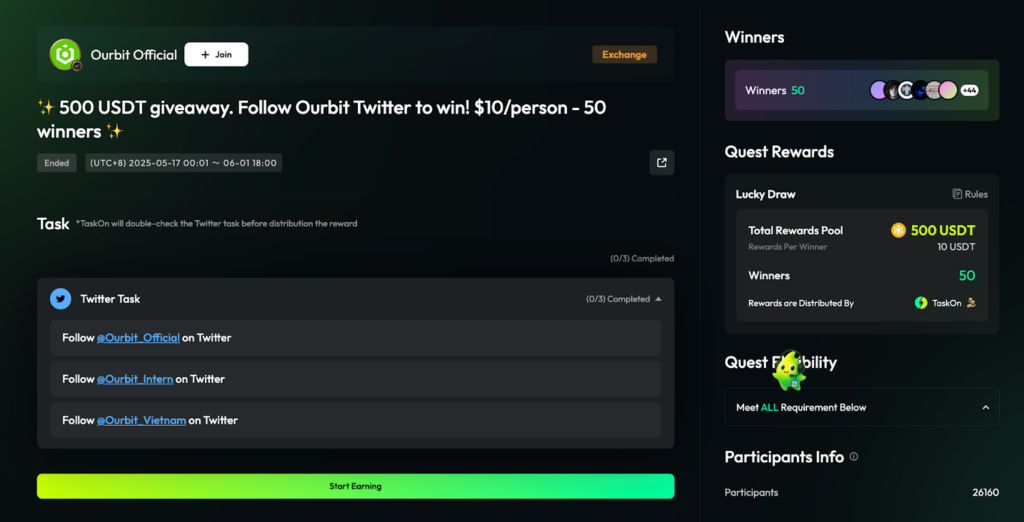
What makes this Quest a success?
- Clear Title: The title clearly states what the quest is mainly about, and specifies the reward, attracting more users to take part in the quest. Data shows that adding stablecoins as prizes attract more users to take part in the quest.
- Big Prize Pool: An adequate Prize Pool with a large number of winners attracts more users to take part in the quest, as they may feel they have more chances to win.
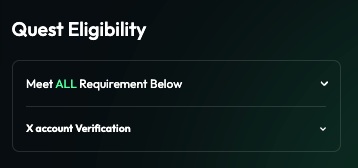
- Clear Eligibility Requirements: By utilizing TaskOn’s paid features, Orobit can ensure that only users who have completed Twitter Verification can take part in the Quest, allowing for real follower growth.
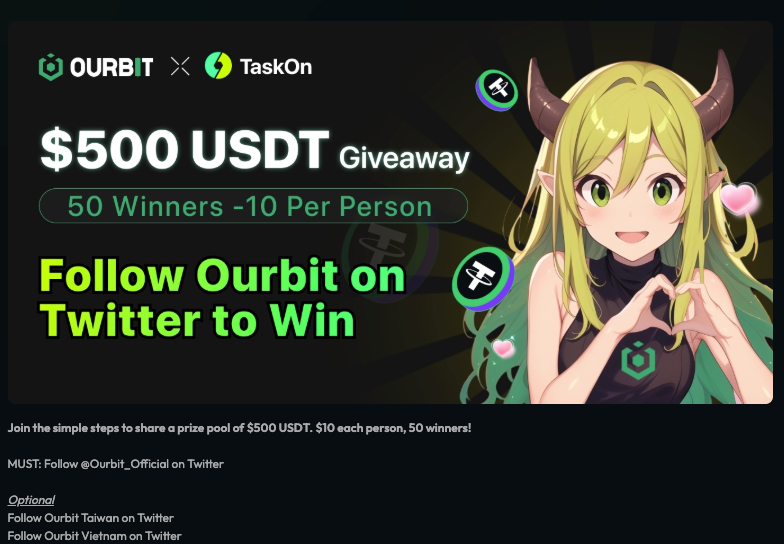
- Attractive Banner: An attractive banner designed exclusively for the quest in the appropriate size with a clear description of the quest attracts more users to take part.
Example 2: Travala
Travala launched a mega quest with two partners with a series of tasks that grow social media engagement.
What makes this Quest a success?
Tangible Reward: The quest offers a substantial USDT prize for 50 winners. This is a huge motivator. 100% participation rewards eliminate the fear of effort being wasted and incentivize everyone to join.
Low Barrier to Entry / Simple Tasks:
- Social Tasks: The majority of tasks are simple social media interactions (follow x). These are quick, easy, and require minimal effort or prior knowledge.
- Visit Website: A simple click to visit a website is also very low friction.
- Optional Tasks: By adding optional onchain tasks such as connecting with EVM wallet & registering on Travala website, users who are eager to earn additional points.
- No On-Chain Transaction Required (for initial entry): For many users, requiring a wallet connection and an on-chain transaction can be a barrier due to gas fees or security concerns. This quest wisely keeps the initial entry purely social/informational, widening its appeal.
- Clear and appealing banner with a title that directly attracts users to take part. Both the prize money ($500USDT) and ‘easy tasks’ are metnioned.
09|Conclusion
When designed right, a Quest is more than an activity — it’s a growth engine.
By aligning goals, proof, and incentives, TaskOn turns short-term actions into long-term engagement loops.
From Referral to Leaderboard to Lottery, each module compounds the viral effect, transforming simple participation into continuous user growth.