
In every successful Web3 community, there’s one common challenge:how to keep users not just active, but growing.
After users complete basic onboarding or daily tasks, how can projects guide them toward deeper participation — such as trading more, learning more, or contributing to the ecosystem over the long term?
That’s where TaskOn’s Milestone feature comes in.
It transforms complex long-term objectives into clear, motivating stages, helping projects cultivate user progress through visualized achievement systems and layered rewards.
1. What Is Milestone?
Milestone is part of TaskOn’s Incentive Center, providing a customizable user achievement framework that enables communities to recognize and reward their most valuable contributors.
Through Milestones, projects can define long-term goals — such as reaching a trading volume target, completing a learning path, or contributing content — and reward users as they hit each stage of progress.
In short, Milestone bridges the gap between activity and achievement. Milestone also lets projects set Participation conditions, enabling more precise recognition of community contributors.
2. How It Works
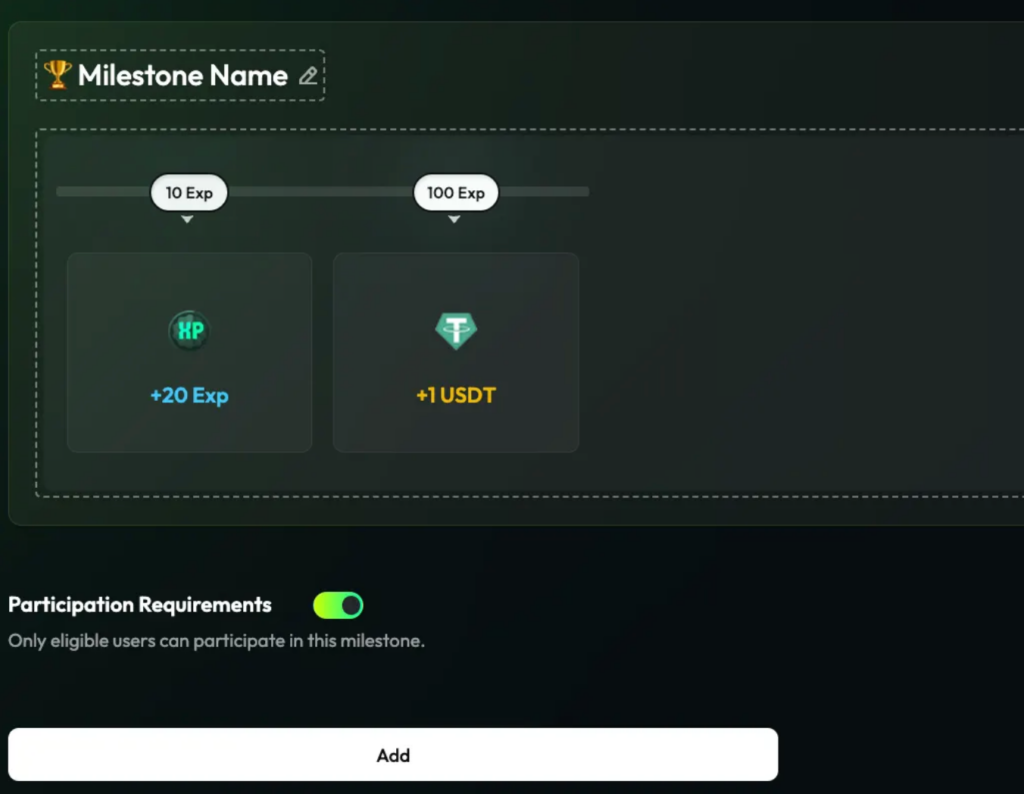
Milestones are powered by level-based points, allowing projects to set measurable thresholds and reward users as they progress. By reaching certain points levels, users are able to unlock additional rewards. These additional one-off rewards increase as they complete more tasks and accumulate platform rewards.
This flexible configuration allows projects to recognize contributors at every step, rather than only rewarding the “final winners.”
3. The Psychology Behind Milestones
Milestones tap into a key behavioral principle — visible progress motivates persistence.
When users can see their progress on a visual bar or badge system, they’re more likely to stay engaged and complete the journey.
Psychological Triggers at Play:
- Goal Gradient Effect:
People accelerate their efforts as they perceive themselves nearing a goal. A visible progress bar turns effort into satisfaction. - Micro-Achievements:
Breaking down large objectives into smaller steps delivers frequent dopamine boosts — reinforcing positive behavior loops. - Intrinsic Motivation:
Milestones shift motivation from purely external rewards to internal satisfaction — users feel they’re mastering something meaningful.
In other words, Milestone transforms participation into purpose.
4. Goal Decomposition: Turning Ambition into Action
The Milestone system is built around Goal Decomposition + Motivation Guidance — two pillars that help projects structure user journeys.
Goal Decomposition
Large goals (like “Trade $10,000” or “Complete 30 learning sessions”) are divided into achievable segments:
- Step 1: Achieve 1 Point (50 Points rewarded)
- Step 2: Achieve 10 Points (50 Points rewarded)
- Step 3: Achieve 20 Points (50 Points rewarded)
Each step feels attainable, guiding users forward with clarity and momentum.
5. Visual Progress: The Power of Seeing Growth
One of Milestone’s most effective design elements is its visualized progress bar, which turns abstract effort into visible achievement.

Each completed segment fills part of the bar, giving users a real-time sense of advancement.
This visual cue is simple yet powerful — it keeps motivation high even before the final reward is reached.
Example:
A user completing a 5-stage learning milestone can see their bar fill 20%, 40%, 60%, etc., until they finally hit 100%.
Each checkpoint is both an accomplishment and an invitation to continue.
6. Layered Rewards: Building Depth into Participation
Unlike one-time prizes, Milestone rewards are progressive.
They’re designed to encourage layered behavioral development — from curiosity to commitment.

Example Applications:
- Learning Path:
Reward users for completing educational content modules or tutorials.
(e.g., Learn DeFi Basics → Explore DEX Trading → Provide Liquidity → Stake Tokens) - Trading Volume Upgrade:
Incentivize traders to gradually increase volume with tiered milestones (e.g., $500 → $2,000 → $10,000). - NFT Integration Path:
Encourage users to mint, hold, or combine NFTs, unlocking advanced utilities or community access along the way.
Each milestone layer acts as both a short-term incentive and a long-term engagement anchor.
7. Why Businesses Choose Milestone
For projects, Milestone = measurable, sustained engagement.
| Business Objective | How Milestone Delivers (Shorter Wording) |
| Increase user retention | Visual progress & consistent rewards drive activity. |
| Educate on complex features | Long-term milestones structure learning paths. |
| Reward true contributors | Points/level system highlights quality engagement. |
| Encourage high-value actions | Tiered targets guide behavior toward KPIs. |
| Simplify campaign management | Automated validation and claiming. |
By combining goal clarity, visual feedback, and smart automation, Milestone turns engagement into a growth engine — without requiring constant manual oversight.
8. The Bigger Picture: Milestone in the TaskOn Ecosystem
Milestone complements other TaskOn modules:
- TaskChain guides short-term learning journeys.
- DayChain reinforces daily engagement habits.
- Leaderboard amplifies competition and visibility.
- Milestone provides long-term direction and purpose.
Together, they form a full User Lifecycle System — from onboarding to mastery.
9. Conclusion: From Tasks to Transformation
Milestone isn’t just a reward system — it’s a framework for meaningful progress.
By turning large goals into visible, rewarding stages, projects can cultivate deeper understanding, loyalty, and satisfaction within their communities.
Whether you’re growing a DeFi platform, NFT ecosystem, or educational community, Milestone helps transform user engagement from momentary activity into long-term achievement.
Empower your users to grow — one milestone at a time.